Astronomers using ESA’s XMM-Newton observatory have captured an X-ray image of 3I/ATLAS, the third confirmed interstellar object to be detected passing through the Solar System, following 1I/ʻOumuamua and 2I/Borisov.
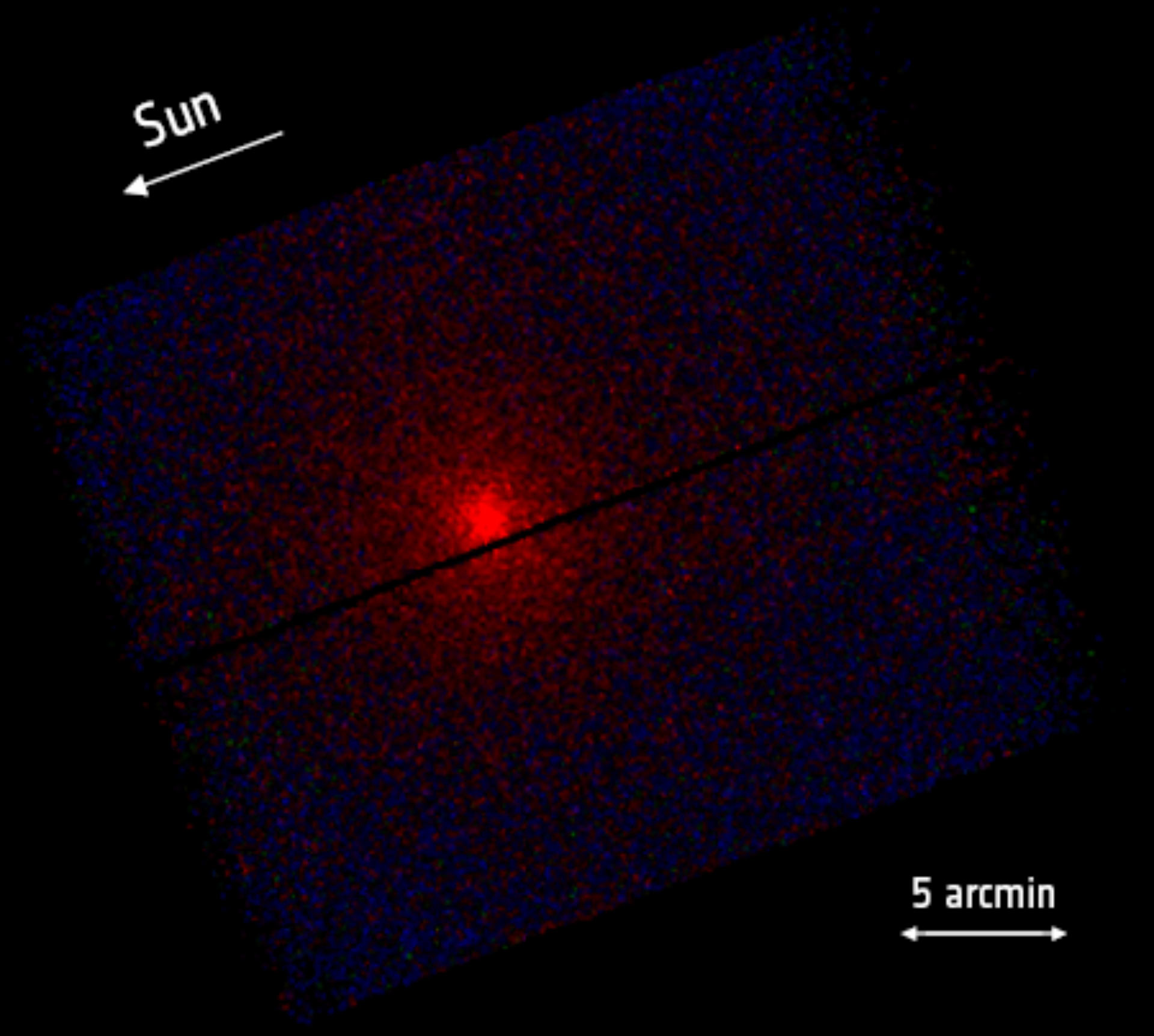
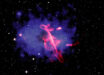
This XMM-Newton image shows an X-ray view of the interstellar comet 3I/ATLAS. At the center of the image, a bright red spot stands out against a dark background, like a fiery beacon. Starting from this core, faint gradients of purple and blue spread outward, creating a slightly rotated rectangular frame, divided by a thin horizontal line, the detector gap. The red color shows low-energy X-rays, blue marks empty space with very few X-rays. Image credit: ESA / XMM-Newton / C. Lisse / S. Cabot / XMM ISO Team.
On December 3, 2025, XMM-Newton observed the interstellar comet 3I/ATLAS for around 20 hours.
During that time, the interstellar object was about 282-285 million km from the spacecraft.
XMM-Newton observed the comet with its European Photon Imaging Camera (EPIC)-PN camera, its most sensitive X-ray camera.
“This XMM-Newton image shows the comet glowing in low-energy X-rays: blue marks empty space with very few X-rays, while red highlights the comet’s X-ray glow,” members of the XMM-Newton team said in a statement.
The astronomers expected to see this glow because when gas molecules streaming from the comet collide with the solar wind, they produce X-rays.
“These X-rays can come from the interaction of the solar wind with gases like water vapor, carbon dioxide, or carbon monoxide — which telescopes such as the NASA/ESA/CSA James Webb Space Telescope and NASA’s SPHEREx have already detected,” they said.
“But they are uniquely sensitive to gases like hydrogen and nitrogen.”
“These are almost invisible to optical and ultraviolet instruments, such as the cameras on the NASA/ESA Hubble Space Telescope or ESA’s JUICE.”
“This makes X-ray observations a powerful tool,” they noted.
“They allow scientists to detect and study gases that other instruments can’t easily spot.”
“Several groups of scientists think that the first detected interstellar object, 1I/‘Oumuamua, may have been made of exotic ice like nitrogen or hydrogen.”
“While 1I/‘Oumuamua is too far away now, 3I/ATLAS presents a new opportunity to study an interstellar object, and observations in X-ray light will complement other observations to help scientists figure out what it is made of.”