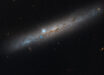
The NASA/ESA Hubble Space Telescope has produced an outstanding new image of the highly inclined spiral galaxy NGC 4388.
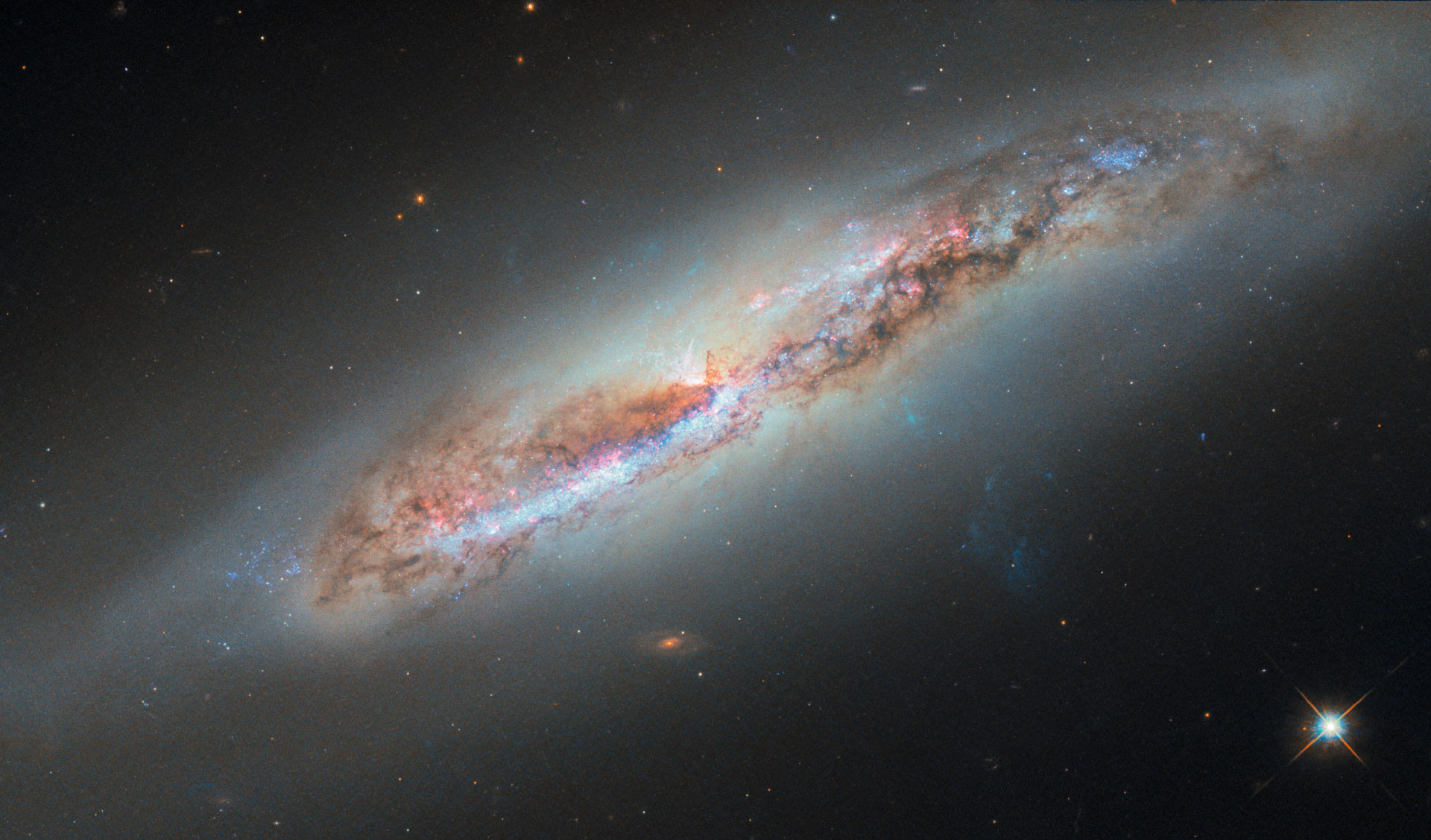
This Hubble image shows NGC 4388, a spiral galaxy some 59 million light-years in the constellation of Virgo. Image credit: NASA / ESA / Hubble / S. Veilleux / J. Wang / J. Greene.
NGC 4388 is located approximately 59 million light-years in the constellation of Virgo.
This galaxy was discovered by the British astronomer Sir Wilhelm Herschel on April 17, 1784.
Also known as LEDA 40581 and IRAS 12232+1256, it has a diameter of 120,000 light-years.
It is one of the brightest galaxies in the Virgo Cluster, a group of more than 2,000 galaxies.
NGC 4388 has a bright energetic nucleus and so is classified as an active galaxy.
“NGC 4388 is tilted at an extreme angle relative to our point of view, giving us a nearly edge-on vantage point,” the Hubble astronomers wrote in a statement.
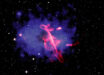
“This perspective reveals a curious feature that wasn’t visible in a previous Hubble image of this galaxy released in 2016: a plume of gas from the galaxy’s nucleus, here seen billowing out from the galaxy’s disk towards the lower-right corner of the image.”
“But where did this outflow come from, and why does it glow?”
“The answer likely lies in vast stretches that separate the galaxies of the Virgo Cluster.”
“Though the space between the galaxies appears to be empty, this space is actually occupied by hot wisps of gas called the intracluster medium.”
“As NGC 4388 journeys within the cluster, it plunges through the intracluster medium.”
“The pressure from the hot intracluster gas whisks away the gas from within NGC 4388’s disk, causing it to trail behind as NGC 4388 moves.”
“The source of the energy that ionizes this gas cloud and causes it to glow is more uncertain,” they noted.
“We suspect that some of the energy comes from the center of the galaxy, where a supermassive black hole has spun the gas around it into a superheated disk.”
“The blazing radiation from this disk might ionize the gas closest to the galaxy, while shock waves might be responsible for ionizing the filaments of gas farther out.”