Deep in the seasonally flooded savannas of Bolivia, a small, olive-green songbird has been quietly eluding science. Now, after six decades of confusion and misidentification, ornithologists have confirmed that the bird is not just a regional variant of a known species in the greenlet genus Hylophilus but an entirely new one. The discovery adds a new endemic species to South America’s already rich avian diversity and underscores how much remains unknown even in well-studied bird families.
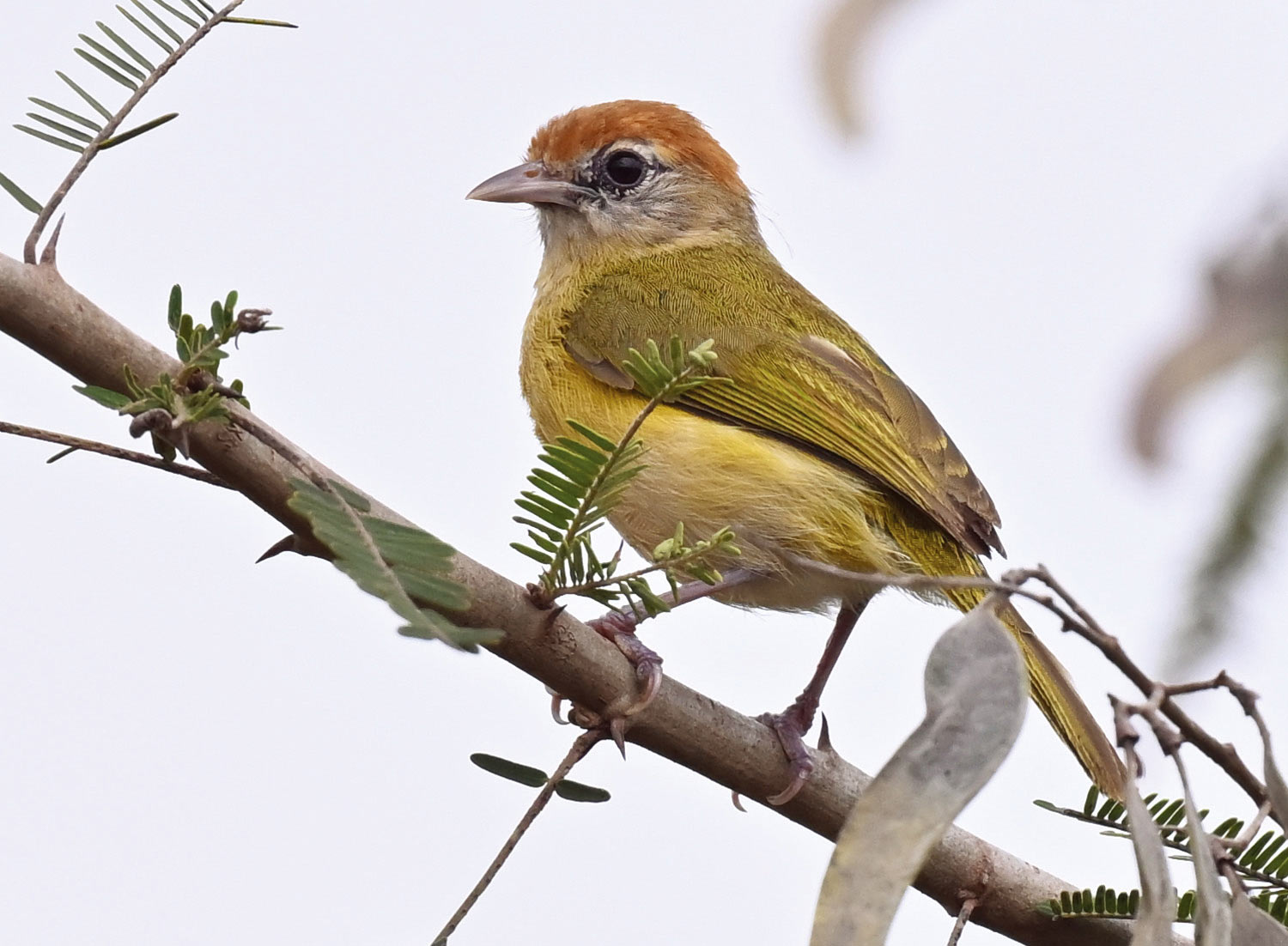
The Beni greenlet (Hylophilus moxensis) in habitat near San Ramón, Beni, Bolivia, on January 10, 2024. Notice the pale brownish gray auriculars, combined with dark lores, dark base of commissure, rufous on the entire crown and frons, and dark irides. Image credit: Tini Wijpkema.
The newly-identified species belongs to Hylophilus, a small genus of songbirds in the family Vireonidae (vireos, greenlets, and shrike-babblers).
Scientifically named Hylophilus moxensis (common name is the Beni greenlet), the bird inhabits marshy scrublands in Bolivia’s Beni savannas, a vast and ecologically distinctive region also known as the Llanos de Moxos.
Although the species was first noted by ornithologists as early as 1960, it was long assumed to be an isolated population of two similar Brazilian species: the rufous-crowned greenlet (Hylophilus poicilotis) and the gray-eyed greenlet (Hylophilus amaurocephalus).
“Morphological variation between many species of Hylophilus greenlet is relatively underwhelming: most are green, gray, yellow, and brown,” lead author Dr. Paul van Els, an ornithologist at the Museo Nacional de Historia Natural de la Paz, the Sovon and the Anthus Bolivia, and his colleagues explained in their paper.
“In some species, iris color may be one of the most useful characters to separate them from similarlooking congeners.”
The uncertainty ended when the authors analyzed one mitochondrial gene and three nuclear genes across the group.
The results showed that the Beni population is not a variant of either known species but instead sister to the branch containing both Hylophilus poicilotis and Hylophilus amaurocephalus, having diverged approximately 6.6 million years ago.
By comparison, the two previously recognized species split from each other much later, around 3.5 million years ago.
Dr. van Els and co-authors also conducted a detailed analysis of facial plumage, eye color and vocalizations.
Hylophilus moxensis can be diagnostically distinct by its lack of black or brown markings on the ear coverts — a feature consistently present in its relatives — as well as its uniformly dark brown eyes and distinctive song patterns, according to the study.
In vocal analyses, the researchers found that the species’ song includes ‘V-shaped notes,’ while its calls contain harmonics similar to those produced by female Hylophilus amaurocephalus — a unique combination not shared by either comparison species.
The discovery of Hylophilus moxensis adds to a growing list of endemic species known from the Beni savannas.
While the scientists stated that they ‘do not believe it to be currently threatened,’ they also warned that large-scale agricultural burning poses an acute problem for biodiversity in the area.
“The recognition of Hylophilus moxensis as an additional endemic taxon in the region should boost conservation prioritization efforts,” they wrote in the paper.
“Rampant burning for large-scale agriculture is an acute problem in the region for biodiversity.”
“Although we are unable to estimate a population size for Hylophilus moxensis, we do not believe it to be currently threatened, because suitable habitat is still widespread in the region.”
“However, the relatively few records of the species may point towards other factors than a lack of observers and may reflect a truly localized occurrence.”
The team’s paper was published online January 1, 2026 in the journal Avian Systematics.
_____
Paul van Els et al. 2026. A new species of greenlet from Bolivia in the Hylophilus poicilotis/amaurocephalus group (Vireonidae). Avian Systematics 3 (3): 17-37