Frogs have conserved their ecology in the last 45 million years, according to new research led by University College Cork.
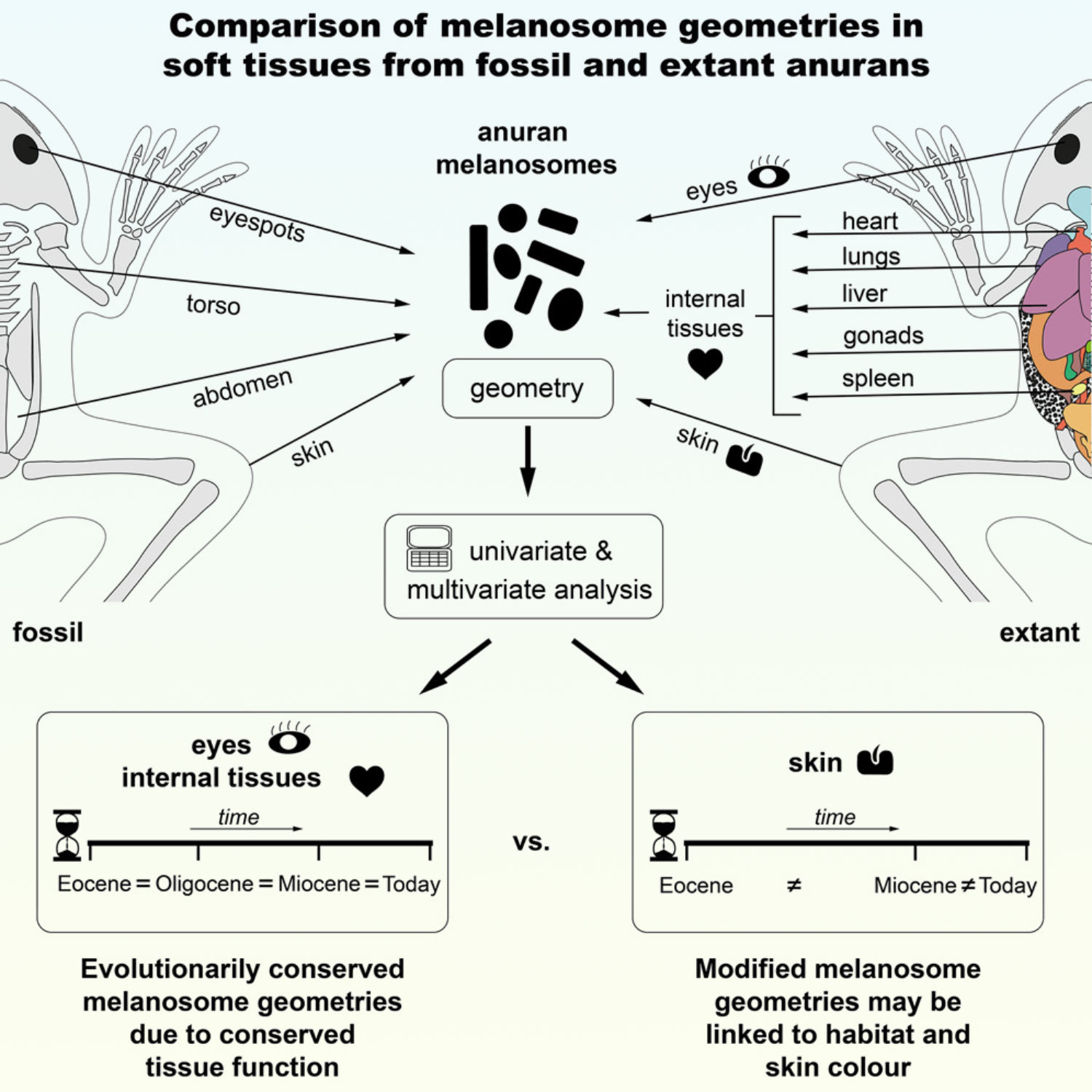
Falk et al. show that the geometry of melanosomes in the eyespots of fossil frogs from the Miocene and Eocene is similar to that of ocular melanosomes in living frogs. Image credit: Falk et al., doi: 10.1016/j.isci.2025.114220.
In the study, the authors studied 45-million-year-old frog fossils from the paleontological site of Geiseltal in central Germany.
Remarkably, the fossils preserve skin remnants and layers of microscopic fossilized cell structures called melanosomes.
These cell structures synthesize, store, and transport melanin — the pigment responsible for skin, hair, and eye color.
Similar to modern frogs, these melanosomes occur in different body areas including the eyes, the internal organs and the skin.
The shape of the melanosomes is different in fossil and modern soft tissues, except for those in the eyes and internal organs.
“We suspect that melanosome shape is related to function, which varies between tissues. This can include photoprotection and homeostasis,” said Dr. Valentina Rossi, a researcher at University College Cork.
“Interestingly, because the shape of eye melanosomes did not change over millions of years, we can assume that their function is still the same. There was no need for any evolutionary change,” added Dr. Daniel Falk, also from University College Cork.
“Some species are keeping ancestral traits instead of evolving new ones.”
“We know that frogs retained their lifestyle for at least 45 million years and that included, for instance, the need to see at dawn and nighttime for hunting and mating.”
This is the first time a study has combined large datasets of modern and fossil melanosomes from one animal group.
The authors studied the melanosomes using cutting edge electron microscope and synchrotron-X-ray fluorescence analyses.
These techniques were not available when the fossils were first discovered in the early 20th century.
“Paleontological studies that integrate data from fossil and modern species have the power to shed new light on evolution” said University College Cork’s Professor Maria McNamara.
“We are just beginning to realize the potential of melanin to serve as an evolutionary signal.”
The study was published this month in the journal iScience.
_____
Daniel Falk et al. Evolutionary constraints on anuran melanin for 45 million years. iScience, published online December 17, 2025; doi: 10.1016/j.isci.2025.114220