A fish species called the armored rockhead poacher (Bothragonus swanii) carries a secret that has confounded marine biologists for decades: a deep, bowl-shaped hole in the middle of its skull. This bizarre anatomical feature has now been linked to an extraordinary form of communication.
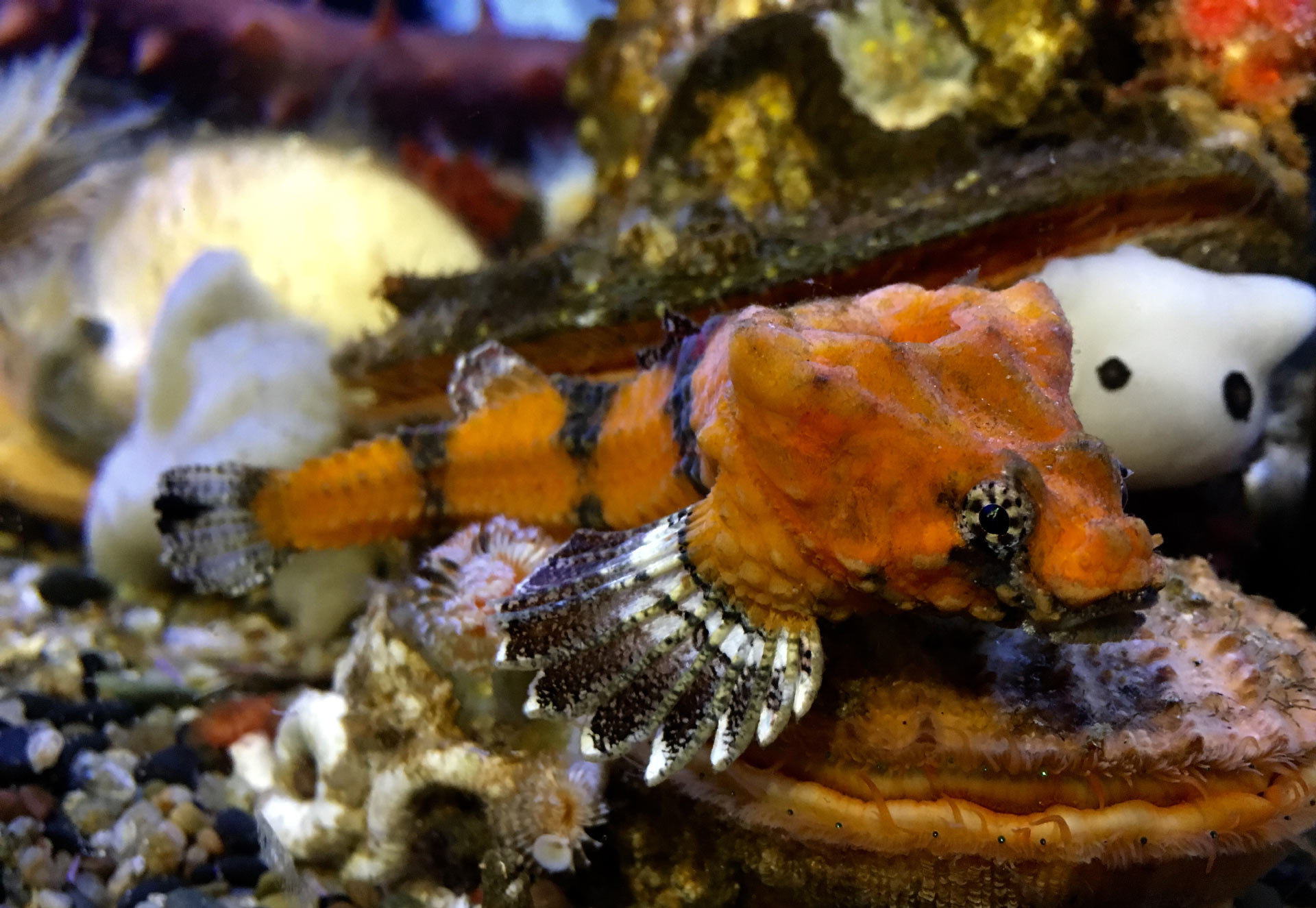
The rockhead poacher (Bothragonus swanii) in Oregon Coast Aquarium. Image credit: Rhinopias / CC BY-SA 4.0.
First described by Franz Steindachner in 1876, Bothragonus swanii is a species in the family Agonidae.
This fish is found in the eastern Pacific Ocean from Alaska to Carmel Bay, California down to depths of 18 m.
Marine biologists have long debated multiple hypotheses for why Bothragonus swanii has a cavernous cranial pit — a cavity about the size of the fish’s brain.
Some thought it helped camouflage the animal among rocks, others speculated that it might aid hearing or sensory perception.
Now, thanks to cutting-edge imaging technology, Louisiana State University student Daniel Geldof suggests an altogether different explanation — one that evokes the rhythms of a rock concert rather than the silence of a reef.
“The goal of my entire thesis project was to figure out why,” Geldof explained.
Using a high-resolution micro-CT scanner, he built detailed 3D models of the rockhead poacher’s anatomy.
These scans revealed that the fish’s first set of ribs are unusually large, free-moving and flattened, sitting close to the cranial pit without direct attachment.
At the bases of these ribs are powerful muscles and tendons — like drumsticks.
When vibrated against the mineralized cavity in the skull, these ribs can create subterranean pulses of sound.
Geldof argues that this percussion-like system likely evolved to help the fish communicate through the ground in its acoustically chaotic intertidal habitat.
In this rocky, shallow zone where crashing waves and environmental noise make traditional waterborne communication difficult, vibrations transmitted through the substrate may travel more effectively — a strategy better suited to this fish’s unique lifestyle.
Geldof also combined contrast-agent enhanced soft-tissue scans with bone structure data to trace nerves, muscles and microstructures within the rockhead poacher’s head, uncovering evidence that the cranial pit may also play a sensory role.
A branch of the posterior lateral line nerve, part of the fish’s motion-sensing system, enters the pit, and the arrangement of surface microstructures may support mechanoreception — the ability to detect movement or pressure.
Geldof argues that the feature may be multifunctional, serving both communication and sensory functions in the noisy intertidal ecosystem.
“What does this tiny thing look like up-close isn’t merely a scientific question — it’s a basic human curiosity,” he said.
_____
Daniel L. Geldof. 2025. The hole truth: morphology of the cranial pit in the rockhead poacher, Bothragonus swanii (Agonidae). LSU Master’s Theses 6270