Paleontology News

Jul 10, 2018 by News Staff

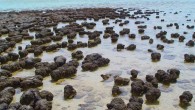
An international team of researchers from Australia, Japan, the United States and Belgium has successfully extracted bright pink biological pigments from 1.1-billion-year-old marine sedimentary rocks of the Taoudeni Basin in Mauritania, West Africa. Biogeochemist Dr. Janet Hope holds an ampoule with pink colored porphyrins. Image credit: Australian National University. “The bright pink pigments called porphyrins are the molecular fossils of chlorophylls...

Jun 29, 2018 by Enrico de Lazaro

An international team of paleontologists has identified two new species of ancient mammals that lived about 13 million years ago (middle Miocene epoch)...

Jun 26, 2018 by News Staff

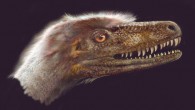
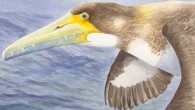
New research reveals that a well-preserved 52-million-year-old bird fossil specimen from the early Eocene of Wyoming, the United States, is from a previously...

Jun 26, 2018 by News Staff

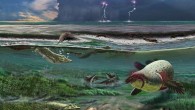
A team of paleontologists from the University of California, Riverside and the South Australian Museum has discovered the fossils of two soft-bodied animals...

Jun 25, 2018 by News Staff

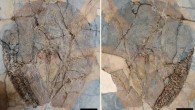
Brindabellaspis stensioi, a remarkable placoderm fish that swam about 400 million years ago (Early Devonian period), had a long snout, reminiscent of a...

Jun 22, 2018 by News Staff

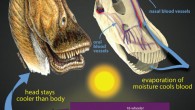
Reconstructions of dinosaurs at theme parks and museums often show their tongues waving — a feature that is completely incorrect. According to new...

Jun 18, 2018 by News Staff

One might expect a dig site in some far-off desert when thinking of a paleontological discovery. Nevertheless, new finds are often made in museum collections. An...

Jun 15, 2018 by News Staff

In a paper published this week in the journal Scientific Reports, paleontologists have described an extinct genus and species of frog, Electrorana limoae,...

Jun 14, 2018 by News Staff

The oldest example of a tick wrapped in spider silk has been found, preserved in Burmese amber. It dates from the Cretaceous period, about 99 million years...

Jun 12, 2018 by News Staff

The oldest known animal ‘footprints’ on Earth, left by bilaterian animals with paired appendages about 545 million years ago, have been discovered...

Jun 5, 2018 by News Staff

The Cretaceous/Paleogene mass extinction ended the reign of the dinosaurs and wiped out 76% of species on Earth. It was caused by the impact of an asteroid...

May 31, 2018 by News Staff

Paleontologists have unearthed the world’s oldest squamate fossil — 240-million-year-old specimen of a species called Megachirella wachtleri —...

May 31, 2018 by Natali Anderson

A tiny fossil of an early juvenile Spinosaurus has been discovered by a duo of Italian paleontologists. The largest and the smallest specimens of Spinosaurus...

May 30, 2018 by News Staff

Ground-dwelling birds survived while their close, tree-dwelling relatives went extinct during the end-Cretaceous mass extinction event, caused by the impact...

May 29, 2018 by News Staff

An international research team led by scientists at University College Cork, Linyi University, and China’s Institute of Vertebrate Paleontology and Paleoanthropology...

May 25, 2018 by News Staff

A team of paleontologists has discovered and described the nearly complete fossilized skull of a previously unknown mammal relative that lived about 130...

May 24, 2018 by News Staff

57-milion-year-old leaf fossils from eastern India suggest that the worldwide-distributed morning glory family (Convolvulaceae), which includes sweet potatoes...

May 14, 2018 by Enrico de Lazaro

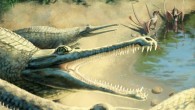
Paleontologists have discovered a fossil of a 180-million-year-old crocodyliform that they say is a long-sought missing link in the evolution of some ancient...

May 11, 2018 by News Staff

The discovery of Llanocetus denticrenatus — an ancient whale species that swam in Antarctic waters 34 million years ago, during a period called the...

Apr 26, 2018 by News Staff

An international team of scientists has found evidence of an interaction between Ice Age humans and now-extinct giant ground sloths. White Sands footprints...