Paleontology News

Apr 20, 2018 by News Staff

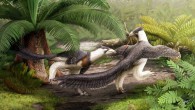
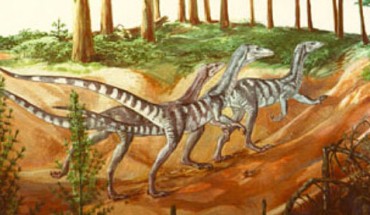
An international team of paleontologists from the Natural History Museum, London, the University of Birmingham and Virginia Tech has formally given an ancient carnivorous reptile a name, over several decades since its fossils were found in Tanzania. The formal species description of Mandasuchus tanyauchen is published in a special memoir of the Journal of Vertebrate Paleontology. A paleoartist’s reconstruction of Mandasuchus tanyauchen. Image credit:...

Apr 17, 2018 by News Staff

Paleontologists believe that all non-avian dinosaurs were wiped out when a giant asteroid or comet collided with Earth some 65 million years ago, resulting...

Apr 16, 2018 by News Staff

A partial skeleton of a megaraptorid dinosaur unearthed over a decade ago in northwestern Patagonia, Argentina, has been recognized as belonging to a new...

Apr 13, 2018 by News Staff

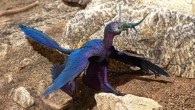
New research by a team of scientists from the University of Exeter and elsewhere offers an illuminating insight into iridescent colors found on the earliest...

Apr 11, 2018 by News Staff

According to a study released this week in the journal PLoS ONE, an isolated bone from the lower jaw of a prehistoric marine reptile found in Somerset,...

Apr 4, 2018 by News Staff

An international team of paleontologists from the University of Edinburgh, Staffin Museum and Chinese Academy of Sciences has discovered a new dinosaur...

Apr 3, 2018 by News Staff

According to a new study, Saniwa ensidens — an extinct monitor lizard that lived in what is now Wyoming 51-49 million years ago (Eocene epoch) —...

Mar 26, 2018 by News Staff

A team of paleontologists from Yale University, Smithsonian Institution and Johns Hopkins University has discovered a new species of reptile that lived...

Mar 14, 2018 by News Staff

Archaeopteryx is an iconic fossil species with feathered wings from the Late Jurassic of Germany. The question of whether this dino-bird was an elaborately...

Mar 7, 2018 by News Staff

A new study shows how a group of ancient reptiles called captorhinids could detach their tails to avoid predation. This is an illustration of Captorhinus,...

Mar 6, 2018 by Enrico de Lazaro

An international research team led by Swedish Museum of Natural History scientists has found that stromatolites (solid, laminar structures of biological...

Mar 5, 2018 by News Staff

The tiny fossil of a juvenile enantiornithe bird from the Early Cretaceous La Huérguina Formation of Spain is helping paleontologists understand how early...

Feb 27, 2018 by News Staff

University of Pennsylvania paleontologist Steven Jasinski has announced the discovery of a previously unknown species of fossil turtle in the Gray Fossil...

Feb 23, 2018 by News Staff

A groundbreaking new technique for studying lake sediments can tell scientists more about the frequency and intensity of past and future insect epidemics,...

Feb 21, 2018 by News Staff

Around 90 million years ago, eastern and western North America were isolated from each other by a salty sea, creating two landmasses: Appalachia and Laramidia....

Feb 14, 2018 by Enrico de Lazaro

Columbian mammoths (Mammuthus columbi) may have moved like modern elephants with infants in matriarchal groups. That’s according to a team of U.S. paleontologists...

Feb 9, 2018 by News Staff

Paleontologists have discovered a new species of fossil fish from 90 million-year-old (Cretaceous period) deposits in Colombia. A paper reporting this...

Feb 7, 2018 by News Staff

A remarkable tailed arachnid found in the mid-Cretaceous (approximately 100 million years ago) Burmese amber of Myanmar documents a key transition stage...

Feb 1, 2018 by News Staff

The 200 million-year-old specimen is only the second known example of Wahlisaurus massarae, a species of ichthyosaur announced recently by a University...

Jan 30, 2018 by News Staff

Paleontologists in Egypt have found fossil fragments from a new species of titanosaurian sauropod dinosaur that walked the Earth around 80 million years...