Paleontologists have examined 289-million-year-old specimens of the early reptile Captorhinus aguti that preserve a covering of three-dimensional skin, a complete shoulder girdle and ribcage with cartilages, and — most astonishingly — protein remnants that predate the previous oldest-known example by nearly 100 million years.
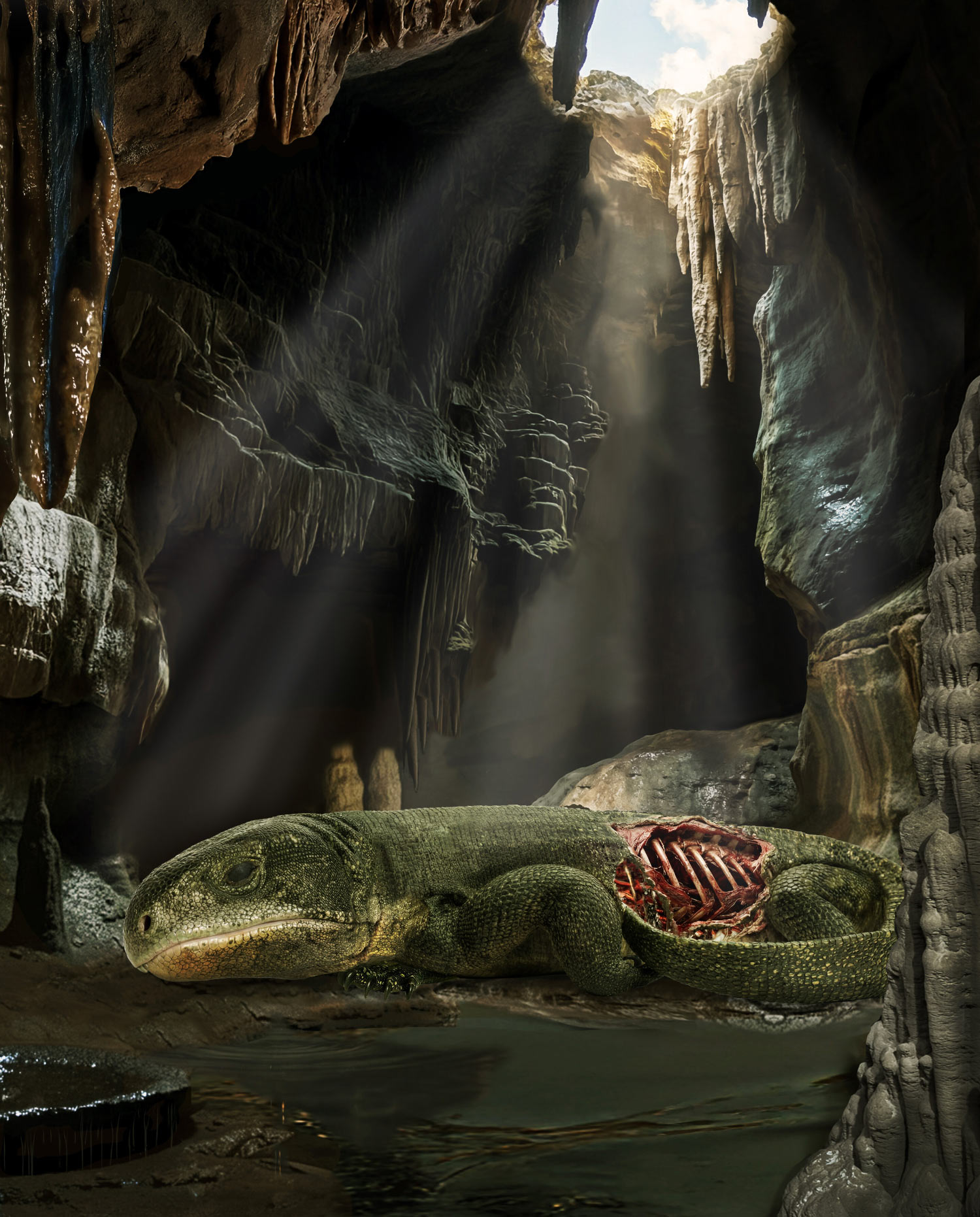
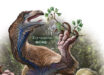
Captorhinus aguti. Image credit: Michael DeBraga.
The move from water to land was a major step in vertebrate evolution, and early amniotes needed new ways of breathing to survive in dry environments.
Earlier amniotes mainly relied on throat-based and skin-based respiration, whereas later amniotes used their ribs and chest to draw air into the lungs.
Because soft tissues almost never fossilize, direct evidence of how and when this shift happened is lacking.
“Captorhinus aguti is an interesting lizard-looking critter that is critical to understanding early amniote evolution,” said Ethan Mooney, a Ph.D. candidate at Harvard University.
“This creature, which grew over 5 cm in length, were among the earliest known reptiles to experiment with living on land. During their time, they were thriving and numerous.”
The three well-preserved specimens of Captorhinus aguti were discovered in unique cave systems near Richards Spur, Oklahoma.
The fossils were encased in fine clay and saturated with oil, revealing previously unknown structures.
In one specimen, the paleontologists identified a segmented cartilaginous sternum, sternal ribs, intermediate ribs, and structures connecting the ribcage to the shoulder girdle.
For the first time in the fossil record, it was possible to view these structures in an early reptile and reconstruct the complete breathing apparatus of an early amniote.
“We propose that the system found in Captorhinus aguti represents the ancestral condition for the kind of rib-assisted respiration present in living reptiles, birds, and mammals” said Professor Robert R. Reisz, a paleontologist at the University of Toronto and Jilin University.
“Using ribcage musculature was an evolutionary innovation fundamental to the conquest of the terrestrial realm by these earliest ancestors of modern reptiles and mammals.”
“This system likely also contributed to the explosive diversification of early amniotes, setting the stage for their dominance on land.”
“It was a game changer that allowed these animals to adopt a much more active lifestyle,” Mooney added.
Using synchrotron infrared spectroscopy, the researchers also detected remnants of original proteins preserved in the bone, cartilage, and skin.
These organic molecules, never before seen in fossils from the Paleozoic era, are nearly 100 million years older than the previous oldest example, which was found in a dinosaur.
“The protein remnant finding is exceptional,” Mooney said.
“It dramatically pushes our understanding of what is possible in terms of soft tissue preservation in the fossil record.”
The discovery is reported in a paper in the journal Nature.
_____
R.R. Reisz et al. Mummified Early Permian reptile reveals ancient amniote breathing apparatus. Nature, published April 8, 2026; doi: 10.1038/s41586-026-10307-y