The composition of Uranus and Neptune might be less icy than previously thought, according to a new study by University of Zürich scientists.
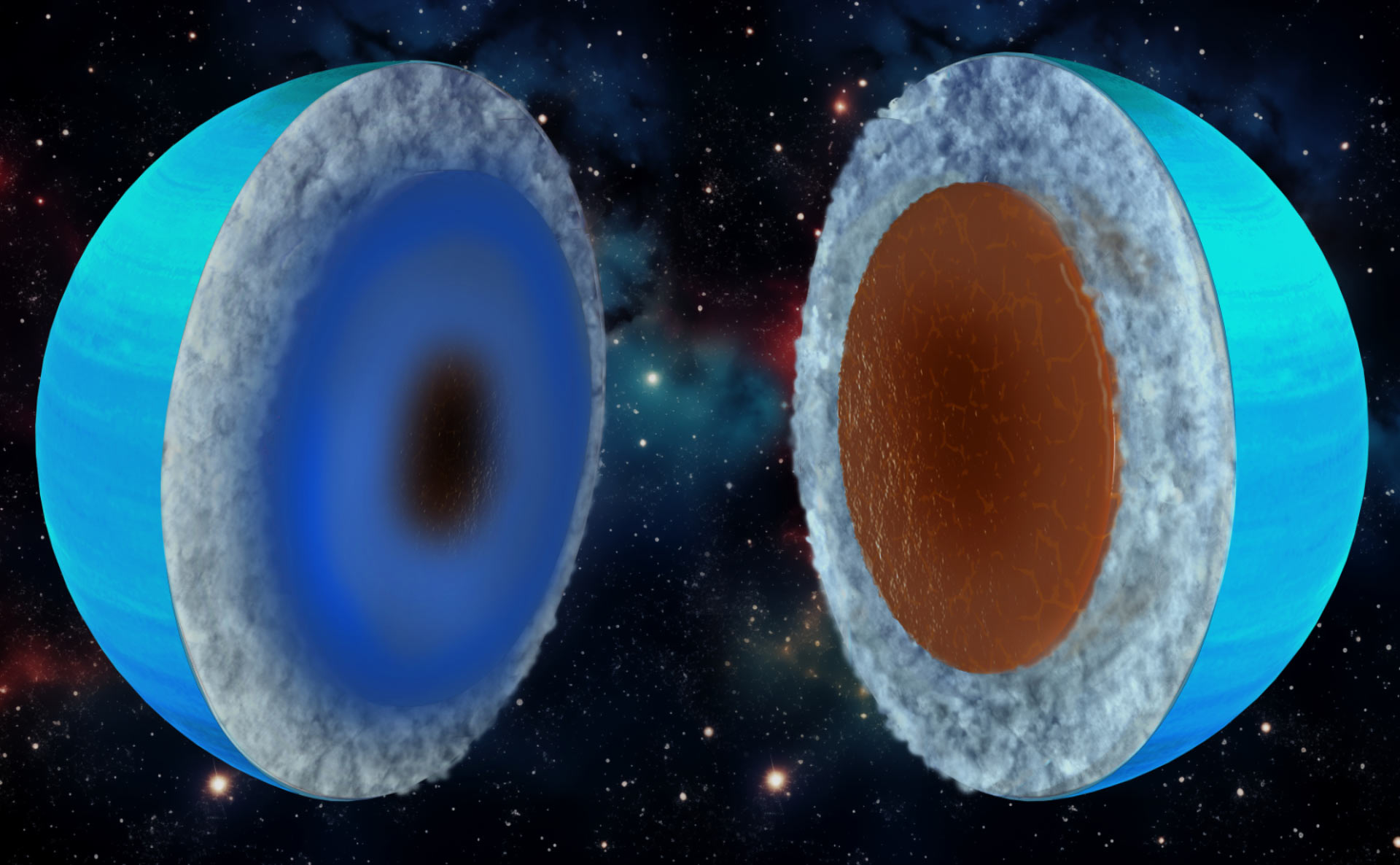
Uranus could be an ice giant (left) or a rock giant (right) depending on the model assumptions. Image credit: Keck Institute for Space Studies / Chuck Carter.
“The ice giant classification is oversimplified as Uranus and Neptune are still poorly understood,” said Luca Morf, a Ph.D. student at the University of Zurich.
“Models based on physics were too assumption-heavy, while empirical models are too simplistic.”
“We combined both approaches to get interior models that are both ‘agnostic’ or unbiased and yet, are physically consistent.”
In their study, the researchers started with a random density profile for the planetary interior.
Then they calculated the planetary gravitational field that is consistent with observational data and inferred a possible composition.
Finally, they repeated the process to obtain the best possible match between the models and the observational data.
With their new agnostic, and yet fully physical model, the scientists found the potential internal composition of the ice giants of our Solar System, is not limited at all to only ice.
“It is something that we first suggested nearly 15 years ago, and now we have the numerical framework to demonstrate it,” said University of Zurich’s Professor Ravit Helled.
“The new range of internal composition shows that both planets can either be water-rich or rock-rich.”
The study also brings new perspectives on Uranus’ and Neptune’s puzzling magnetic fields.
While the Earth has clear North and South magnetic poles, the magnetic fields of Uranus and Neptune are more complex having more than two poles.
“Our models have so-called ‘ionic water’ layers which generate magnetic dynamos in locations that explain the observed non-dipolar magnetic fields,” Professor Helled said.
“We also found that Uranus’ magnetic field originates deeper than Neptune’s.”
While the results are promising, some incertitude remains.
“One of the main issues is that physicists still barely understand how materials behave under the exotic conditions of pressure and temperature found at the heart of a planet, this could impact our results,” Morf said.
Despites the uncertainties, the new results also pave the way for new potential interior composition scenario and challenge decade-old assumptions and guide future material science research at planetary conditions.
“Both Uranus and Neptune could be rock giants or ice giants depending on the model assumptions,” Professor Helled said.
“Current data are currently insufficient to distinguish the two, and we therefore need dedicated missions to Uranus and Neptune that can reveal their true nature.”
A paper describing this research was published this week in the journal Astronomy & Astrophysics.
_____
Luca Morf & Ravit Helled. 2025. Icy or rocky? Convective or stable? New interior models of Uranus and Neptune. A&A 704, A183; doi: 10.1051/0004-6361/202556911