Astronomers using the NASA/ESA/CSA James Webb Space Telescope have discovered a supernova explosion accompanying the gamma-ray burst event GRB 250314A at a redshift of 7.3, when the Universe was only 730 million years old. The previous chart-topping supernova event occurred when the Universe was 1.8 billion years old. The discovery is reported in two papers in the journal Astronomy & Astrophysics.
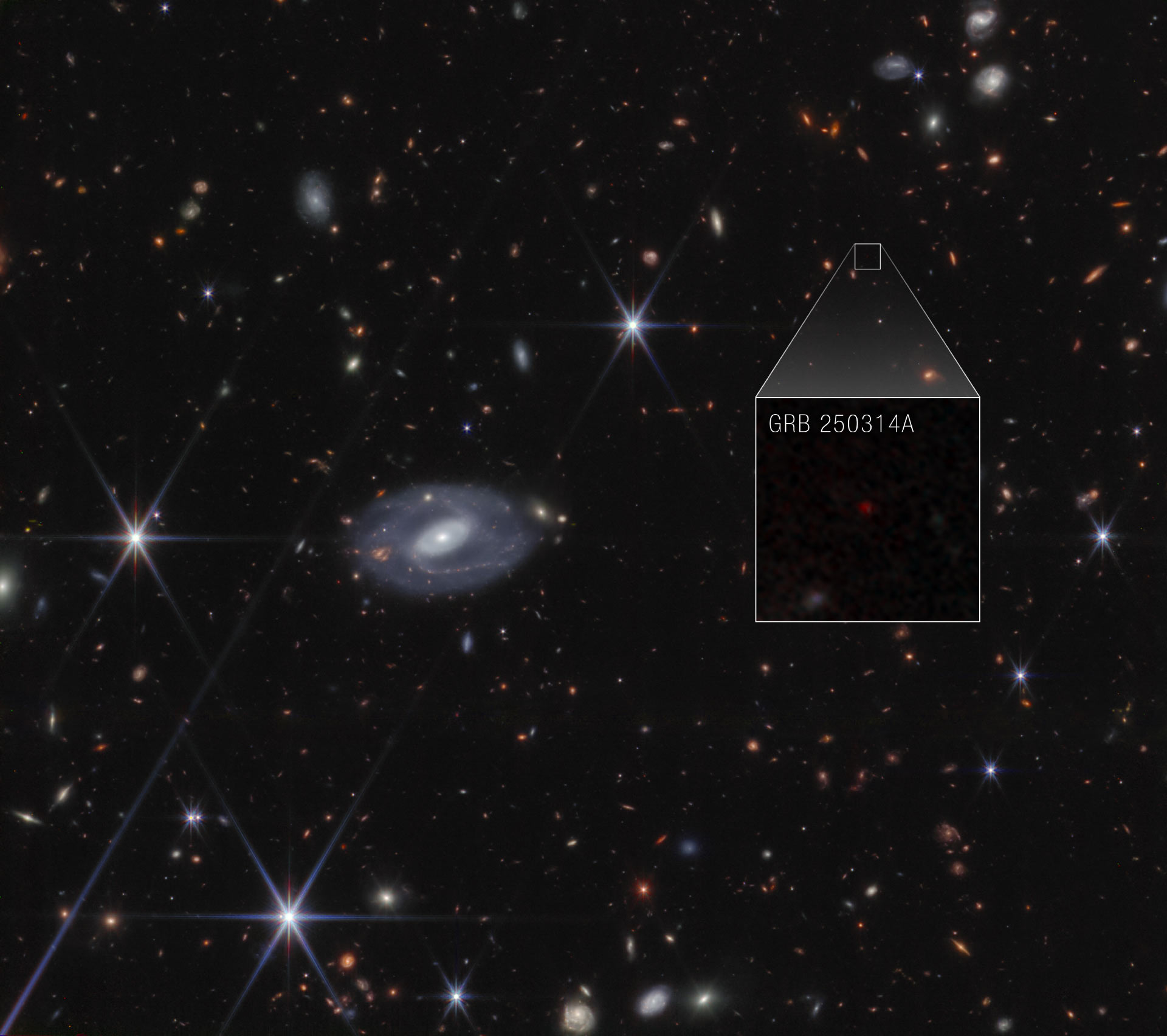
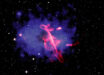
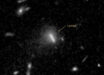
Webb identified the source of a super bright flash of light known as a gamma-ray burst: a supernova that exploded when the Universe was only 730 million years old. Image credit: NASA / ESA / CSA / STScI / A. Levan, IMAPP / A. Pagan, STScI.
“Only Webb could directly show that this light is from a supernova — a collapsing massive star,” said Dr. Andrew Levan, an astronomer at Radboud University and the University of Warwick, and lead author of one of the two papers.
“This observation also demonstrates that we can use Webb to find individual stars when the Universe was only 5% of its current age.”
While a gamma-ray burst typically lasts for seconds to minutes, a supernova rapidly brightens over several weeks before it slowly dims.
In contrast, the supernova associated with GRB 250314A brightened over months.
Since it exploded so early in the history of the Universe, its light was stretched as the cosmos expanded over billions of years.
As light is stretched, so is the time it takes for events to unfold.
Webb’s observations were intentionally taken 3.5 months after the GRB 250314A event ended, since the underlying supernova was expected to be brightest at that time.
“Webb provided the rapid and sensitive follow-up we needed,” said Dr. Benjamin Schneider, an astronomer at the Laboratoire d’Astrophysique de Marseille.
Gamma-ray bursts are incredibly rare. Those that last a few seconds may be caused by two neutron stars, or a neutron star and a black hole colliding.
Longer bursts like this one, which lasted around 10 seconds, are frequently linked to the explosions of massive stars.
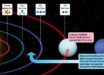
On March 14, 2025, the SVOM mission, a Franco-Chinese telescope that launched in 2024 and was designed to detect fleeting events, detected a gamma-ray burst from a very distant source.
Within an hour and a half, NASA’s Neil Gehrels Swift Observatory pinpointed the X-ray source’s location on the sky. That enabled subsequent observations that would pin down the distance for Webb.
Eleven hours later, the Nordic Optical Telescope was queued up and revealed an infrared-light gamma-ray burst afterglow, an indication that the gamma ray might be associated with a very distant object.
Four hours later, ESO’s Very Large Telescope estimated the object existed 730 million years after the Big Bang.
“There are only a handful of gamma-ray bursts in the last 50 years that have been detected in the first billion years of the Universe,” Dr. Levan said.
“This particular event is very rare and very exciting.”
Since this is the earliest, farthest supernova to be detected to date, the researchers compared it to modern, nearby supernovae. The two turned out to be very similar, which surprised them.
Why? Little is still known about the first billion years of the Universe.
Early stars likely contained fewer heavy elements, were more massive, and led shorter lives.
They also existed during the Era of Reionization, when gas between galaxies was largely opaque to high-energy light.
“Webb showed that this supernova looks exactly like modern supernovae,” said University of Leicester’s Professor Nial Tanvir.
“Webb’s observations indicate that this distant galaxy is similar to other galaxies that existed at the same time,” said Dr. Emeric Le Floc’h, an astronomer at the CEA Paris-Saclay.
_____
A.J. Levan et al. 2025. JWST reveals a supernova following a gamma-ray burst at z ≃ 7.3. A&A 704, L8; doi: 10.1051/0004-6361/202556581
B. Cordier et al. 2025. SVOM GRB 250314A at z ≃ 7.3: An exploding star in the era of re-ionization. A&A 704, L7; doi: 10.1051/0004-6361/202556580