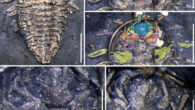
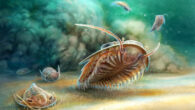
Based on multiple analytical techniques applied to well-preserved soft-bodied specimens of two trilobite species, the Late Ordovician species Triarthrus...
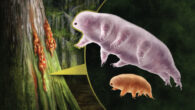
Tardigrades are a diverse group of microscopic invertebrates widely known for their extreme survival capabilities. Molecular clocks suggest that tardigrades...
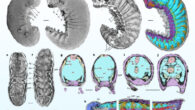
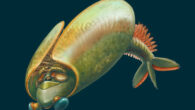
Named Youti yuanshi, the newly-identified euarthropod species fills an important gap in our understanding of how the arthropod body plan originated and...
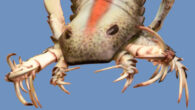
Sea scorpions (eurypterids), extinct giant aquatic arthropods, were apex predators. New research suggests that early species of the scorpion-like carcinosomatoid...
The evolution of the first animals on land, 500 million years ago, has been revealed. The ancestors of millipedes, called euthycarcinoids, evolved in warm...
Mandibulates are an example of evolutionary success, representing over half of all current species on Earth. Today, mandibulates are everywhere: from sea-dwelling...
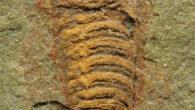
Paleontologists have unearthed a well-preserved fossil assemblage of Cambrian trilobites in the High Atlas of Morocco. The 510-million-year-old specimens...
Euchelicerata is a large group of arthropods comprising horseshoe crabs, scorpions, spiders, mites and ticks, as well as the extinct sea scorpions and...
In a new paper in the journal Nature Ecology & Evolution, paleontologists described the diversity of the Cabrières Biota, a new Early Ordovician site...
In a 100-page monograph published in the journal Papers in Palaeontology, paleontologists have described ten new species of trilobites from the tuff-bearing...
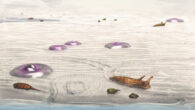
Minterichnus shieldi, a new type of trace fossil (resting trace) of a phyllocarid crustacean from Texas shows animals trapped in a tidal pool, just before...
The Waukesha Biota, a 437-million-year-old fossil assemblage from Wisconsin, USA, provides a rare glimpse into life in an ancient lagoon. In his book Wonderful...
Paleontologists from Yunnan University, the University of Leicester and the Natural History Museum, London have conducted a microtomographic study of new...
Paleontologists have examined a collection of 160-million-year-old sea spider fossils from Southern France. The rare specimens show that the diversity...