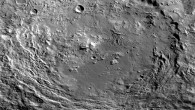
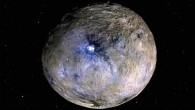
Ceres is the largest body in the asteroid belt. Because Ceres is small, there was not enough gravitational energy when it formed to heat the interior....
Cryovolcanoes (ice volcanoes) are similar to normal volcanoes but instead of being formed from molten rock, they are made by frozen liquids like ammonia...
Using the Framing Camera (FC) and the Visible and Infrared Spectrometer (VIR) aboard NASA’s Dawn spacecraft, planetary researchers have spotted bright...
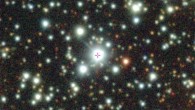
Astronomers using NASA’s Transiting Exoplanet Survey Satellite (TESS) have discovered a unique object of uncertain nature — possibly a disintegrating...
University of Exeter’s Dr. Adrien Morison and colleagues have shown how vast ice forms have been shaped in Sputnik Planitia, a nitrogen-ice-filled basin...
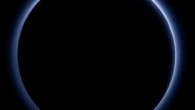
The surface pressure on the dwarf planet Pluto is decreasing and that its nitrogen atmosphere is condensing, forming ice on the dwarf planet’s surface,...
Using high spatial-resolution data gathered by the Gamma Ray and Neutron Detector (GRaND) aboard NASA’s Dawn spacecraft, planetary researchers have detected...
Terrestrial planets (Mercury, Venus, Earth, and Mars) are differentiated into three layers: a metallic core, a silicate shell (mantle and crust), and a...
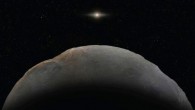
Nicknamed ‘Farfarout’ and officially designated 2018 AG37, the newly-confirmed planetoid has a very elongated orbit that takes it out to 175 AU (astronomical...
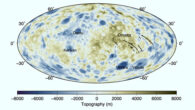
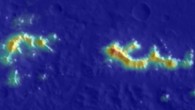
The bright frosts observed in 2015 in the equatorial region of Cthulhu on Pluto are mostly made of methane-rich ice, according to new research.
This image,...
Using data from the PACS photometer onboard ESA’s Herschel Space Observatory, astronomers have found that thermal properties of the five major moons...
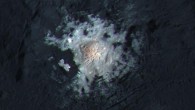
High-resolution observations from NASA’s Dawn spacecraft of mysterious bright spots (faculae) in Occator crater on the dwarf planet Ceres suggest the...
Pluto is thought to possess a subsurface ocean beneath its thick ice shell. It has generally been assumed that the dwarf planet formed out of cold material...
Pluto’s famous heart-shaped structure, named Tombaugh Regio, controls winds in the atmosphere of the dwarf planet and may give rise to features on its...
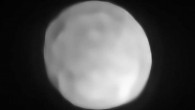
Hygiea is the fourth largest main belt asteroid and the only known asteroid whose surface composition appears similar to that of the dwarf planet Ceres....
Many icy bodies in our Solar System have underground oceans. On the dwarf planet Pluto, an area called Sputnik Planitia suggests the presence of a subsurface...
The tenuous nitrogen atmosphere of the dwarf planet Pluto is predicted to ultimately collapse and freeze over.
This high-resolution image of Pluto was...
Collisions between bodies in our Solar System produce impact craters on large objects at a rate that depends on the population of impacting small bodies....
NASA’s Dawn mission recently spotted mysterious bright spots in the center of Occator Crater on the dwarf planet Ceres. According to a new study published...