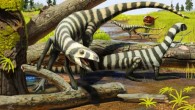
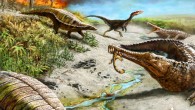
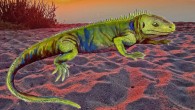
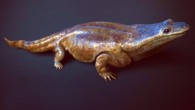
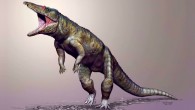
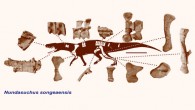
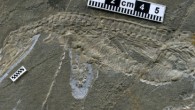
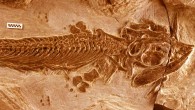
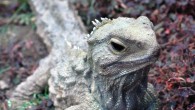
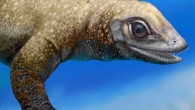
Fossil remains of a previously unknown species of reptile that lived about 250 million years ago (Triassic period) have been found in the Brazilian state...
A multinational group of paleontologists has determined that the time elapsed between the emergence of early dinosauromorphs (dinosaur relatives) and the...
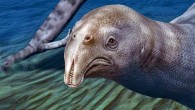
A team of paleontologists has discovered a new species of turtle-like reptile that lived in what is now Germany during the Middle Triassic period, approximately...
A new study published in the Proceedings of the National Academy of Sciences sheds light on why early dinosaurs were small, rare and species-poor in tropical...
A group of paleontologists, led by Catherine Klein from the University of Bristol, UK, has put together the remains of a new small species of prehistoric...
A mass extinction some 201 million years ago may have been triggered by changes in the biochemical balance of Panthalassa (also known as the Panthalassic...
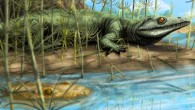
A team of scientists led by Dr Steve Brusatte of the University of Edinburgh, UK, has discovered a new species of metoposaurus that lived in lakes and...
A new species of prehistoric crocodile that dates back 231 million years ago (Carnian stage of the Triassic period) has been identified by a team of paleontologists...
A team of paleontologists headed by Dr Sterling Nesbitt of Virginia Tech has described a new genus and species of archosaur that lived in what is today...
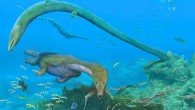
Paleontologists led by Dr Xiao-hong Chen of the China Geological Survey’s Wuhan Center have discovered a new species of marine reptile that lived in...
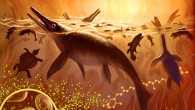
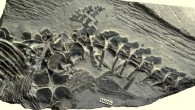
Paleontologists led by Prof Ryosuke Motani of the University of California, Davis, have discovered an amphibious ichthyosaur that lived in the seas of...
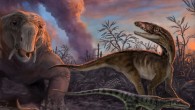
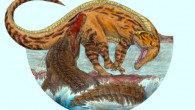
The evidence comes from a team of U.S. scientists who found remnants of a prehistoric clash in a slab of rock at the Chinle Formation in New Mexico. The...
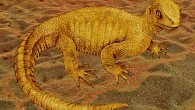
Paleontologists led by Dr Xiao-Chun Wu from Canadian Museum of Nature say they have discovered a new genus and species of reptile that lived in what is...
A team of paleontologists led by Dr Guan-bao Chen of Anhui Geological Museum, China, says a newly discovered fossil of a Mesozoic ichthyosaur reveals the...
Paleontologists from the National Museums Scotland, the Field Museum of Natural History in Chicago and the Institute of Vertebrate Palaeontology and Palaeoanthropology...
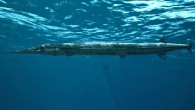
A newly discovered fossil of an early ray-finned fish, named Saurichthys curionii, from the Middle Triassic of Switzerland reveals a previously unknown...
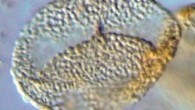
Well-preserved fossilized pollen grains found in northern Switzerland provide evidence that flowering plants may have originated in the early Triassic...
A 246-million-year-old skull fossil found in Winterswijk, the Netherlands, sheds new light on the origin and phylogenetic development of placodonts, a...