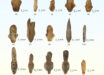
Geochemical analysis of 780,000-year-old stone tools from Israel suggests Acheulean (or Acheulian) hominins repeatedly sought specific basalt sources, revealing sophisticated planning and deep knowledge of their landscape.

The basalt slabs at the Acheulean site of Gesher Benot Ya‘aqov in Israel were used for biface production, and most of their knapping took place away from the site. Image credit: Chuang Zhao.
“The acquisition of suitable raw material of various sources was a crucial aspect in the life for prehistoric people as part of tool preparation,” said Dr. Tzahi Golan from the Geological Survey of Israel and colleagues.
“Hence, the procurement of adequate raw material was a key behavioral aspect in the culture of prehistoric societies and reflects their knowledge of their surroundings, which facilitated artifact manufacturing for more than three million years.”
“Two patterns — the increase of raw material variability at younger sites and the exploitation of nearby sources — characterize hominin evolution during the Early and early Middle Pleistocene, evident by the study of Oldowan and Acheulean lithic assemblages, suggesting that hominin preferences in selecting raw materials evolved with time.”
In their new research, the archaeologists examined basalt artifacts from the Acheulean site of Gesher Benot Ya‘aqov and nearby basalt sources.
They aimed to trace where the raw material used for tool production came from, and to reconstruct how early hominins selected stone within a landscape that has changed dramatically over time.
“Dated to about 780,000 years ago, preserves repeated occupations of Acheulean hominins along the shores of paleo-Lake Hula,” they said.
“Excavations revealed a rich archaeological record, including stone tools made of flint, limestone, and basalt, as well as evidence for fire use, plant exploitation, animal processing, and fish consumption.”
“Basalt was a significant raw material at the site, especially for the production of large cutting tools such as handaxes and cleavers.”
“Previous studies showed that these tools were produced through a complex reduction sequence: hominins selected large basalt slabs, shaped them into giant cores, detached large flakes, and then modified these flakes into bifaces.”
“This process required planning, technical skill, and detailed knowledge of the properties of basalt.”
The researchers analyzed the chemical composition of basalt artifacts from several archaeological horizons and compared them with geological samples from basalt flows around the site.
They also analyzed basalt recovered from the Eshel Ya‘aqov borehole drilled at the Gesher Benot Ya‘aqov site.
The results show that many basalt artifacts match sources located very close to the site, in some cases within about 1 km.
Some artifacts also match basalt units that are now buried beneath the site and are no longer exposed at the surface.
By combining geochemical fingerprinting with evidence from deep boreholes beneath the site, the scientists were able to reconstruct parts of an ancient landscape that no longer exist today.
This approach allowed them to identify basalt flows that were accessible to hominins 780,000 years ago but were later buried or eroded as the Jordan Valley landscape changed through tectonic activity.
“This is especially important because Gesher Benot Ya‘aqov lies in a tectonically active region along the Dead Sea Transform,” they said.
“Faulting, subsidence, erosion, and sediment burial have reshaped the local landscape over time.”
“Basalt flows once accessible to hominins may later have been buried, eroded, or removed from the visible surface.”
The geochemical results also reveal differences between tool types.
Giant cores are closely linked to nearby and buried local basalt sources, whereas some cleavers appear to have been procured from sources not represented among the sampled exposures.
“This suggests that hominins did not simply collect any available basalt, but selected particular sources according to technological needs such as slab size, shape, internal structure, or suitability for cleaver production,” the authors said.
The study also identified differences between tool types: some cleavers appear to have been made from basalt sources different from those used for most handaxes and giant cores.
This is particularly significant because previous research at the site showed that cleaver production required especially advanced planning and technical expertise.
The findings suggest that hominins deliberately searched for basalt with specific qualities suited to particular tools.
The same raw-material selection strategies appear repeatedly across multiple archaeological layers, indicating a long-lasting technological tradition that persisted over tens of thousands of years.
“The results suggest that Acheulean hominins at Gesher Benot Ya‘aqov possessed detailed environmental knowledge that was maintained and transmitted across generations,” the researchers said.
Their paper was published on May 14 in the journal Scientific Reports.
_____
T. Golan et al. Geochemical basalt investigation reveals procurement strategy at the Acheulian site of Gesher Benot Ya‘aqov, Dead Sea Transform, Israel. Sci Rep, published online May 14, 2026; doi: 10.1038/s41598-026-51905-0