New radiocarbon dates from Sala Keimada, a hard-to-reach chamber of Cueva Palomera in the province of Burgos, northern Spain, suggest that generations of people returned to the sacred space from the end of the Ice Age through the Iron Age, leaving behind art, structures and offerings.
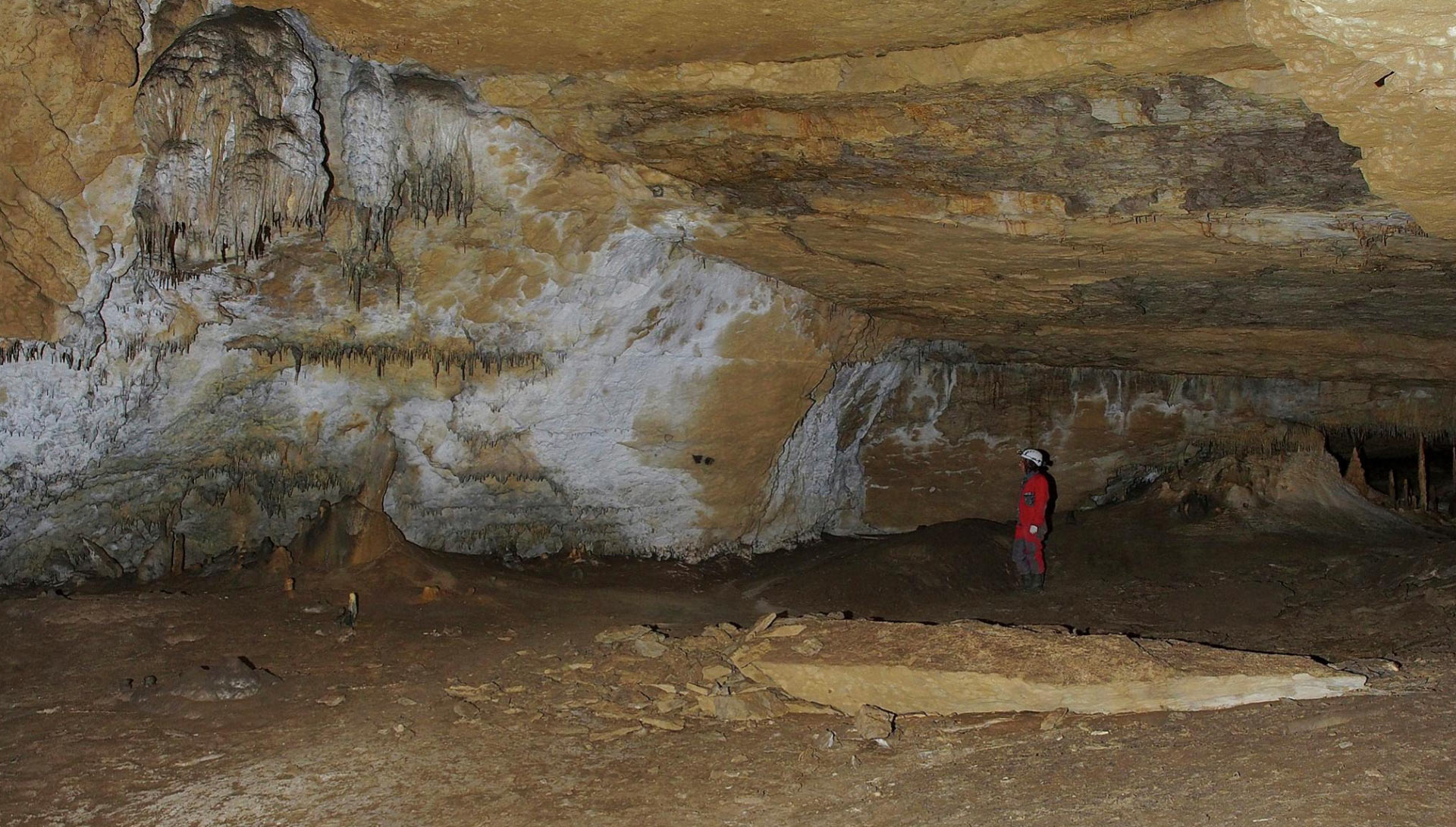
Sala Keimada, a chamber of Cueva Palomera in Burgos, Spain. Image credit: Ortega-Martínez et al., doi: 10.1016/j.jasrep.2026.105818.
“Cueva Palomera is the main entrance to the Ojo Guareña cave system, and where most of the spaces with rock art in the system are located,” said lead author Dr. Ana Isabel Ortega Martínez, a researcher at the Royal Burgos Academy of History and Fine Arts — Fernán González Institution, and her colleagues.
“Sala Keimada is in the third level in the cave, about 290 m from the entrance.”
“It is reached along a crawl — wide and low passage — 13 m wide and 0.2 m high.”
In the new study, the researchers obtained 18 new radiocarbon dates from charcoal samples, drawings, and bone remains scattered throughout Sala Keimada.
The oldest dates back roughly 13,700 years, placing the earliest known use of the site firmly in the Upper Paleolithic.
The newest belongs to a domestic piglet whose bones were found in a small rocky pool — dated to around 2,100 years ago, during the Iron Age, suggesting the animal may have been brought deep into the cave as a ritual offering.
Between those two extremes, the evidence points to repeated visits during the Neolithic, the Chalcolithic, and the Bronze Age.
Crucially, each generation of visitors appears to have respected the artwork left by their predecessors, adding new marks and drawings while leaving earlier ones intact.
“One of the most significant discoveries is a complex structure built from two large limestone slabs placed upright and supported against one another, reinforced by smaller stones,” the scientists said.
“The main slab, measuring 1.5 m in length, has a carefully shaped upper edge that creates a pointed profile resembling an animal figure facing the main panel of paintings.”
“Both this slab and some of the stones supporting it preserve engravings and charcoal marks that attest to intense human activity around the structure.”
“In terms of its characteristics, it closely resembles another Paleolithic slab documented in Tito Bustillo Cave (Ribadesella, Asturias), although it is larger.”
The findings add Sala Keimada to a growing list of cave sanctuaries across the Iberian Peninsula where prehistoric peoples returned, century after century, to a place they clearly considered sacred.
“It is remarkable that eight different phases have been detected in Sala Keimada, one of the most hidden sanctuaries with difficult access in Cueva Palomera,” the authors said.
“This implies that, over the millennia, as well as using the entrance areas as a habitat, humans repeatedly visited this complex underground world.”
The findings were published on May 23 in the Journal of Archaeological Science: Reports.
_____
Ana Isabel Ortega-Martínez et al. 2026. Sala Keimada: another Palaeolithic sanctuary in Cueva Palomera at Ojo Guareña (Burgos, Spain). Journal of Archaeological Science: Reports 73: 105818; doi: 10.1016/j.jasrep.2026.105818