The Upper Paleolithic site of Mezhyrich, located in Cherkasy oblast, central Ukraine, is home to four remarkable mammoth bone structures. Ranging from 12 to 24 m2, they were intricately constructed using hundreds of mammoth bones and tusks. A new analysis of small mammal remains recovered directly from the archaeological layers indicates that at least one of these structures was used for up to 429 years, supporting the interpretation that it functioned as a dwelling.
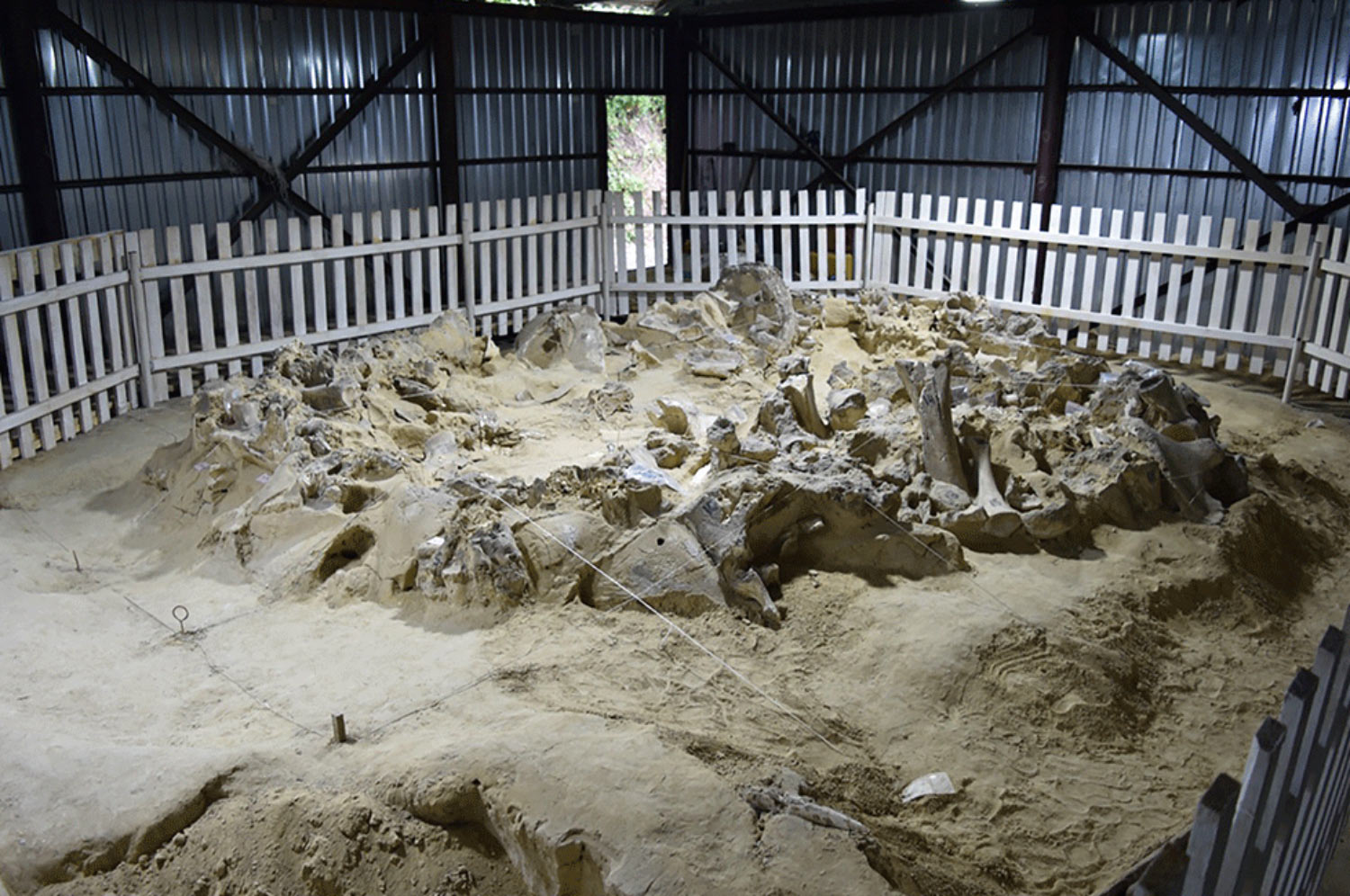
MBS 4 during excavation at the Upper Paleolithic site of Mezhyrich in Cherkasy oblast, Ukraine. Image credit: Chu et al., doi: 10.12688/openreseurope.20112.1.
“Open-air Upper Paleolithic sites in East-Central Europe offer valuable insights into human activity and biogeography during the Late Pleniglacial, a period of intense environmental change,” said Universiteit Leiden archaeologist Wei Chu and colleagues.
“Many of these sites, characterized by deep loessic sedimentary sequences, contain abundant lithic, faunal, and osseous assemblages with embedded environmental proxies to help determine contemporaneous environmental factors.”
“Notably in this region, some of these sites are found in direct association with mammoth bone accumulations posited to be among the earliest evidence of built structures that exhibit spatial and seasonal organization.”
“Many of these constructions have been previously interpreted as the remains of domestic structures,” they added.
“However, since most were excavated decades ago, the question has reemerged as to whether they functioned primarily as dwellings or if they represent sites of other functions, such as bone beds, food caches, burials, religious traditions, or ritualized middens that may have served as early monuments.”
“A key site to this debate is Mezhyrich, situated in the Middle Dnieper Basin of Ukraine known for its exceptional preservation of four mammoth bone structures (MBS 1-4) between 12-24 m2 in diameter.”
“These structures are associated with peripheral features and artifacts including artifact-filled pits, hunting weapons, ivory, and bone ornaments, as well as delimited activity areas with butchered animal remains and workshops with dense cultural layers, each delimited into economical settlement units with the mammoth bone structure as the focal point.”
In their new study, the authors focused on the dating and analysis of MBS 4, the only one of the structures at Mezhyrich that contains well-provenienced artifacts within cultural layers from which to obtain direct ages.
By dating small mammal remains instead of mammoth bones, they were able to establish a more precise age for MBS 4, placing it at around 18,248-17,764 years ago.
Crucially, the new data indicate that the structure was in use for as long as 429 years.
The findings suggests that rather than being a temporary camp used for a few seasons, Mezhyrich was a stable, long-term settlement.
The structure likely served as a multi-generational dwelling, maintained and re-occupied over several centuries.
“MBS 4 dates to the harshest phase of the last Ice Age,” the researchers said.
“Even more intriguing, the occupation span was short; possibly a single or few visits over centuries.”
“This suggests that these bone-built shelters were practical solutions for survival rather than permanent settlements.”
“Why does this matter? Beyond the sheer ingenuity of using mammoth bones as building material, these findings reshape our understanding of human resilience and adaptation.”
“They show how communities thrived in extreme environments, turning the remnants of giant animals into protective architecture.”
“As dating methods become more precise, sites like Mezhyrich continue to challenge our assumptions about prehistoric life,” they concluded.
“Far from being static, these societies were dynamic, resourceful, and deeply connected to their environment, a lesson that still resonates today.”
The team’s paper was published in the journal Open Research Europe.
_____
W. Chu et al. 2025. A revised radiocarbon chronology for the mammoth bone structures and associated features at Mezhyrich, Ukraine. Open Res Europe 5: 198; doi: 10.12688/openreseurope.20112.1