Archaeologists from the University of Tübingen and the LMU Munich have unearthed the ruins of an ancient pottery workshop at the early Iron Age Dinka Settlement Complex in the Peshdar Plain, Sulaymaniyah province, Kurdish Autonomous Region of Iraq. The discovery sheds light on craft specialization, technological traditions, and urban life, revealing an unexpectedly level of socio-economic complexity in the region at that time.
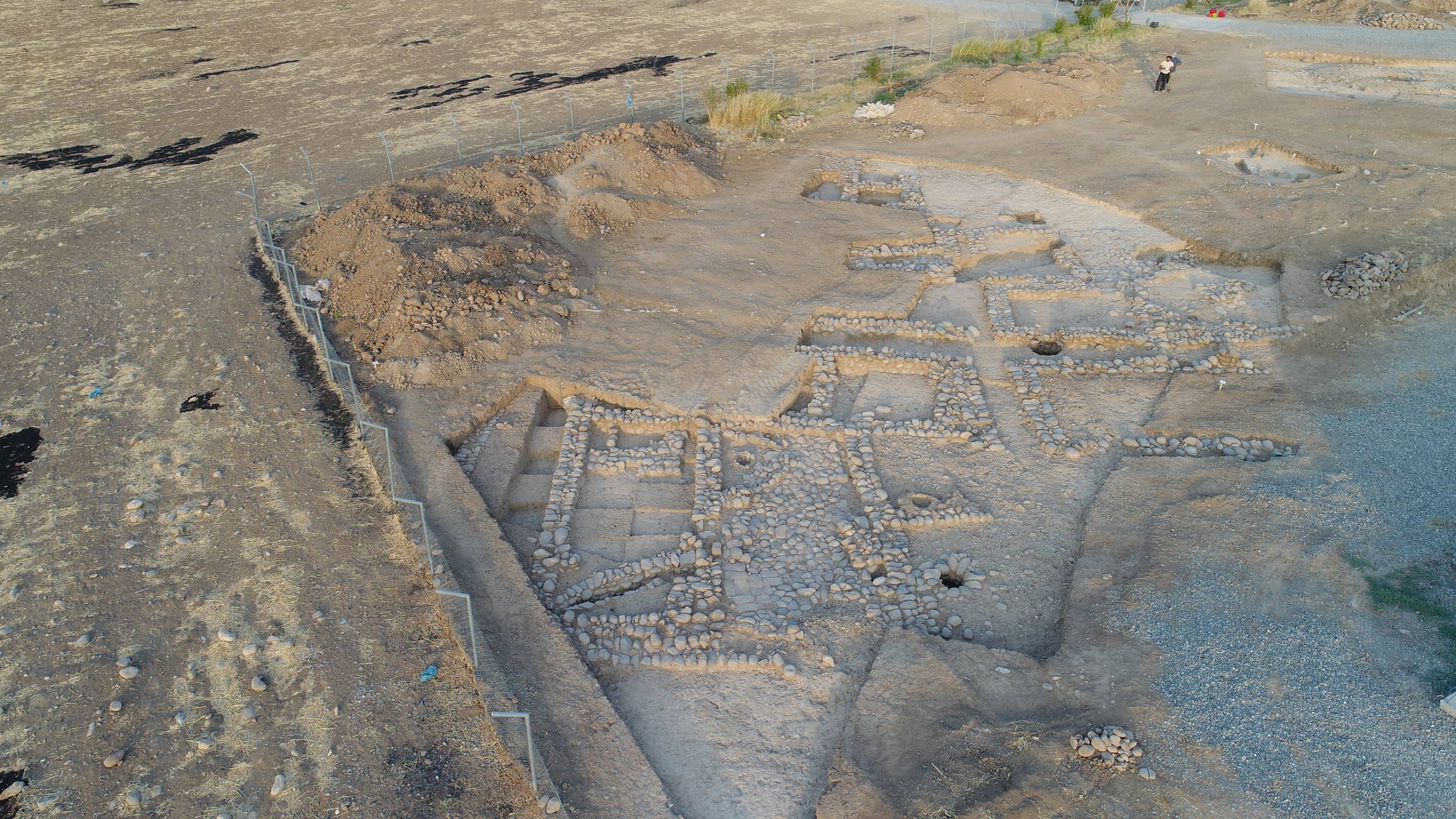
The 3,000-year-old pottery workshop of Gird-i Bazar at the Dinka Settlement Complex in Kurdish Autonomous Region of Iraq. From this perspective, the walls of the buildings are clearly visible, along with the kilns. Image credit: Andrea Squitieri.
The Dinka Settlement Complex, which includes Gird-i Bazar, Qalat-i Dinka, and the surrounding area, was excavated by the Peshdar Plain Project, initiated by LMU Munich archaeologists in 2015.
The project focused on the Iron Age in the headwaters of the Lower Zab, a region of the western Zagros that remains poorly understood.
Excavations revealed a previously unknown Iron Age site. Among the discoveries was a rich pottery assemblage and, significantly, a pottery production workshop in the lower town of Gird-i Bazar.
This workshop included two updraft kilns and production tools, dated to between approximately 1200 and 800 BCE.
“Because the workshop was so well preserved, we were able to combine various techniques and thus obtain a comprehensive picture of how potters actually worked in this region during the Iron Age,” said Dr. Silvia Amicone, an archaeologist at the University of Tübingen.
The archaeologists examined the materials, including raw clay, finished pottery, and kiln linings, as well as the kiln fill and the remains of the fuel used during firing.
By analyzing the mineralogy and microstructure of the clay and pottery samples and by establishing the presence of specific minerals, they identified the raw materials and manufacturing techniques used to produce the pottery.
The analyses show that, although vessels from the settlement were shaped and finished in slightly different ways, likely depending on their intended function, these variations were embedded within a modular and well-organized production system that probably served not only the Dinka Settlement Complex but also the surrounding region, in which the Gird-i Bazar workshop likely played a central role.
This interpretation is reinforced by the widespread evidence of pottery production across the settlement complex, including more possible kilns identified using geophysical analysis.
This suggests that pottery manufacture was integral to the urban layout and that Gird-i Bazar formed part of a network of workshops operating according to common procedures.
“Our results show that pottery was typically fired at relatively low temperatures (below 900 degrees Celsius) under oxidising conditions, with relatively slow heating rates and short dwelling times, in simple updraught kilns,” the researchers said.
“The variability observed in microstructural and mineralogical features is best explained by the fact that our samples reflect different firing events conducted within a shared technological framework.”
“All vessel types appear to have been fired using similar methods, reflecting a coherent pyrotechnological tradition.”
“The study of pottery production at the Dinka Settlement Complex offers a unique glimpse into the organization and innovative strength of early urban societies,” said Professor (Dōshisha) Karla Pollmann, President of the University of Tübingen.
“These findings reveal how technological knowledge and communal structures laid the foundation for cultural development more than 2,500 years ago.”
“Research of this kind reminds us that progress has always been a collective achievement — then as now.”
A paper described the findings was published December 23 in the Journal of Archaeological Science.
_____
Silvia Amicone et al. Assembling the puzzle pieces: Integrating pottery and kiln analysis to reconstruct pyrotechnology at the Dinka Settlement Complex (Iraqi Kurdistan). Journal of Archaeological Science, published online December 23, 2025; doi: 10.1016/j.jas.2025.106425