New high-resolution observations by ESA’s Solar Orbiter mission show that solar flares are driven by cascading magnetic reconnection events, unleashing vast energy and ‘raining’ plasma blobs across the Sun’s atmosphere.
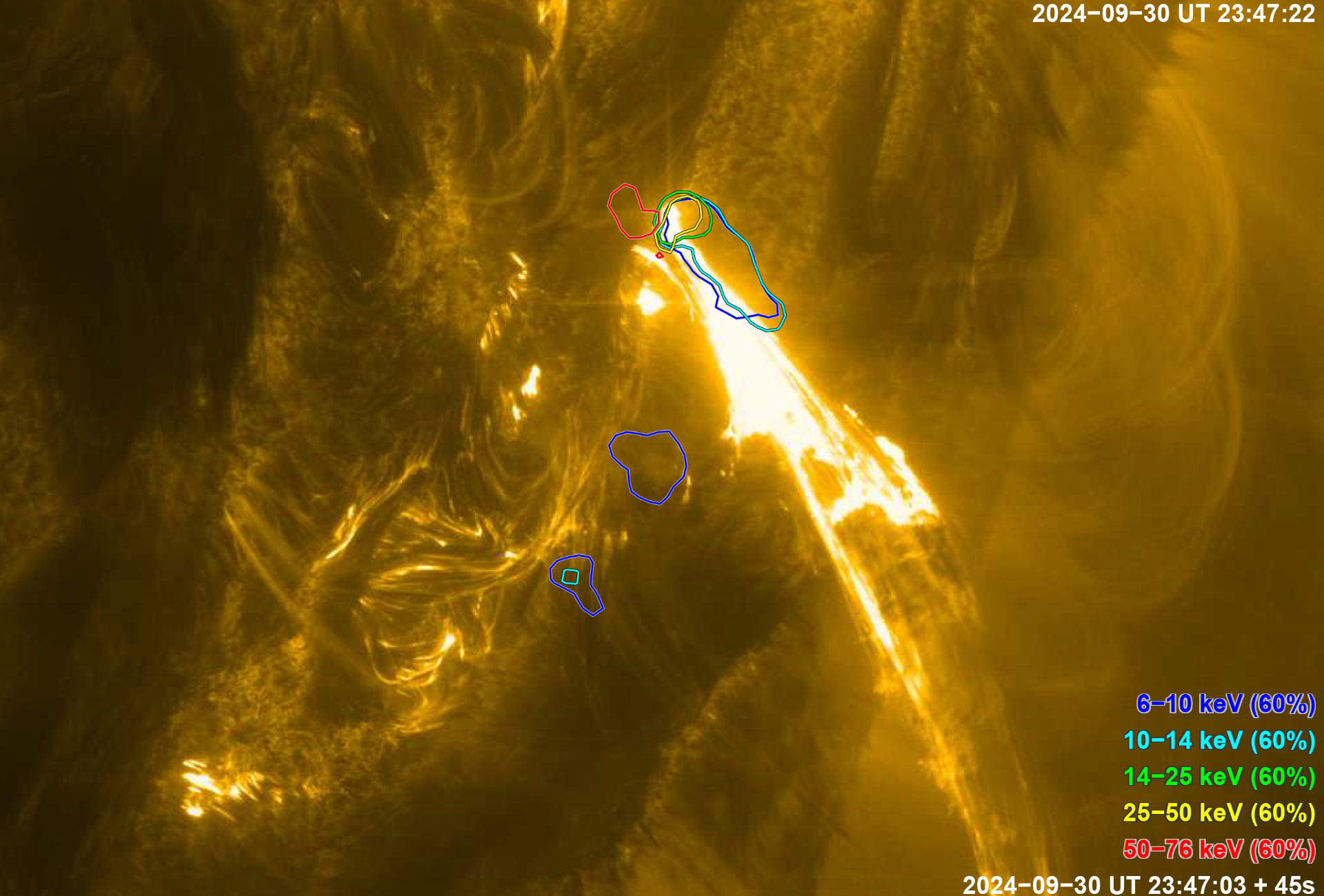
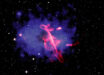
Overview of the impulsive phase of an M-class solar flare, observed by ESA’s Solar Orbiter. Image credit: ESA / Solar Orbiter / Chitta et al., doi: 10.1051/0004-6361/202557253.
Solar flares are powerful explosions produced by the Sun.
They occur when energy stored in tangled magnetic fields is suddenly released through a process described as ‘reconnection.’
In a matter of minutes, criss-crossing magnetic field lines of opposite direction break and then reconnect.
The newly-reconnected field lines can quickly heat up and accelerate million-degree plasma, and even high-energy particles, away from the reconnection site, potentially creating a solar flare.
The most powerful flares may start a chain of reactions that lead to geomagnetic storms on Earth, perhaps triggering radio blackouts, which is why it is so important to monitor and understand them.
But the fine-grained details of how exactly this humungous amount of energy is released so rapidly has remained poorly understood.
The unprecedented set of new Solar Orbiter observations — from four of the mission’s instruments working in complement to provide the most complete picture of a solar flare ever made — finally has a compelling answer.
High-resolution imagery from Solar Orbiter’s Extreme Ultraviolet Imager (EUI) zoomed in to features just a few hundred km across in the Sun’s outer atmosphere (its corona), capturing changes every two seconds.
Three other instruments — SPICE, STIX and PHI — analyzed a range of depths and temperature regimes, from the corona down to the Sun’s visible surface, or photosphere.
“We were really very lucky to witness the precursor events of this large flare in such beautiful detail,” said Dr. Pradeep Chitta, an astronomer at the Max Planck Institute for Solar System Research.
“Such detailed high-cadence observations of a flare are not possible all the time because of the limited observational windows and because data like these take up so much memory space on the spacecraft’s onboard computer.”
“We really were in the right place at the right time to catch the fine details of this flare.”
The Solar Orbiter observations revealed a comprehensive picture of the central engine of the pre-flare and impulsive phases of a solar flare in the form of a magnetic avalanche.
“We saw ribbon-like features moving extremely quickly down through the Sun’s atmosphere, even before the main episode of the flare,” Dr. Chitta said.
“These streams of ‘raining plasma blobs’ are signatures of energy deposition, which get stronger and stronger as the flare progresses.”
“Even after the flare subsides, the rain continues for some time.”
“It’s the first time we see this at this level of spatial and temporal detail in the solar corona.”
“We didn’t expect that the avalanche process could lead to such high energy particles.”
“We still have a lot to explore in this process, but that would need even higher resolution X-ray imagery from future missions to really disentangle.”
“This is one of the most exciting results from Solar Orbiter so far,” said ESA’s Solar Orbiter co-project scientist Dr. Miho Janvie.
“Solar Orbiter’s observations unveil the central engine of a flare and emphasize the crucial role of an avalanche-like magnetic energy release mechanism at work.”
“An interesting prospect is whether this mechanism happens in all flares, and on other flaring stars.”
The results appear in the journal Astronomy & Astrophysics.
_____
L.P. Chitta et al. 2026. A magnetic avalanche as the central engine powering a solar flare. A&A 705, A113; doi: 10.1051/0004-6361/202557253