PSR J2322-2650b, an enigmatic Jupiter-mass exoplanet orbiting the millisecond pulsar PSR J2322-2650, appears to have an exotic helium-and-carbon-dominated atmosphere unlike any ever seen before.
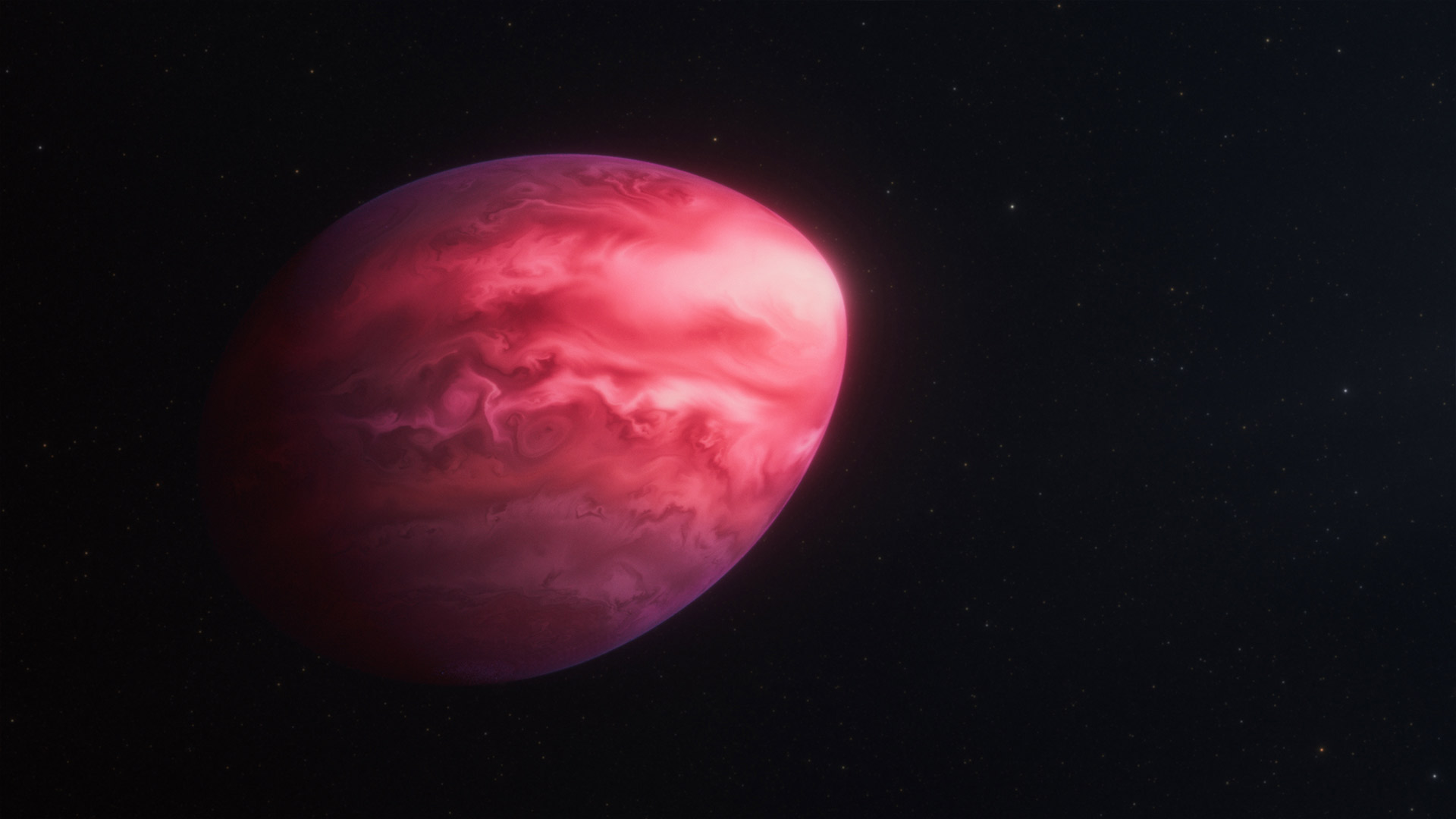
This artist’s concept shows what PSR J2322-2650b may look like. Image credit: NASA / ESA / CSA / Ralf Crawford, STScI.
“This was an absolute surprise,” said Dr. Peter Gao, an astronomer at the Carnegie Earth and Planets Laboratory.
“I remember after we got the data down, our collective reaction was ‘What the heck is this?’ It’s extremely different from what we expected.”
“This system is unique because we are able to view the planet illuminated by its host star, but not see the host star at all,” said Maya Beleznay, a Ph.D. candidate at Stanford University.
“So we get a really pristine spectrum. And we can study this system in more detail than normal exoplanets.”
“The planet orbits a star that’s completely bizarre — the mass of the Sun, but the size of a city,” said Dr. Michael Zhang, an astronomer at the University of Chicago.
“This is a new type of planet atmosphere that nobody has ever seen before. Instead of finding the normal molecules we expect to see on an exoplanet — like water, methane, and carbon dioxide — we saw molecular carbon, specifically C3 and C2.”
Molecular carbon is very unusual because at these temperatures (over 2,000 degrees Celsius), if there are any other types of atoms in the atmosphere, carbon will bind to them.
Out of the approximately 150 planets that astronomers have studied inside and outside the Solar System, no others have any detectable molecular carbon.
“Did this thing form like a normal planet? No, because the composition is entirely different,” Dr. Zhang said.
“Did it form by stripping the outside of a star, like ‘normal’ black widow systems are formed? Probably not, because nuclear physics does not make pure carbon.”
“It’s very hard to imagine how you get this extremely carbon-enriched composition. It seems to rule out every known formation mechanism.”
The authors propose one evocative phenomenon that could occur in the unique atmosphere.
“As the companion cools down, the mixture of carbon and oxygen in the interior starts to crystallize,” said Dr. Roger Romani, an astronomer at Stanford University and the Kavli Institute for Particle Astrophysics and Cosmology Institute.
“Pure carbon crystals float to the top and get mixed into the helium, and that’s what we see.”
“But then something has to happen to keep the oxygen and nitrogen away. And that’s where the mystery come in.”
“But it’s nice to not know everything. I’m looking forward to learning more about the weirdness of this atmosphere. It’s great to have a puzzle to go after.”
The discovery is described in a paper in the Astrophysical Journal Letters.
_____
Michael Zhang et al. 2025. A Carbon-rich Atmosphere on a Windy Pulsar Planet. ApJL 995, L64; doi: 10.3847/2041-8213/ae157c