Using data gathered by a suite of space- and ground-based telescopes, astronomers have discovered AT 2024wpp, the most luminous fast blue optical transient (LFBOT) ever observed. These rare, brief, and intensely bright outbursts have puzzled scientists for a decade, but the extreme brightness and detailed multiwavelength data from AT 2024wpp show that they cannot be explained by any kind of normal stellar explosion such as a supernova. Instead, the new observations indicate that AT 2024wpp was powered by an extreme tidal disruption event in which a black hole up to about 100 times the mass of the Sun tore apart a massive companion star in a matter of days, converting an extraordinary fraction of the star’s mass into energy.
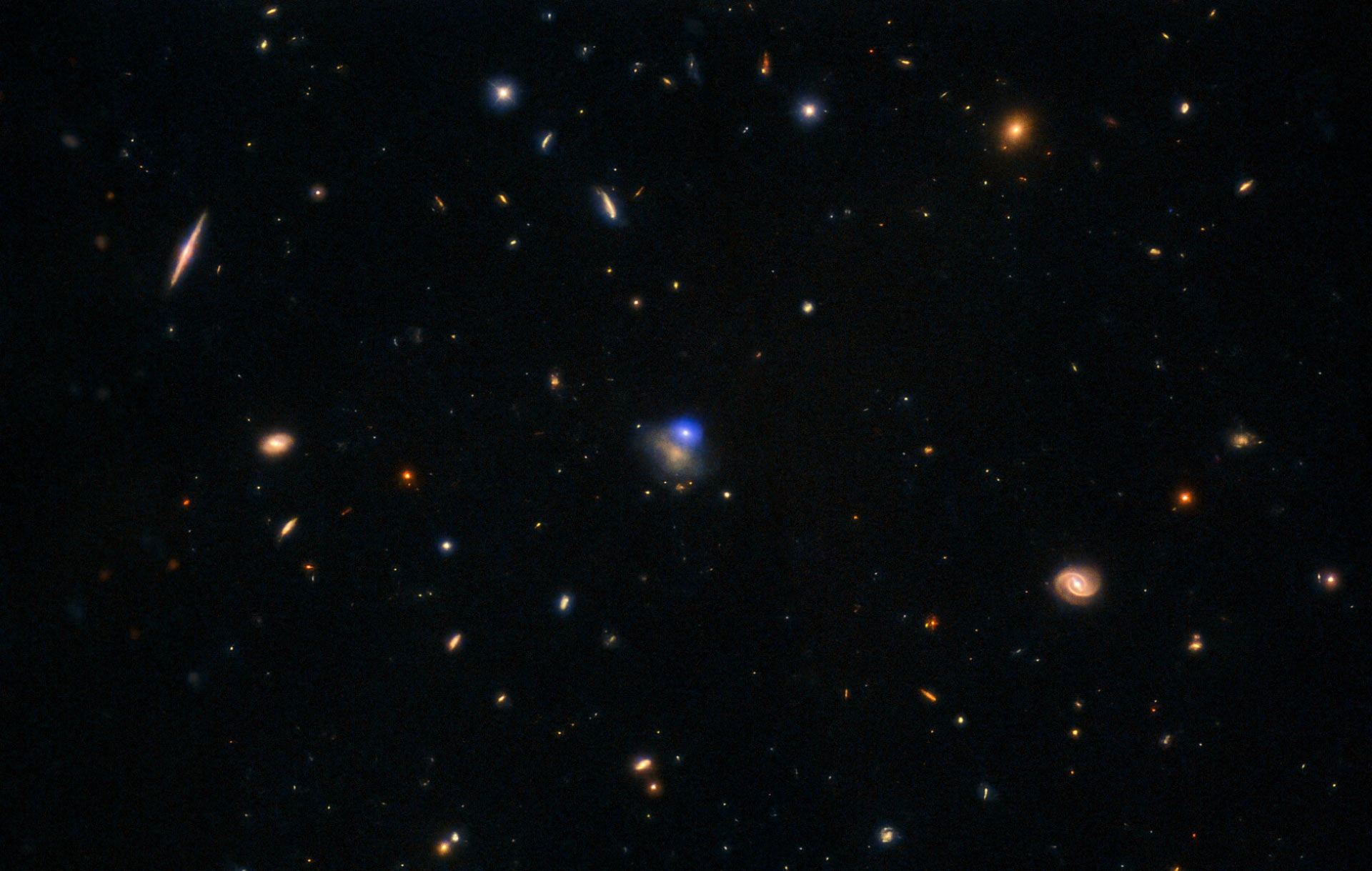
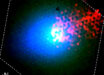
This composite image features X-ray and optical data of the LFBOT event AT 2024wpp. Image credit: NASA / CXC / UC Berkeley / Nayana et al. / Legacy Survey / DECaLS / BASS / MzLS / SAO / P. Edmonds / N. Wolk.
LFBOTs got their name because they are bright — they’re visible over distances of hundreds of millions to billions of light-years — and last for only a few days.
They produce high-energy light ranging from the blue end of the optical spectrum through ultraviolet and X-ray.
The first was seen in 2014, but the first with sufficient data to analyze was recorded in 2018 and, per the standard naming convention, was called AT 2018cow.
The name led researchers to refer to it as the Cow, and subsequent LFBOTs have been called, tongue in cheek, the Koala (ZTF18abvkwla), the Tasmanian devil (AT 2022tsd) and the Finch (AT 2023fhn). Perhaps AT 2024wpp will be known as the Wasp.
The realization that AT 2024wpp could not have resulted from a supernova came after the researchers calculated the energy it emitted.
It turned out to be 100 times greater than what would be produced in a normal supernova.
The radiated energy would require the conversion of about 10% of the rest-mass of the Sun into energy over a very short time scale of weeks.
Specifically, the Gemini South observations revealed an excess of near-infrared light being emitted from the source.
This is only the second time astronomers have observed such a phenomenon — the other case being AT 2018cow — which is clearly not present in ordinary stellar explosions.
These observations establish the near-infrared excess as a hallmark feature of FBOTs, though no model can explain this occurrence.
“The sheer amount of radiated energy from these bursts is so large that you can’t power them with a core collapse stellar explosion — or any other type of normal stellar explosion,” said Natalie LeBaron, a graduate student at the University of California, Berkeley.
“The main message from AT 2024wpp is that the model that we started off with is wrong. It’s definitely not just an exploding star.”
The scientists hypothesize that the intense, high-energy light emitted during this extreme tidal disruption was a consequence of the long parasitic history of the black hole binary system.
As they reconstruct this history, the black hole had been sucking material from its companion for a long time, completely enshrouding itself in a halo of material too far from the black hole for it to swallow.
Then, when the companion star finally got too close and was torn apart, the new material became entrained into the rotating accretion disk and slammed against the existing material, generating X-ray, ultraviolet, and blue light.
Much of the gas from the companion also ended up swirling toward the poles of the black hole, where it was ejected as a jet of material.
The authors calculated that the jets were traveling at about 40% of the speed of light and generated radio waves when they encountered surrounding gas.
Like most LFBOTs, AT 2024wpp is located in a galaxy with active star formation, so large stars like these are expected.
AT 2024wpp is 1.1 billion light-years away and between 5 and 10 times more luminous than AT 2018cow.
The estimated mass of the companion star that was shredded was more than 10 times the mass of the Sun.
“It may have been what’s known as a Wolf-Rayet star, which is a very hot and evolved star that has already used up much of its hydrogen,” the astronomers said.
“This would explain the weak hydrogen emission from AT 2024wpp.”
The results appear in two papers in the Astrophysical Journal Letters.
_____
Natalie LeBaron et al. 2025. The Most Luminous Known Fast Blue Optical Transient AT 2024wpp: Unprecedented Evolution and Properties in the Ultraviolet to the Near-Infrared. ApJL, in press; arXiv: 2509.00951
A.J. Nayana et al. 2025. The Most Luminous Known Fast Blue Optical Transient AT 2024wpp: Unprecedented Evolution and Properties in the X-rays and Radio. ApJL, in press; arXiv: 2509.00952