Keratin composites enable animals to hike with hooves, fly with feathers, and sense with skin. Mammalian whiskers are elongated keratin rods attached to tactile skin structures that extend the animal’s sensory volume. In a new study, scientists at the Max Planck Institute for Intelligent Systems aimed to characterize the geometry, porosity, and stiffness of Asian elephant (Elephas maximus) whiskers.
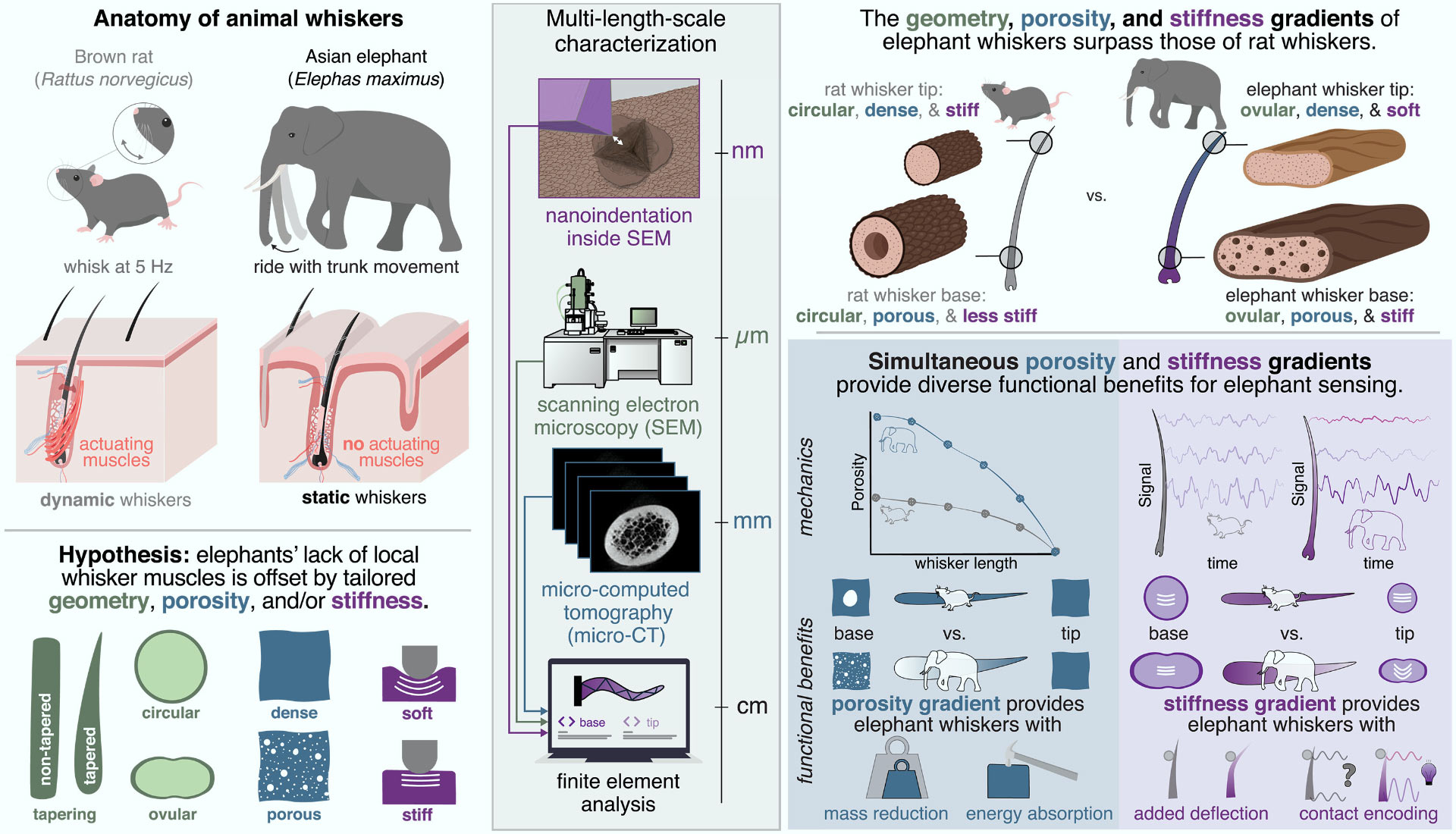
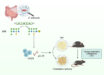
Schulz et al. examined the whiskers that cover Asian elephant (Elephas maximus) trunks and found that they are geometrically and mechanically tailored to facilitate tactile perception by encoding contact location in the amplitude and frequency of the vibrotactile signal felt at the whisker base. Image credit: Schulz et al., doi: 10.1126/science.adx8981.
In mammals, whiskers — elongated keratin rods akin to stiff hairs — are especially sophisticated sensory tools.
Although the keratin from which they are made cannot detect touch itself, whiskers are embedded in follicles surrounded by densely packed sensory neurons that convert tiny mechanical vibrations into nerve signals.
Most previous research has focused on whisker shape and motion, often assuming that whiskers are mechanically uniform across their length.
However, growing evidence shows that whiskers can vary in stiffness and internal structure from base to tip, suggesting that material properties also play a critical role in sensation.
Unlike those of other mammals, elephants have thousands of nonmoving whiskers spread across the thick skin of their highly dexterous trunk.
Although these whiskers cannot move independently, they still make frequent contact with objects and help the animal carry out highly precise tasks, from delicate manipulation to handling food.
Since elephants lack active control of their whiskers, Dr. Andrew Schulz and his colleagues hypothesized that the animals must compensate through functional differences in whisker shape and material structure.
The researchers used micro-CTR imaging, electron microscopy, mechanical testing, and functional modeling to characterize the geometry, porosity, and stiffness of whiskers from both young and adult Asian elephant whiskers.
The findings show that the material properties of elephant whiskers change gradually from base to tip, transitioning from thick, porous, stiff roots to thin, dense, soft tips.
“I noticed that tapping the railing with different parts of the whisker wand felt distinct — soft and gentle at the tip, and sharp and strong at the base,” Dr. Schulz said.
“I didn’t need to look to know where the contact was happening; I could just feel it.”
These functional gradients directly shape how mechanical vibrations are transmitted to sensory neurons, influencing the strength and clarity of tactile signals.
In particular, the transition from a stiff base to a softer tip amplifies changes in signal power, which may help elephants better determine where along the whisker contact occurs, which is an advantage for navigation and precise manipulation.
In this way, elephant whiskers achieve a form of built-in, or ‘physical,’ intelligence, using their material design to optimize sensation without the need for active movement.
The discovery excites the authors, who are working to apply these insights from nature to applications in robotics and intelligent systems.
“Bio-inspired sensors that have an artificial elephant-like stiffness gradient could give precise information with little computational cost purely by intelligent material design,” Dr. Schulz said.
The team’s work was published on February 12, 2026 in the journal Science.
_____
Andrew K. Schulz et al. 2026. Functional gradients facilitate tactile sensing in elephant whiskers. Science 391 (6786): 712-718; doi: 10.1126/science.adx8981