A new study published this week in the journal Biology Letters overturns the popular assumption that the mitochondrial evolution is only visible over long time scales.
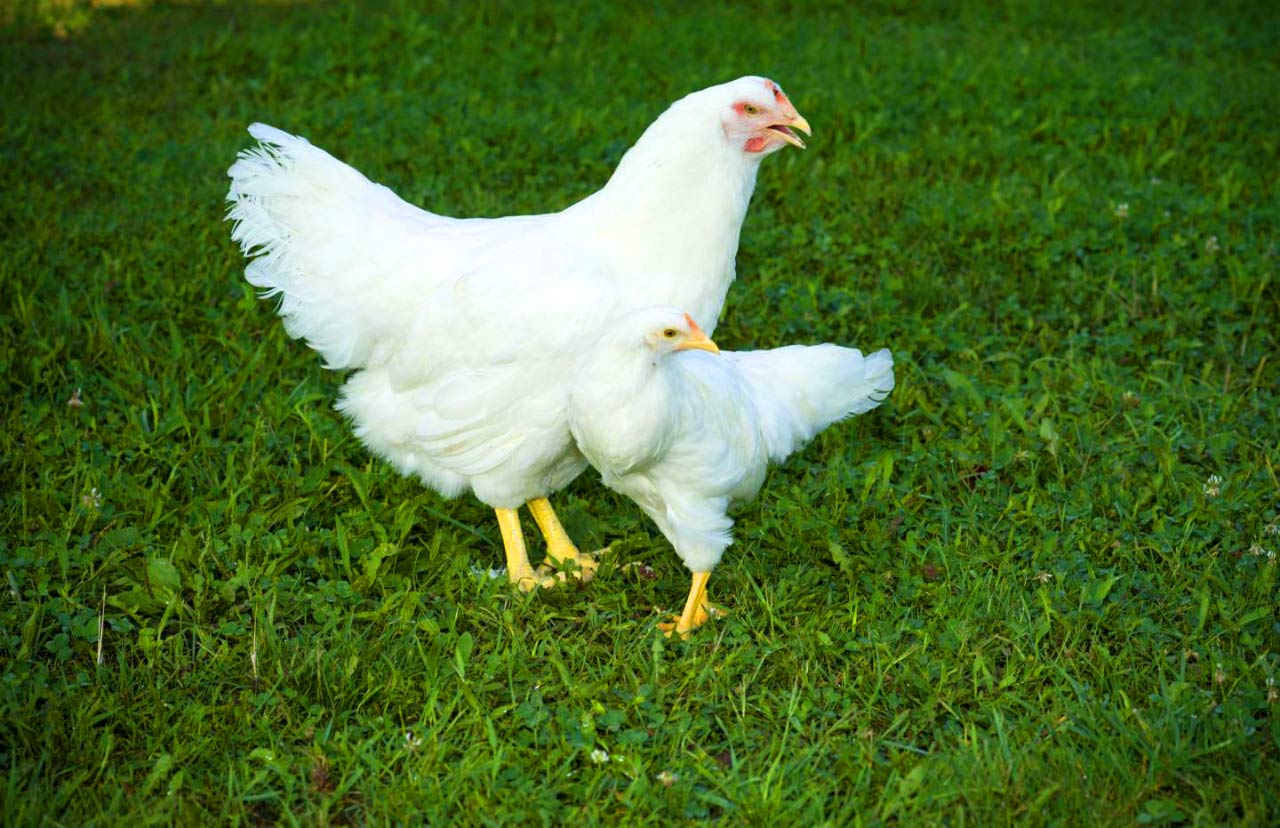
A selective mating approach within the population that started in 1957 has resulted in an over tenfold difference in the size of the chickens. Image credit: John McCormick / Virginia Tech.
By studying individual chickens that were part of a long-term pedigree, an international team of researchers found two mutations that had occurred in the mitochondrial genomes of the birds in only 50 years.
“For a long time scientists have believed that the rate of change in the mitochondrial genome was never faster than about two percent per million years. The identification of these mutations – in ND4L and CYTB genes, both novel mutations in the bird genus Gallus – shows that the rate of evolution in this pedigree is in fact 15 times faster,” the scientists said.
In addition, by determining the genetic sequences along the pedigree, the team – led by Prof. Greger Larson of Oxford University, UK – also discovered a single instance of mitochondrial DNA being passed down from a father.
This is a surprising discovery, showing that so-called ‘paternal leakage’ is not as rare as previously believed.
Using a well-documented 50-year pedigree of a population of White Plymouth Rock, the team reconstructed how the mitochondrial DNA passed from mothers to daughters within the population.
They did this by analyzing DNA from the blood samples of 12 chickens of the same generation using the most distantly related maternal lines, knowing that the base population had started from seven partially inbred lines.
A selective mating approach within the population started in 1957, resulting in what is now an over tenfold difference in the size of the chickens in the two groups when weighed at 56 days old.
“There is now considerable evidence of a disparity between long-term and short-term estimates of mitochondrial changes,” the researchers said.
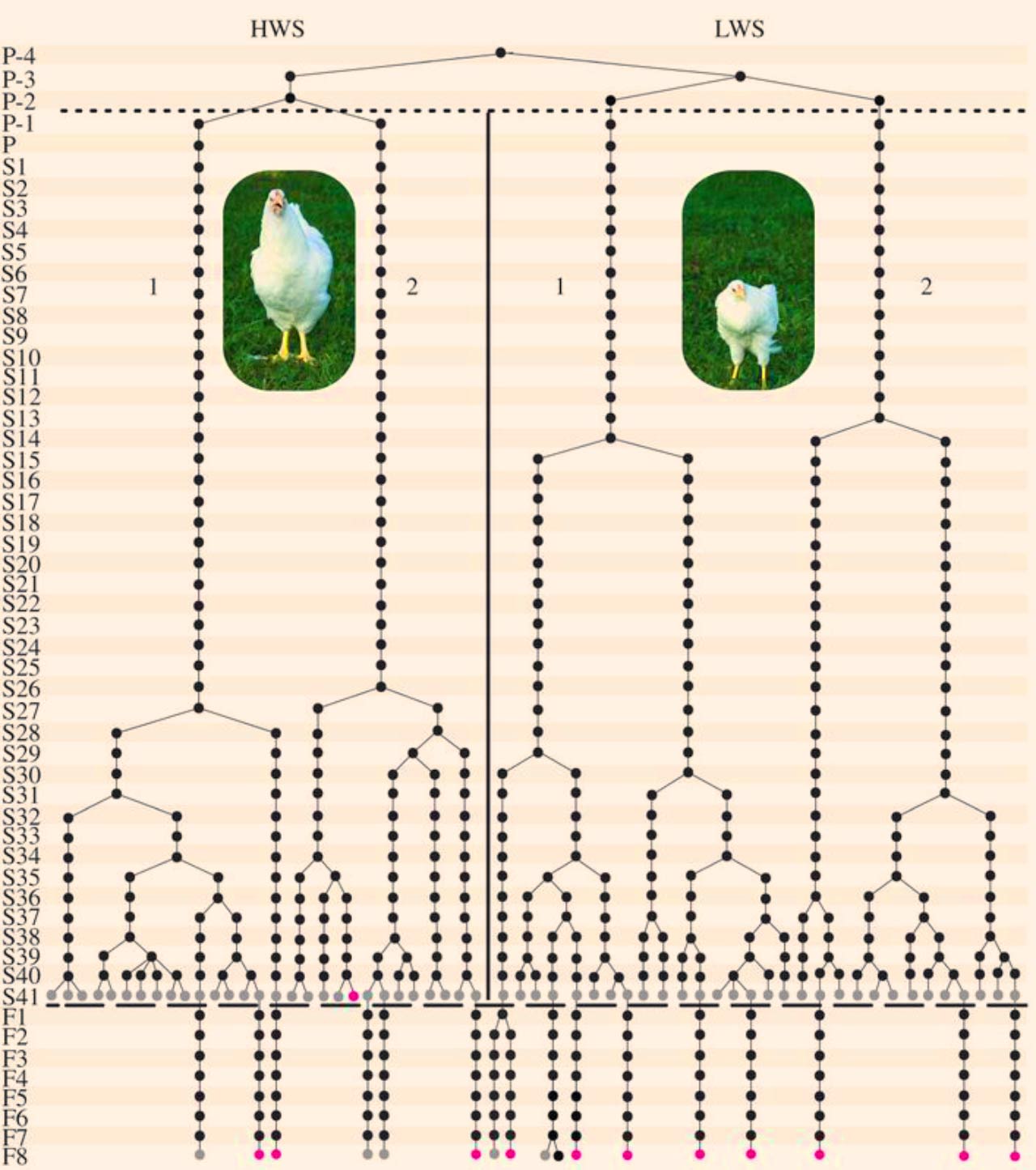
Chicken pedigree from which mitochondrial genomes were sequenced: overview of the maternal lineages of the chicken pedigree, comprising high weight selected (HWS) and low weight selected (LWS) lines; pink circles indicate individuals from which the scientists sequenced complete mitochondrial genomes and grey circles represent those that were typed for the mutations in CYTB and ND4L; black circles indicate individuals that were either not sampled or not successfully sampled; codes on the left-hand side refer to generations before (P) and after (S) the selection experiment began, and following the initiation of the inter-cross experiments (F); the numerals 1 and 2 level with the chicken figures refer to the two maternal lines present in the HWS and LWS, respectively. Image credit: Michelle Alexander et al.
One theory put forward in recent studies is that mitochondrial DNA evolves non-neutrally, that there is a purifying selection process and negative mutations are removed more quickly, resulting in the impression of a short-term elevation in rates.
There have been few studies of short-term mitochondrial evolution, including both mutation rates and paternal leakage. There is now direct evidence that it is not always inherited from the mother.
“The one thing everyone knew about mitochondria is that it is almost exclusively passed down the maternal line, but we identified chicks who inherited their mitochondria from their father, meaning the paternal leakage can happen in avian populations,” said co-author Dr Michelle Alexander, of the University of York.
“Both of these findings demonstrate the speed and dynamism of evolution when observed over short time periods.”
_____
Michelle Alexander et al. Mitogenomic analysis of a 50-generation chicken pedigree reveals a rapid rate of mitochondrial evolution and evidence for paternal mtDNA inheritance. Biology Letters, published online October 28, 2015; doi: 10.1098/rsbl.2015.0561