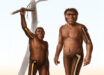
For decades, paleoanthropologists assumed that hominins — the lineage leading to modern humans — gradually grew larger over millions of years. New research led by the University of Reading complicates that picture considerably: the biggest jump in body size happened around 2 to 2.5 million years ago, with the appearance of Homo rudolfensis or Homo erectus/ergaster; Homo floresiensis and Homo naledi stayed small, with the early hominin Australopithecus weighing 40 kg, on average, and reaching the height of a child; other branches of Homo grew larger; Homo erectus/ergaster were the first hominins to weigh around 60 kg or more, on average, achieving weights similar to many modern humans.

A Homo heidelbergensis, a Neanderthal and a Cro-Magnon. Image credit: SINC / José Antonio Peñas.
Body size is central to organismal biology, influencing ecology, life history, physiology, and neuroanatomy.
In the context of hominin evolution, increases in body size have been linked to larger brains, improved bipedal locomotion, and expanded range sizes.
However, despite its importance, there is no consensus on whether hominin body size increased consistently over time.
Recent studies present conflicting views: some argue against a general evolutionary trend, while others support an overall increase in body mass and stature.
Small-bodied species like Homo floresiensis and Homo naledi are often cited as exceptions.
Additionally, some researchers suggest that size increases may be specific to Homo or later-occurring Homo.
However, a lineage-specific size shift has not been tested alongside a general trend in a single model.
“For years, different studies have come to different conclusions about whether our ancestors steadily grew bigger over time or jumped in size at some key point in our Homo ancestors,” said lead author Dr. Jacob Gardner, a researcher at the University of Reading.
“We think that’s because everyone was looking at slightly different pieces of a much bigger puzzle.”
“When you put all the fossils together, examine multiple competing ideas, and account for how species are related to each other, a clearer picture emerges. The answer is most likely a combination of these ideas.”
“The human story is not simply one of constant growth, but also of a major change that happened later, within our own genus, while other branches of the family, including some surprisingly small relatives, went their own way entirely.”
In the new study, Dr. Gardner and his colleagues analyzed body mass estimates from 386 fossil specimens spanning 21 hominin species, from ancient australopiths to Homo sapiens.
Using sophisticated statistical models that account for evolutionary relationships between species, they found that the story of human body size is far messier than a simple upward trend.
The clearest signal in the data points to a marked size increase specifically in later members of the genus Homo — roughly those appearing after Homo habilis — rather than a steady climb across all hominins throughout time.
Species like Homo ergaster and Homo erectus appear to represent a genuine size leap, one that coincides with other major evolutionary shifts including increased bipedality and carnivory.
A broader, gradual size increase across all hominins receives only moderate support, and largely depends on which fossil datasets and estimation methods are used — a recurring source of disagreement in the field.
Two species stand out as persistent exceptions: Homo floresiensis from Indonesia and Homo naledi from South Africa, both of which fall well below average body mass predictions for their time periods.
“Our results suggest that human body size evolution was not simply a story of steady growth over time,” said co-author Dr. Thomas Puschel, a researcher at the University of Oxford.
“Although body mass generally increased throughout our evolutionary history, the most significant shift occurred later within the genus Homo.”
“This change coincided with broader developments in how our ancestors moved across landscapes and exploited their environments, pointing to a close relationship between body size and major ecological and behavioral transitions.”
The findings were published today in the Proceedings of the National Academy of Sciences.
_____
Jacob D. Gardner et al. 2026. Competing models of hominin body size evolution. PNAS 123 (27): e2521732123; doi: 10.1073/pnas.2521732123