A newly-described partial skeleton from the Koobi Fora Formation in northern Kenya is giving paleoanthropologists their most complete picture yet of Homo habilis — one of the earliest members of the human genus — revealing just how physically distinct it was from later Homo species.
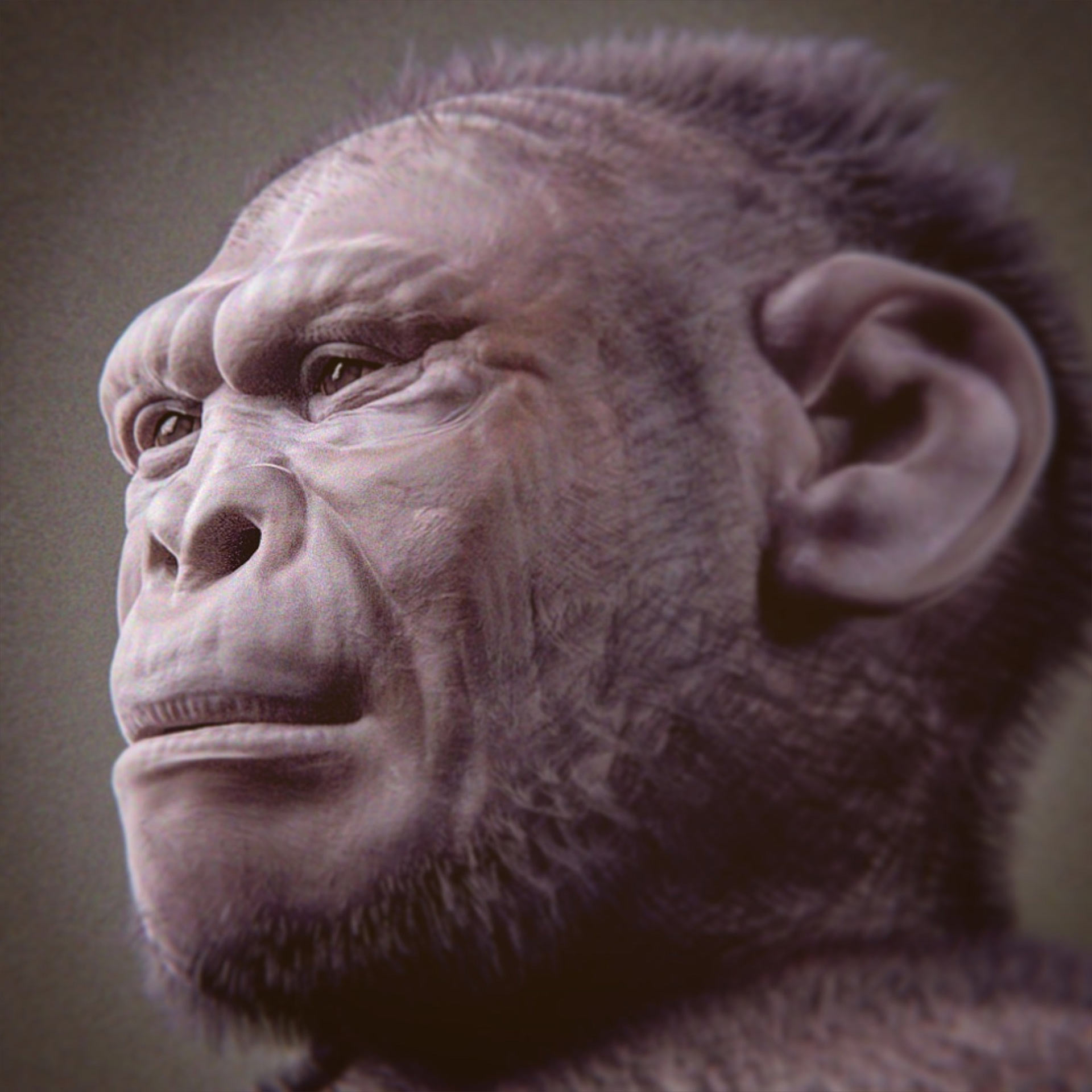
Facial reconstruction of Homo habilis. Image credit: Cicero Moraes.
Cataloged as KNM-ER 64061, the partial skeleton is the most complete ever attributed to Homo habilis.
Dating to about 2 million years ago, the fossil was recovered from the Upper Burgi Member of the Koobi Fora Formation near Ileret, Kenya.
The specimen was found in close association with a nearly complete set of teeth and jaw fragments, KNM-ER 64060, previously identified as belonging to Homo habilis.
Geological, taphonomic and geochemical analyses indicate that the teeth and postcranial bones almost certainly come from the same individual.
Together, the finds represent what the researchers describe as ‘possibly the fourth individual’ of Homo habilis known to preserve both diagnostic dental remains and associated postcranial bones, a combination that is exceedingly rare in the Early Pleistocene fossil record.
“Indeed, there are only three other very fragmentary and incomplete partial skeletons known for this important species,” said Stony Brook University’s Professor Fred Grine.
The KNM-ER 64061 skeleton includes both humeri, both radii and ulnae, parts of the shoulder girdle, fragments of the pelvis and sacrum, and other elements.
Although no leg bones were recovered, features of the pelvis suggest that lower-limb mechanics were more similar to later members of Homo than to earlier australopiths.
At the same time, the upper limbs tell a more primitive story. The forearm appears relatively long compared with the upper arm, a pattern known as a high brachial index, which aligns Homo habilis more closely with earlier hominins than with Homo erectus.
The arm bones also possess unusually thick cortical bone, resembling the condition seen in australopiths and other early Homo fossils.
Based on the length of the humerus, the scientists estimate that the individual stood about 1.6 m tall.
Estimated body mass, between about 30.7 and 32.7 kg, is lower than in other known Homo habilis specimens and markedly smaller than estimates for Homo erectus.
“Homo habilis upper limbs have been coming more and more into focus, and KNM-ER 64061 confirms that the arms were fairly long and strong,” said Dr. Ashley Hammond, a researcher at the American Museum of Natural History, the Institut Català de Paleontologia Miquel Crusafont at the Universitat Autònoma de Barcelona and the Institucio Catalana de Recerca i Estudis Avançats.
“What remains elusive is the lower limb build and proportions.”
“Going forward, we need lower limb fossils of Homo habilis, which may further change our perspective on this key species.”
The findings reinforce the view that Homo habilis retained a mosaic of ancestral and derived traits.
While aspects of the skeleton point toward more human-like locomotion, the overall body proportions and small size suggest that this early species had not yet acquired the tall, heavier-bodied form seen in later humans.
Between about 2.2 and 1.8 million years ago, eastern Africa was home to multiple hominin species, including Paranthropus boisei, Homo habilis, Homo rudolfensis and possibly early Homo erectus.
The new skeleton underscores that Homo habilis occupied a distinct place among them, both physically and evolutionarily.
“Insofar as they are known, the Homo habilis partial skeletons present a picture of postcranial anatomy that tends to differ from that of other members of our genus, with the caveat that the postcranial skeleton of Homo rudolfensis is currently unknown,” the authors said.
Their paper was published online on January 13, 2026 in The Anatomical Record.
_____
Frederick E. Grine et al. New partial skeleton of Homo habilis from the upper Burgi Member, Koobi Fora Formation, Ileret, Kenya. The Anatomical Record, published online January 13, 2026; doi: 10.1002/ar.70100