New research challenges conventional wisdom by demonstrating that mid-ocean ridges and continental rifts, not volcanic eruptions, played the central role in atmospheric carbon swings and long-term climate shifts throughout Earth’s geological past.
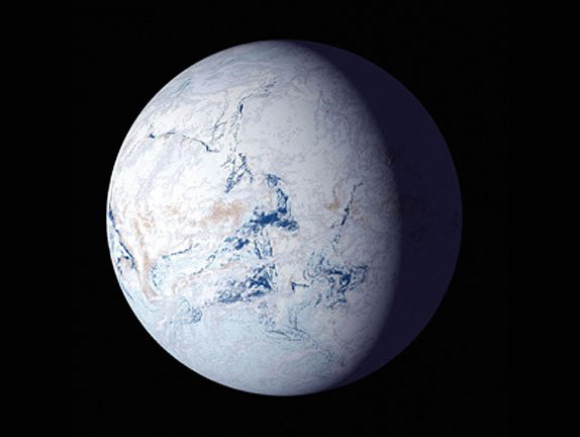
Cryogenian Earth. Image credit: NASA.
Earth’s climate has swung between extreme states several times over the past 540 million years, shifting from frigid icehouse conditions to much warmer greenhouse worlds.
Icehouse climates dominated during the Late Ordovician, the Late Paleozoic and the Cenozoic era.
Warmer periods coincided with higher concentrations of carbon dioxide in the atmosphere, while drops in the greenhouse gas were associated with global cooling and widespread glaciation.
In their study, University of Melbourne researcher Ben Mather and his colleagues reconstructed how carbon moved between volcanoes, oceans and deep within the Earth over the last 540 million years.
“Our findings challenge a long-held view that chains of volcanoes — formed by colliding tectonic plates — were the Earth’s main natural source of atmospheric carbon,” Dr. Mather said.
“Our findings show that carbon gas released from gaps and ridges deep under the ocean from moving tectonic plates was instead likely driving major shifts between icehouse and greenhouse climates for most of Earth’s history.”
“We found that carbon emitted from volcanoes, around the Pacific ring of fire for example, only became a major carbon source in the last 100 million years, which challenges current scientific understanding.”
The study provides the first clear long-term evidence that the global climate was shaped mainly by carbon released where tectonic plates pull apart, rather than where they collide.
“This new insight not only reshapes our understanding of past climates but also helps refine future climate models,” Dr. Mather said.
By pairing global plate tectonic reconstructions with carbon-cycle modeling, the team was able to trace how carbon was stored, released and recycled as continents shifted.
“Our study’s findings help explain key historical climate shifts, including the Late Paleozoic ice age, the warm Mesozoic greenhouse world, and the emergence of the modern Cenozoic icehouse, by showing how changes in carbon released from spreading plates shaped these long-term transitions to our climate,” said University of Sydney’s Professor Dietmar Müller.
The research also provides important context for our currently changing climate.
“This research adds to a large pool of evidence that the amount of carbon in the Earth’s atmosphere is a key trigger to cause major swings in climate,” Dr. Mather said.
“Understanding how Earth controlled its climate in the past highlights how unusual the present rate of change is.”
“Human activities are now releasing carbon far faster than any natural geological process that we’ve seen to have taken place before.”
“The climate scales are being tipped at an alarming rate.”
The findings appear in the journal Communications Earth & Environment.
_____
B.R. Mather et al. 2026. Carbon emissions along divergent plate boundaries modulate icehouse-greenhouse climates. Commun Earth Environ 7, 48; doi: 10.1038/s43247-025-03097-0