Paleontologists in North Dakota have unearthed a set of 66.5-million-year-old fossilized footprints that can be confidently attributed to a full-grown Tyrannosaurus rex.
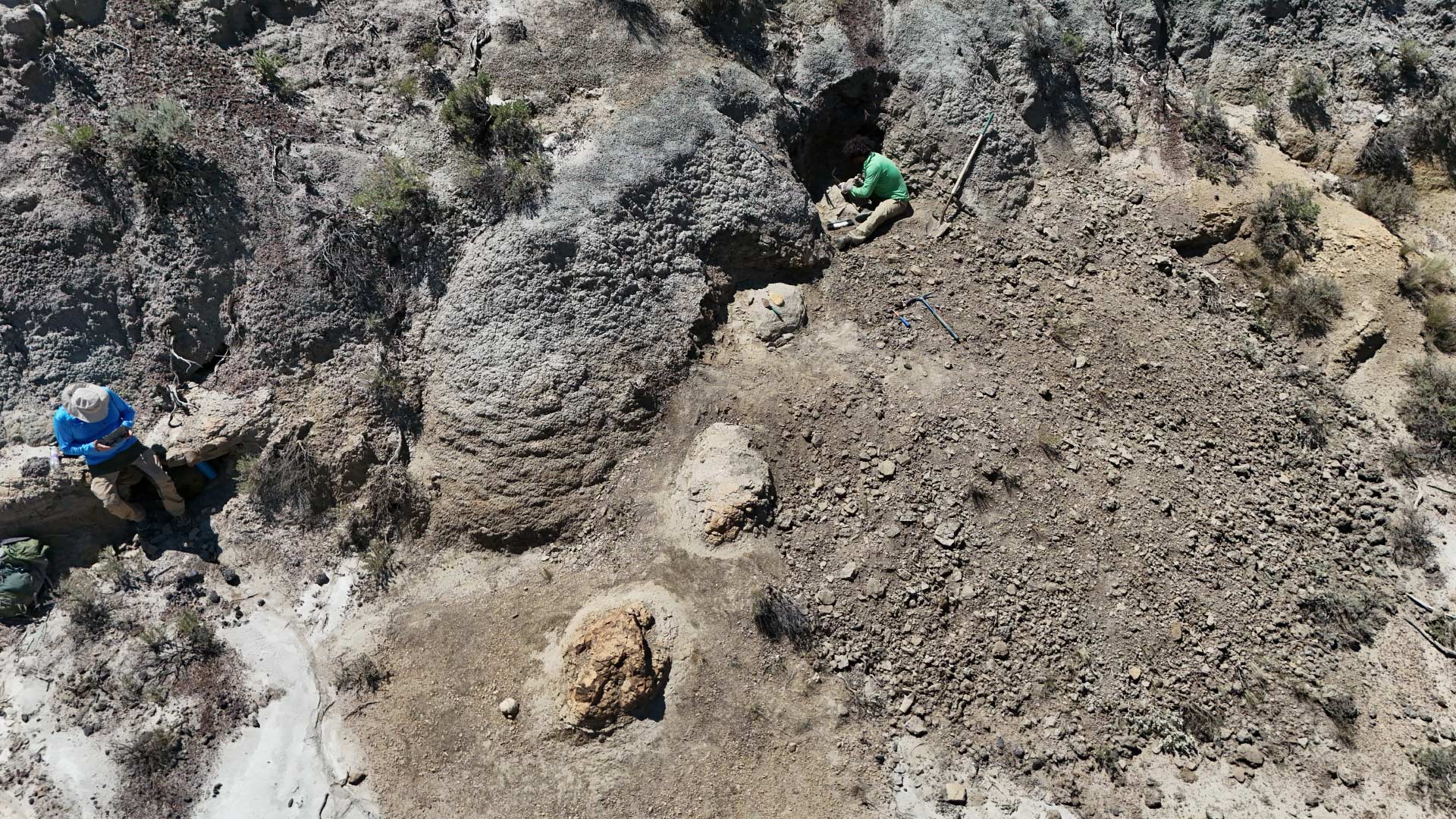
The Tyrannosaurus rex trackway in the Hell Creek Formation in North Dakota, the United States. Image credit: Kent Hups.
The newly discovered trackway is roughly 7 m (23 foot) long, and consists of four large, three-toed prints, each around 1 m (3.3 feet) in length.
It was discovered in 2025 in the Hell Creek Formation of southwestern North Dakota, the United States.
The site dates to about 66.5 million years ago (latest Cretaceous period), just before the asteroid impact that wiped out the dinosaurs.
“Bones tell us an enormous amount about these animals, but footprints capture a moment of behavior,” said Dr. Tyler Lyson, senior curator of vertebrate paleontology at the Denver Museum of Nature & Science.
“With a trackway, we can actually follow an animal as it moved across the landscape. That is incredibly rare for T. rex.”
Large theropod tracks are uncommon in the Hell Creek Formation, and trackways are especially rare.
While isolated tracks have previously been linked to tyrannosaurs, including one described in New Mexico in 1994 and another in Montana in 2008, none had recorded more than a single footprint from what paleontologists believed was a fully grown individual.
Other tyrannosaur trackways found in Canada and Wyoming were made by smaller animals — either younger Tyrannosaurus or related, smaller species.
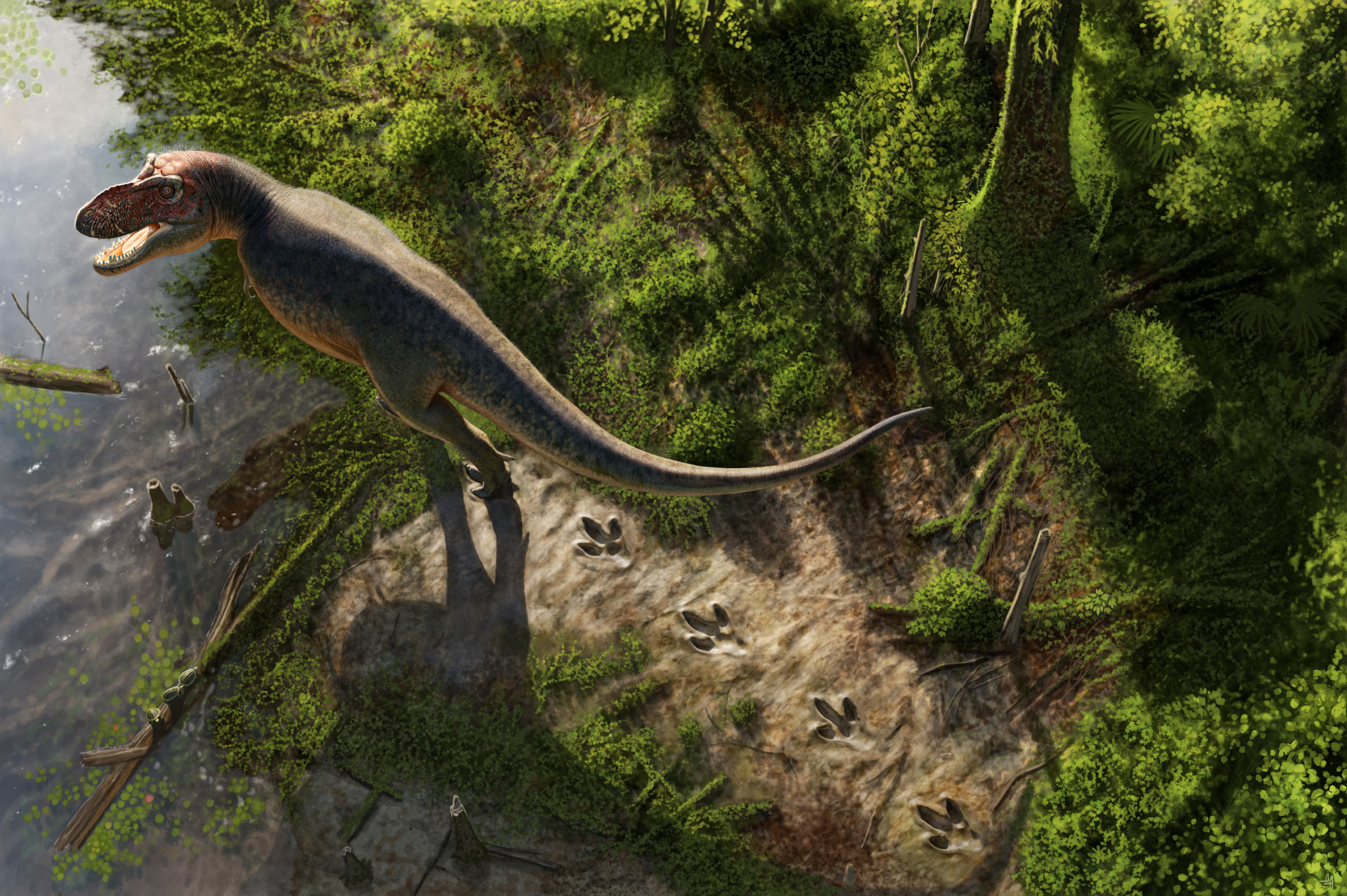
Walking Tyrannosaurus rex. Image credit: Andrey Atuchin.
The size of the Hell Creek footprints, combined with their shape, the narrow angle between the toe impressions, and the abundance of Tyrannosaurus rex bones already found in the surrounding rock, led the paleontologists to conclude that an adult Tyrannosaurus rex was the most likely trackmaker.
Based on the spacing between prints — a stride of roughly 4 m (13 feet) — the researchers estimated the animal was walking at about 1.5 to 2 m per second (3.4-4.5 mph), a pace consistent with other large theropod trackways.
The footprints themselves are preserved in an unusual way: as hardened, calcium-carbonate-cemented sandstone casts that formed around the original depressions left in soft, muddy overbank sediment.
Over time, erosion stripped away the softer surrounding rock, leaving the harder footprint casts exposed.
This process left the surfaces heavily fractured, and the prints retain little fine anatomical detail beyond their overall size and the number of toes.
“As a teacher, I’m always telling my students that science starts with curiosity, passion and careful observation,” said Kent Hups, a teacher at Northglenn High School who discovered the trackway.
“I never imagined that could lead me to a discovery like this.”
The findings were published this week in the Journal of Vertebrate Paleontology.
_____
Peter L. Falkingham et al. A large tridactyl trackway from the Upper Cretaceous Hell Creek Formation of North Dakota, likely attributable to an adult Tyrannosaurus rex. Journal of Vertebrate Paleontology, published online September 8, 2026; doi: 10.1080/02724634.2026.2706201