Paleontologists in Montana have discovered remarkably preserved feathers of an ancient aquatic bird inside a fossilized dinosaur dropping, offering rare insight into why certain birds survived the asteroid strike that wiped out the dinosaurs 66 million years ago.
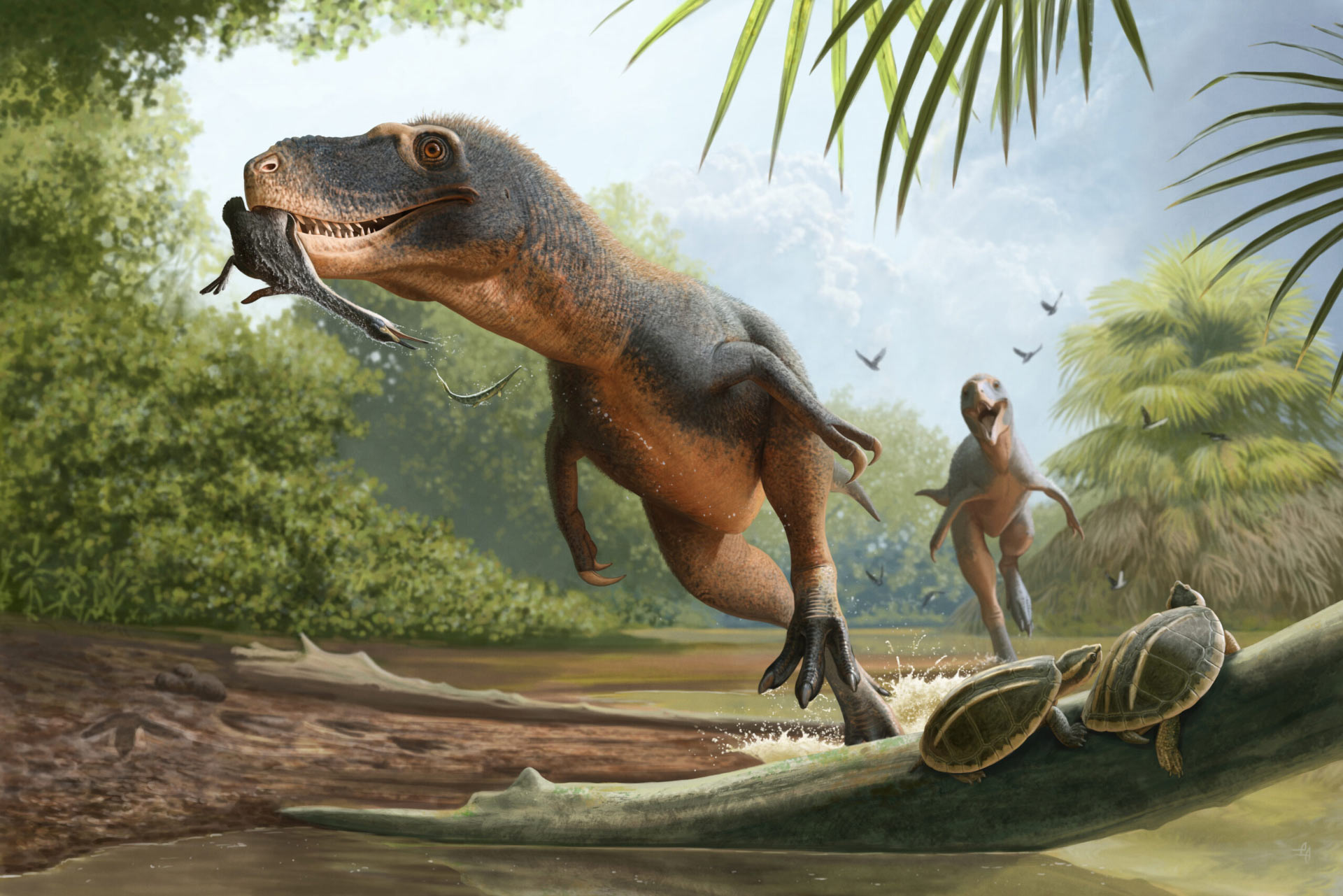
While some dinosaurs are thought to have had ‘fuzzy’ or ‘downy’ feathers (shown in this illustration as the yellow spikes on a Nanotyrannus’ neck), ancient birds (such as the one in the Nanotyrannus’ mouth) were more likely to have had feathers that look similar to the birds of today. Image credit: Andrey Atuchin.
“We rarely find fossils of birds and even more rarely their feathers, giving us such important insight into the evolution of this key aspect of their biology,” said Professor Gregory Wilson Mantilla, a researcher at the University of Washington and curator of vertebrate paleontology at the Burke Museum of Natural History and Culture.
“On top of that, these bird feathers found within a large fossilized dinosaur dung give us an incredible window into predator-prey interactions 66 million years ago.”
The coprolite was discovered in 2016 in the Hell Creek Formation of Montana by Burke Museum paleontologist David DeMar Jr.
The specimen was from a large predatory dinosaur, possibly a Tyrannosaurus rex or a Nanotyrannus.
It contained multiple feathers, fish scales from a gar, and bones from a hesperornithiform, an extinct, loon-like diving bird.
The researchers reasoned that the feathers must have also come from the same bird.
Crucially, these are the first hesperornithiform feathers ever identified, and they appear to represent an evolutionary middle ground — some feathers looked modern and waterproof, while others were smaller, fuzzy and primitive, resembling those of earlier dinosaurs.
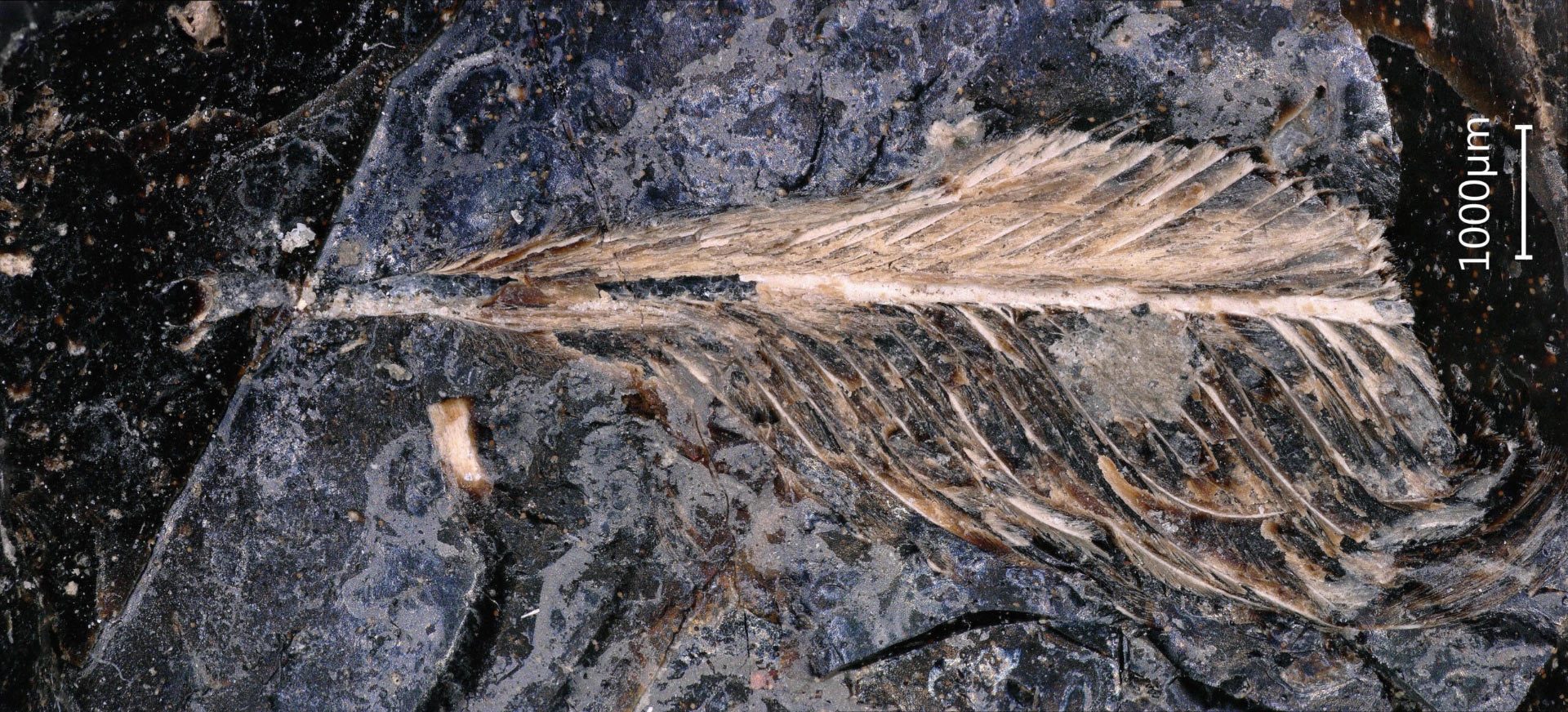
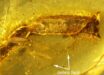
The fossilized feather of a hesperornithiform bird exposed on the surface of the 66-million-year-old coprolite. Image credit: O’Connor et al., doi: 10.1016/j.cub.2026.08.054.
“Two of the feathers, including the one exposed at the surface of the coprolite, have features found only in those of living birds — and their immediate ancestors,” Dr. DeMar said.
“This includes a square feather shaft with a sponge-like center. No other Mesozoic feather has this combination of features.”
“The next oldest record of this sponge-like center is from the Early Eocene of Denmark, which is about 10 million years younger than this new feather record from the Hell Creek Formation.”
The hesperornithiforms are close cousins of the birds that survived the end-Cretaceous mass extinction and still live today.
Some paleontologists have hypothesized that the birds that survived did so because they lived near water, and something about this habitat helped buffer them from the effects of the mass extinction.
But the hesperornithiforms also lived by water, and they went extinct.
“We think the types of feathers that these birds had, and/or the way they molted those feathers, may have been one of the underlying causes of the selectivity of the end-Cretaceous mass extinction — essentially, why some birds died out and why others survived,” said Dr. Jingmai O’Connor, associate curator of fossil reptiles at the Field Museum.
“Some of these diving birds’ feathers seem to have been modern-looking and waterproof, but they also had some smaller fuzzy, primitive body feathers that we associate with dinosaurs.”
The team’s paper was published today in the journal Current Biology.
_____
Jingmai K. O’Connor et al. Bird feathers from a Late Cretaceous coprolite. Current Biology, published online September 10, 2026; doi: 10.1016/j.cub.2026.08.054