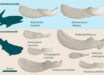
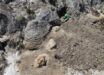
Nanotyrannus lancensis — long thought by many to be a teenage Tyrannosaurus rex — was in fact a fully mature, distinct species of smaller tyrannosaurid, according to a team of U.S. paleontologists who analyzed the ceratobranchial (hyoid bone) of Nanotyrannus lancensis and revealed a record of development.
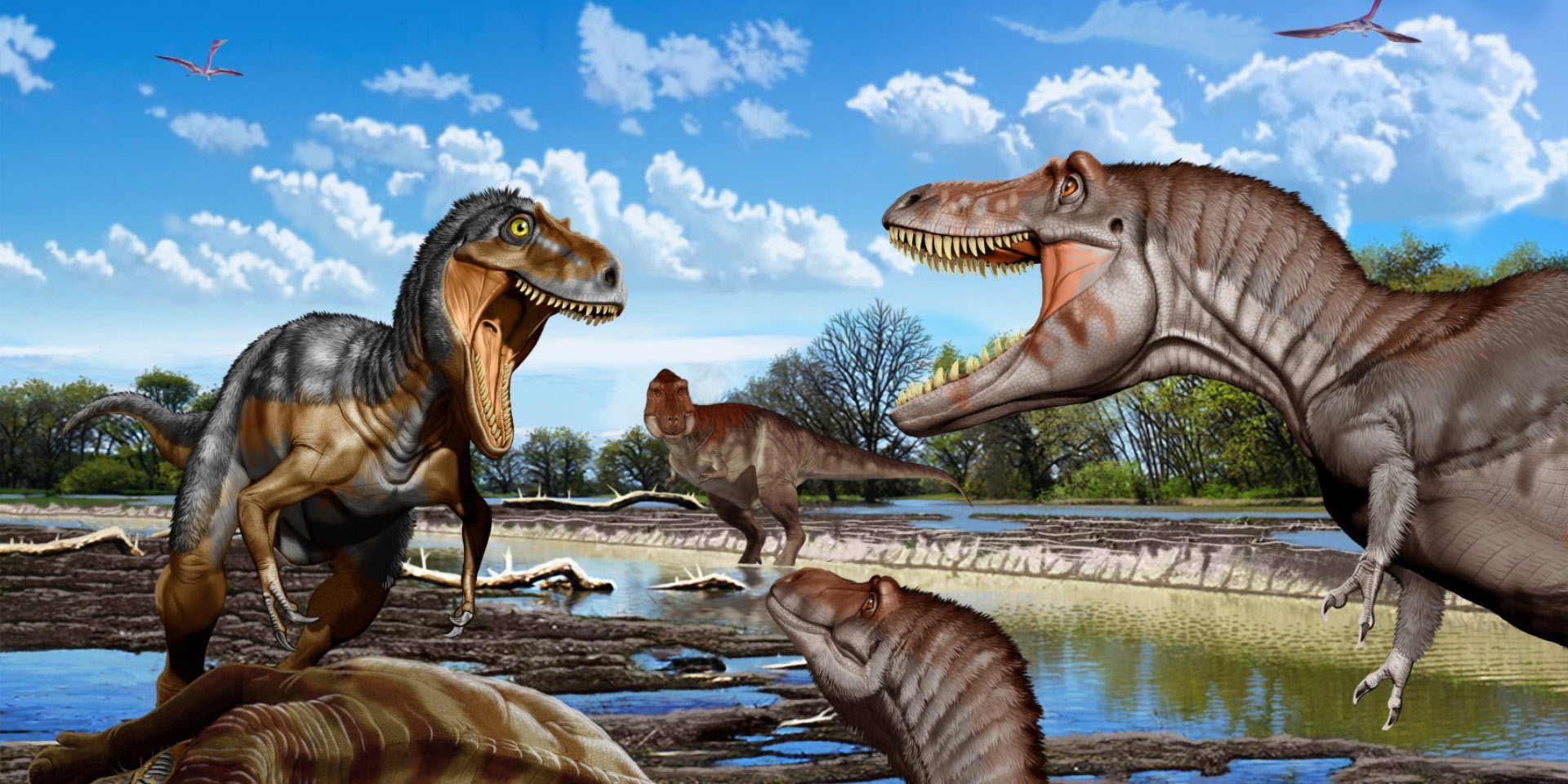
A Late Cretaceous face-off between an adult Nanotyrannus lancensis (left) and two juvenile Tyrannosaurus rex, with a sub-adult Tyrannosaurus rex watching from a distance. Image credit: Jorge Gonzalez.
Nanotyrannus lancensis stood 5.5 m (18 feet) tall, diminutive compared to a length of more than 12 m (40 feet) for Tyrannosaurus rex.
Discovered in 1942, the holotype of Nanotyrannus lancensis was originally classified as Gorgosaurus but was reidentified as a distinct species in 1988 after further scientific work.
This decades-long debate has persisted largely because the holotype exists as an isolated skull, and traditional maturity assessments are often based on limb bones.
Until recently, previous studies on other, more complete fossils thought to belong to Nanotyrannus lancensis have produced conflicting results.
In new research, Princeton University paleontologist Christopher Griffin and his colleagues tested whether the microscopic structure of a small throat bone, the ceratobranchial, can be used to reliably indicate age and skeletal maturity in fossil remains.
“At the time, the prevailing consensus was that the Nanotyrannus holotype skull represented an immature Tyrannosaurus rex, and was not a separate species,” Dr. Griffin said.
“Our expectations were simply following along with that consensus, but once we sampled the hyoid and saw features that strongly indicated maturity, we knew that we had to examine that idea more skeptically.”
The researchers found that, in both living archosaur species (i.e., ostrich and crocodilians) and extinct theropods, the ceratobranchial bone preserves clear signals of growth and maturity, making them valuable for determining developmental stage, especially in fully mature individuals.
Applying this method to the controversial Nanotyrannus lancensis holotype, they examined three sections of its ceratobranchial and discovered several hallmarks of near-complete or complete skeletal maturity.
This suggests that Nanotyrannus lancensis is a taxonomically distinct species that coexisted with Tyrannosaurus rex, implying a greater predatory diversity in Late Cretaceous ecosystems than previously recognized.
“This small-bodied — in relation to Tyrannosaurus rex — meat-eater’s hyoid bone showed growth patterns that suggest maturity or approaching maturity,” said University of Nebraska State Museum paleontologist Ashley Poust.
“This lets us be confident in keeping the name Nanotyrannus, because this animal is clearly not on a growth path to becoming a Tyrannosaurus rex.”
“You’re left with at least two different sized meat eaters in the same environment, which has some big implications for ecology and the extinction of dinosaurs,” he added.
“Knowing more about what existed gives us a sense of how big the fossil record is and how species change through time.”
“And understanding the complexities of an ecosystem is important.”
The results appear in the journal Science.
_____
Christopher T. Griffin et al. A diminutive tyrannosaur lived alongside Tyrannosaurus rex. Science, published online December 4, 2025; doi: 10.1126/science.adx8706