Paleontologists have performed a comprehensive anatomical reassessment of the fossilized remains of two coelurosaurian theropod dinosaurs from the Early Cretaceous of South America: Santanaraptor placidus and Mirischia asymmetrica.
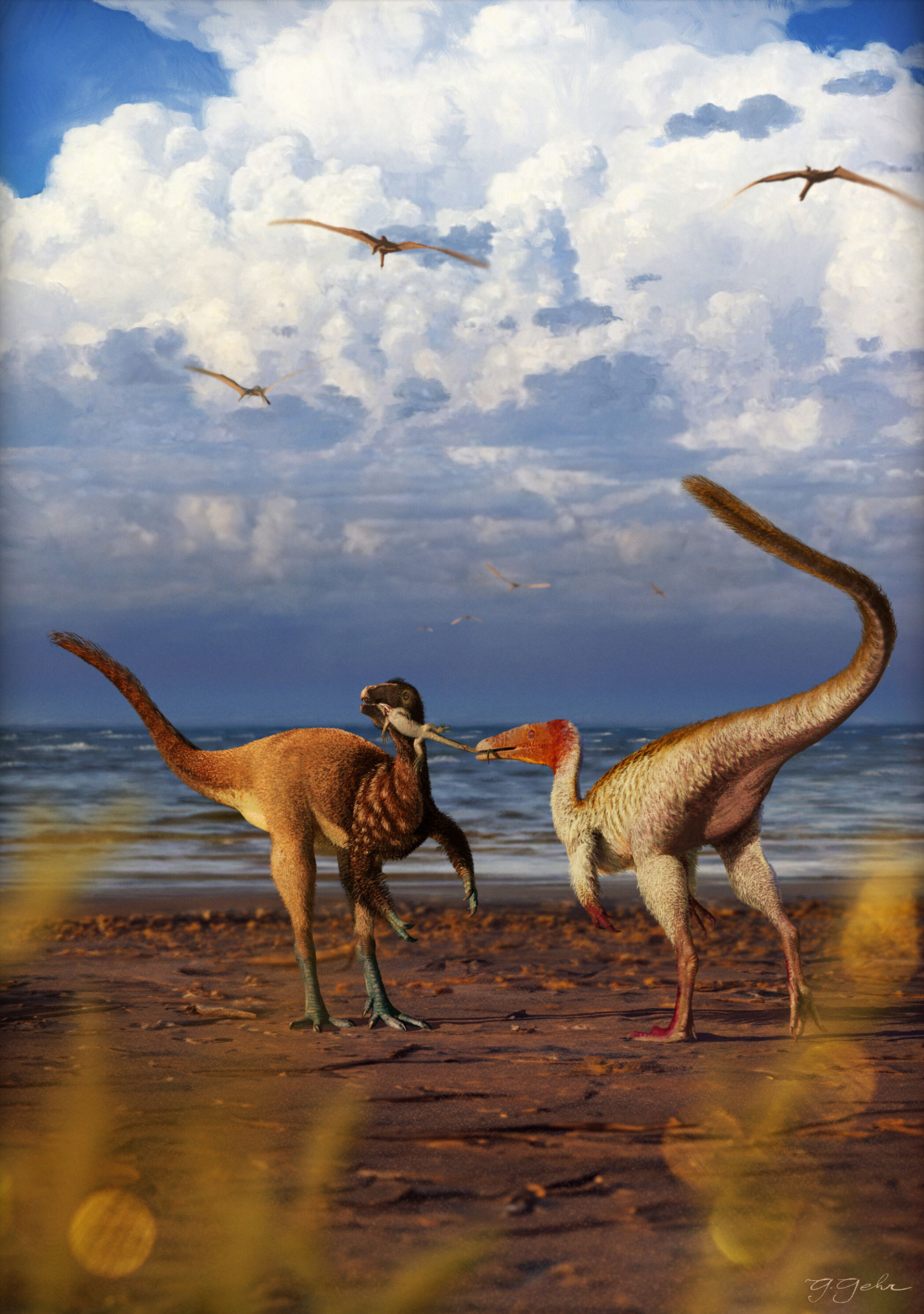
Hypothetical reconstruction of Mirischia asymmetrica (left) and Santanaraptor placidus (right) disputing a lizard in what is now northeastern Brazil approximately 112 million years ago. Image credit: Guilherme Gehr.
Santanaraptor placidus and Mirischia asymmetrica lived in what is now Brazil during the Early Cretaceous epoch, some 112 million years ago.
The holotypes of these coelurosaur species were discovered in the Romualdo Formation in 1996 and 2000, respectively.
“The Romualdo Formation is a world-famous Early Cretaceous fossil Konservat Lagerstätte that crops out along the margins of the Araripe Plateau, in northwestern Brazil,” said Dr. Rafael Delcourt from the Universidade de São Paulo and colleagues.
“Its macrofossil record includes one of the most diverse and well-preserved ichthyofaunas of the Mesozoic, as well as plants, invertebrates, turtles, crocodilians, pterosaurs, and theropod dinosaurs.”
“Spinosaurs are arguably the best-known Romualdo theropods, with many referred specimens, including the well-preserved skull of Irritator challenger and the snout of Angaturama limai.”
“Among coelurosaurs, Santanaraptor placidus and Mirischia asymmetrica come from the same deposits that yielded the spinosaurs, that is, the better-known upper carbonate concretion levels of the Romualdo Formation.”
In the new research, Dr. Delcourt and his co-authors from Brazil, Argentina and Germany revised and compared the anatomy of Santanaraptor placidus and Mirischia asymmetrica, with the goal of investigating their phylogenetic affinities and possible synonymy.
Their analysis places both species in a group of early branching maniraptoromorph dinosaurs, along with Juratyrant langhami and Tanycolagreus topwilsoni from the Late Jurassic of Laurasia, suggesting an early diversification of coelurosaurs in the area.
Despite the minor overlapping of skeletal elements, they have anatomical differences that support their recognition as distinct species.
“The clade containing Juratyrant langhami, Mirischia asymmetrica, Tanycolagreus topwilsoni, and Santanaraptor placidus appears to trace back at least to the Late Jurassic of Laurasia, prior to the opening of the Apulian route, which allowed faunal exchange during the Early Cretaceous,” the paleontologists said.
“In fact, several coelurosaur groups occur in both Laurasia and Gondwana at the time, including Megaraptora, as well as branches of Ornithomimosauria, Alvarezsauridae, and Dromaeosauridae.”
“Our phylogenetic proposal better matches the available biogeographical data than those nesting the Romualdo coelurosaurs to the mostly Laurasian Compsognathidae and Tyrannosauroidea.”
“Yet, further research, including more extensive field work, is needed to untangle the early radiation of coelurosaurs, including the affinity of the Romualdo forms.”
A paper on the findings was published November 18, 2025 in The Anatomical Record.
_____
Rafael Delcourt et al. The coelurosaur theropods of the Romualdo Formation, Early Cretaceous (Aptian) of Brazil: Santanaraptor placidus meets Mirischia asymmetrica. The Anatomical Record, published online November 18, 2025; doi: 10.1002/ar.70085