For more than 165 years, one of the earliest giants to rise above Earth’s barren land has defied classification. Known as Prototaxites, the towering, column-like organism dominated terrestrial landscapes more than 400 million years ago, reaching heights of up to 8 m (26 feet) long before trees evolved. A new study by paleontologists from the University of Edinburgh and National Museums Scotland argues that this enigmatic organism was not a massive fungus, as many scientists have believed, but belonged instead to an entirely extinct lineage of complex life.
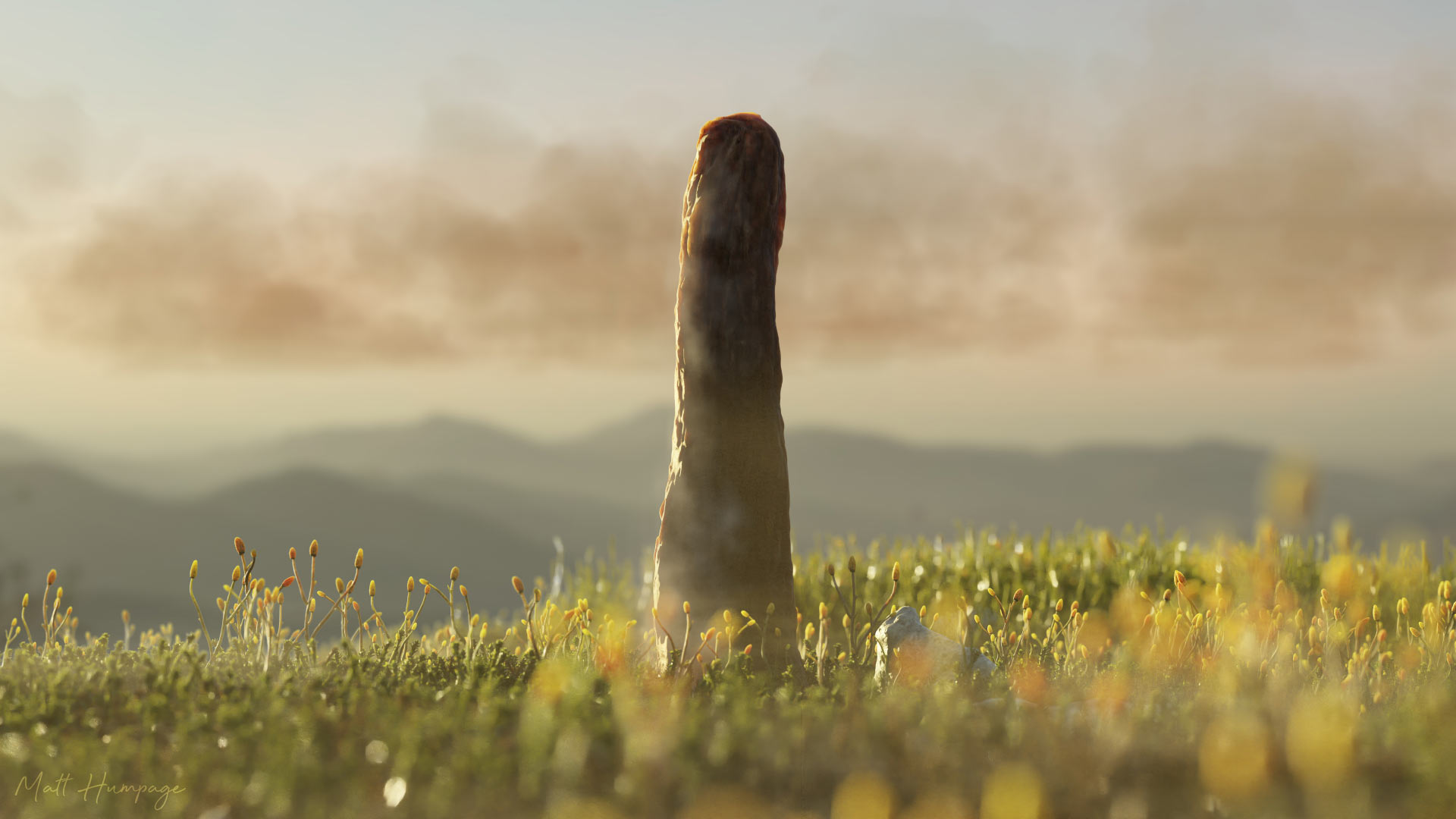
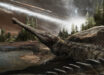
Prototaxites was the largest organism on land 410 million years ago. Image credit: Matt Humpage.
Prototaxites was the first giant organism to inhabit Earth’s terrestrial surface, appearing during the Late Silurian and Devonian periods, roughly 420 to 370 million years ago.
Known from columnar fossils that could reach up to 8 m in length, it dominated early land ecosystems long before the rise of trees.
Widespread in ancient terrestrial environments and evidently consumed by arthropods, Prototaxites played a significant ecological role during a pivotal phase in the colonization of land.
Yet despite more than 165 years of study, its biological identity has remained unresolved, with paleontologists debating whether it was a fungus or a member of an entirely extinct lineage of complex eukaryotic life.
In the new study, Dr. Corentin Loron and colleagues focused on Prototaxites taiti, a species preserved in exceptional three-dimensional detail in the 407-million-year-old Rhynie chert in Aberdeenshire, Scotland.
“The Rhynie chert is incredible,” said Dr. Loron, first author of the study published this week in the journal Science Advances.
“It is one of the world’s oldest fossilized terrestrial ecosystems and because of the quality of preservation and the diversity of its organisms, we can pioneer novel approaches such as machine learning on fossil molecular data.”
“There is a lot of other material from the Rhynie chert already in museum collections for comparative studies, which can add important context to scientific results.”
The researchers examined a new specimen of Prototaxites taiti — that is the largest known example of the species from the site — allowing for detailed anatomical and molecular comparisons with fossil fungi preserved in the same rock.
Microscopic imaging revealed a complex internal organization unlike that of any known fungus.
The fossil is composed of three distinct types of tubes, including large, thick-walled tubes with annular banding and dense spherical regions known as medullary spots.
These spots consist of intricate three-dimensional networks of interconnected tubes, a branching pattern that the scientists argue has no parallel in fungal biology.
Using infrared spectroscopy and machine-learning-based classification, the authors compared the molecular fingerprint of Prototaxites with that of fossil fungi, arthropods, plants and bacteria from the Rhynie chert.
Fungal fossils from the site preserve characteristic chemical signatures associated with chitin-rich cell walls, but these signatures were absent in Prototaxites.
The team also searched for perylene, a biomarker linked to pigment compounds produced by certain fungi and previously detected in other Rhynie chert fossils. The compound was not found in Prototaxites samples.
Taken together, the structural, chemical and biomarker evidence undermines the idea that Prototaxites belonged to any fungal group, including early or stem relatives of modern fungi.
“It’s really exciting to make a major step forward in the debate over Prototaxites, which has been going on for around 165 years,” said Dr. Sandy Hetherington, senior author of the paper.
“They are life, but not as we now know it, displaying anatomical and chemical characteristics distinct from fungal or plant life, and therefore belonging to an entirely extinct evolutionary branch of life.”
“Our study, combining analyzing the chemistry and anatomy of this fossil, demonstrates that Prototaxites cannot be placed within the fungal group,” said Laura Cooper, co-author of the paper.
“As previous researchers have excluded Prototaxites from other groups of large complex life, we concluded that Prototaxites belonged to a separate and now entirely extinct lineage of complex life.”
“Prototaxites therefore represents an independent experiment that life made in building large, complex organisms, which we can only know about through exceptionally preserved fossils.”
_____
Corentin C. Loron et al. 2026. Prototaxites fossils are structurally and chemically distinct from extinct and extant Fungi. Science Advances 12 (4); doi: 10.1126/sciadv.aec6277