This gum-like material — never seen before in space — was likely formed in the early days of the Solar System, as Bennu’s parent asteroid warmed. Once soft and flexible, but since hardened, the ancient ‘space gum’ consists of polymer-like materials extremely rich in nitrogen and oxygen. Such complex molecules could have provided some of the chemical precursors that helped trigger life on Earth, and finding them in the pristine samples from Bennu is important for scientists studying how life began and whether it exists beyond our planet.
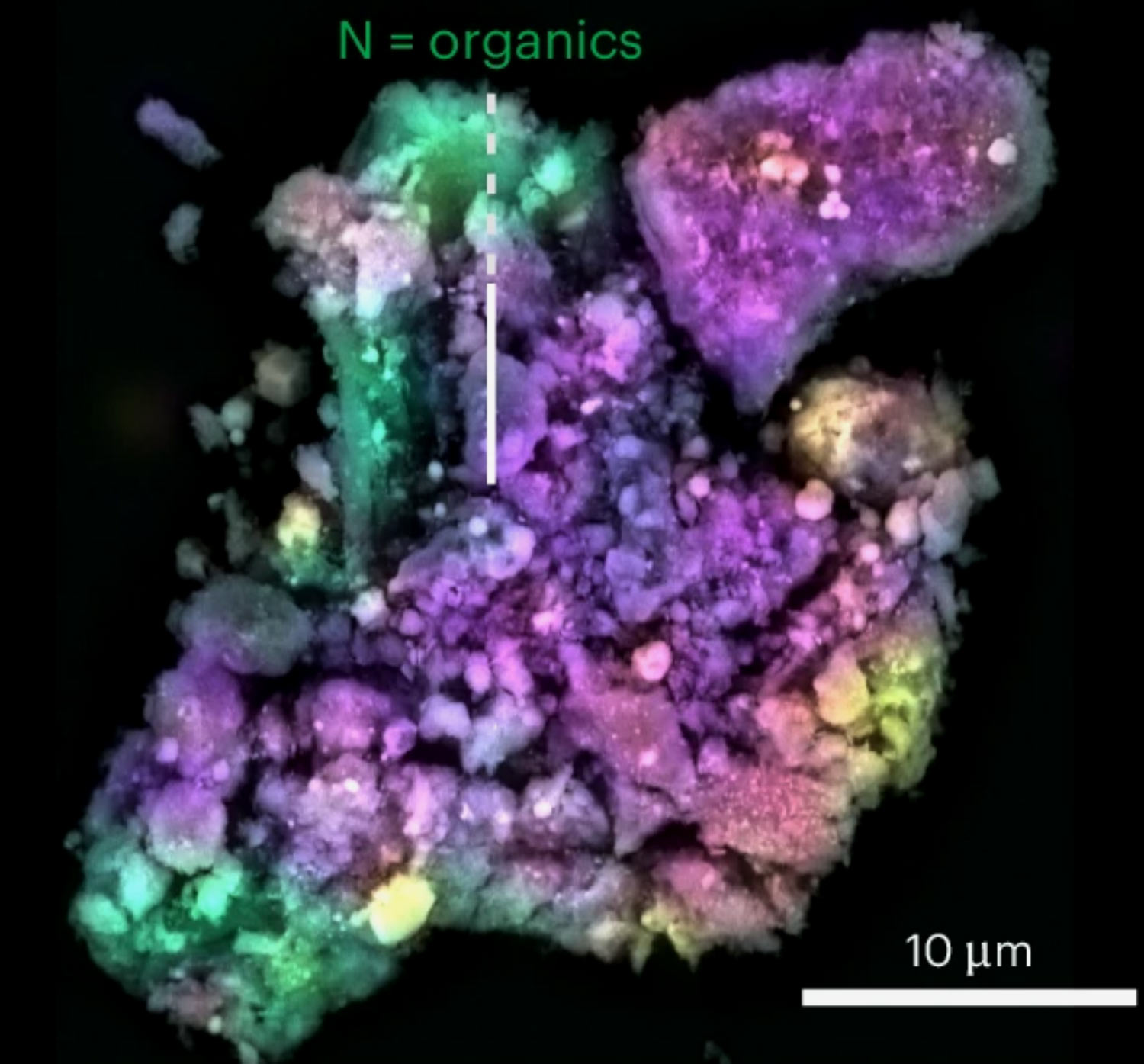
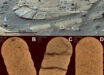
Electron microscopy of a particle from the sample from Bennu. Image credit: Sandford et al., doi: 10.1038/s41550-025-02694-5.
Bennu’s ancestral asteroid formed from materials in the Solar Nebula — the rotating cloud of gas and dust that gave rise to the Solar System — and contained a variety of minerals and ices.
As the asteroid began to warm, due to natural radiation, a compound called carbamate formed through a process involving ammonia and carbon dioxide.
Carbamate is water soluble, but it survived long enough to polymerize, reacting with itself and other molecules to form larger and more complex chains impervious to water.
This suggests that it formed before the parent body warmed enough to become a watery environment.
“With this strange substance, we’re looking at, quite possibly, one of the earliest alterations of materials that occurred in this rock,” said Dr. Scott Sandford, a researcher at NASA’s Ames Research Center.
“On this primitive asteroid that formed in the early days of the Solar System, we’re looking at events near the beginning of the beginning.”
In the study, the authors examined the characteristics of Bennu’s gum-like material.
As the details emerged, the evidence suggested the substance had been deposited in layers on grains of ice and minerals present in the asteroid.
It was also flexible — a pliable material, similar to used gum or even a soft plastic.
Indeed, during their work with the samples, the researchers noticed the strange material was bendy and dimpled when pressure was applied.
The stuff was translucent, and exposure to radiation made it brittle, like a lawn chair left too many seasons in the Sun.
“Looking at its chemical makeup, we see the same kinds of chemical groups that occur in polyurethane on Earth, making this material from Bennu something akin to a ‘space plastic’,” Dr. Sandford said.
“The ancient asteroid stuff isn’t simply polyurethane, though, which is an orderly polymer.”
“This one has more random, hodgepodge connections and a composition of elements that differs from particle to particle.”
The team’s findings were published December 2, 2025 in the journal Nature Astronomy.
_____
S.A. Sandford et al. Nitrogen- and oxygen-rich organic material indicative of polymerization in pre-aqueous cryochemistry on Bennu’s parent body. Nat Astron, published online December 2, 2025; doi: 10.1038/s41550-025-02694-5