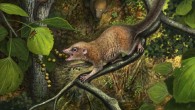
The newly-discovered minuscule fossils of Purgatorius — a shrew-sized mammal considered the earliest known relative of all primates, including humans,...
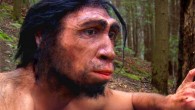
A research team led by Max Planck Institute for Evolutionary Anthropology scientists has generated the high-quality genome assembly of a Denisovan using...
Paleoanthropologists have examined and reconstructed DAN5, a 1.5-million-year-old fossilized skull of early Homo erectus found in Gona in the Afar region...
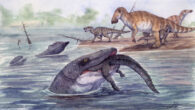
Paleontologists have unearthed a 66-million-year-old mosasaurine tooth in the Hell Creek Formation in North Dakota, the United States. This discovery adds...
In 2009, paleoanthropologists found eight bones from the foot of an ancient human ancestor in 3.4-million-year-old sediments at the paleontological site...
Paleontologists have uncovered the fossilized lower right canine of a large proborhyaenid sparassodont in the Taubaté Basin of Brazil.
The right lower...
Several hominids — Australopithecus africanus, Paranthropus robustus, early Homo sp., Gigantopithecus blacki, Pongo sp., Papio sp., Homo neanderthalensis,...
Platysomus parvulus, a species of ray-finned fish that lived 310 million years ago, had a unique way of eating never seen in ray-finned fish from that...
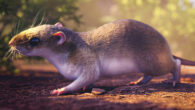
Paleontologists have identified a new species of rodent in Acarechimys, an extinct genus with a widespread South American distribution, from a partial...
The atmosphere of Earth during the Mesozoic era, between 252 and 66 million years ago, contained far more carbon dioxide than it does today and total photosynthesis...
Archaeologists from University College London and elsewhere have examined a molar tooth of a female Bos taurus (cow) discovered at Stonehenge.
Stonehenge....
New hominin fossils recovered from the Ledi-Geraru Research Project area in the Afar region of Ethiopia suggest the presence of early Homo at 2.78 and...
During the Paleocene-Eocene Thermal Maximum (PETM), a period of geological rapid warming and aridification approximately 56 million years ago, a flesh-eating...
Paleontologists have retrieved ancient enamel protein sequences from a fossilized tooth of Epiaceratherium sp., a rhinocerotid that lived in Canada’s...
Paleontologists have discovered protein sequences within dense enamel tissues of ancient rhinocerotid and proboscidean fossils collected at sites of Buluk...
Most megafaunal herbivores in the Americas went extinct around 10,000 years ago, presumably disrupting the long-distance seed dispersal of large, fleshy-fruited...
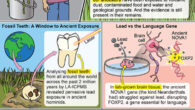
Paranthropus robustus is a well-documented hominin species with no genetic evidence reported so far. It lived between 2 million and 1.2 million years ago...