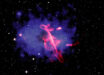
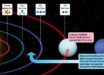
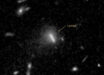
The Vela Junior supernova, also known as RX J0852.0-4622 or G266.2-1.2, exploded a few thousand years ago, leaving behind a glowing nebula, but scientists couldn’t answer just how far away it was and how big the explosion was. That has changed with the discovery of a still-forming star, Ve 7-27. Using the Multi Unit Spectroscopic Explorer (MUSE) instrument on ESO’s Very Large Telescope, astronomers have now captured the first detailed image of Ve 7-27.
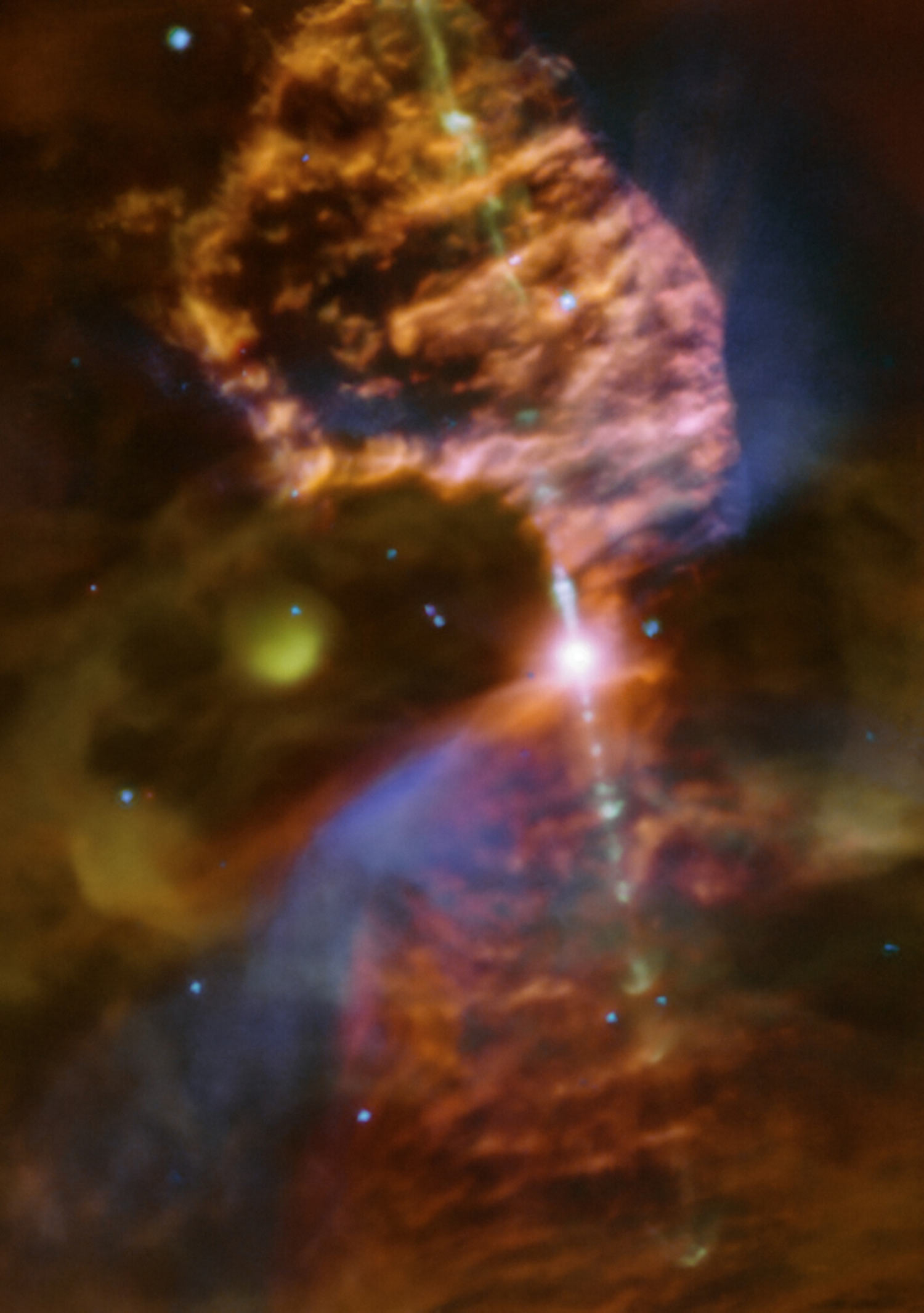
This VLT/MUSE image shows Ve 7-27. Image credit: ESO / Suherli et al.
“This is the first-ever proof linking a newborn star to the remains of a supernova,” said Dr. Samar Safi-Harb, an astrophysicist at the University of Manitoba.
“It allows us to settle a decades-long debate and determine how far away Vela Junior is, how big it is, and how powerful the explosion really was.”
By analyzing gas flowing out of Ve 7-27, Dr. Safi-Harb and colleagues discovered it carries the same chemical fingerprint as material from the Vela Junior supernova.
That match confirms that the two objects are physically connected, allowing the astronomers to finally pin down Vela Junior’s distance.
Since Ve 7-27 is known to be approximately 4,500 light-years away, so is Vela Junior.
“The gas we’re seeing in this young star carries the same chemical signature as the star that exploded long ago,” Dr. Safi-Harb said.
“It’s kind of poetic, those same elements eventually made their way to Earth, and now we’re watching them help form a new star.”
The findings show that Vela Junior is larger, more energetic, and expanding faster than scientists previously believed, placing it among the more powerful supernova remnants in our Galaxy.
“A star is layered, like an onion,” Dr. Safi-Harb said.
“When it explodes, those layers are scattered into space.”
“What we’ve found is that those layers are now turning up in the jet of a baby star nearby.”
“Beyond solving a long-standing astronomical puzzle, the research offers new insight into how stars evolve, how galaxies are enriched with elements, and how extreme cosmic events continue to shape the Universe to this day.”
The study was published today in the Astrophysical Journal Letters.