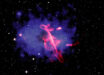
A team of Webb astronomers has released an absolutely beautiful image taken by the NASA/ESA/CSA James Webb Space Telescope of MACS J1149.5+2223 (MACS J1149 for short), an assembly of hundreds of galaxies residing some 5 billion light-years from Earth in the constellation of Leo. The new image reveals not just the cluster’s luminous galaxies, but also the extraordinary ways their immense gravity affects the fabric of spacetime itself.
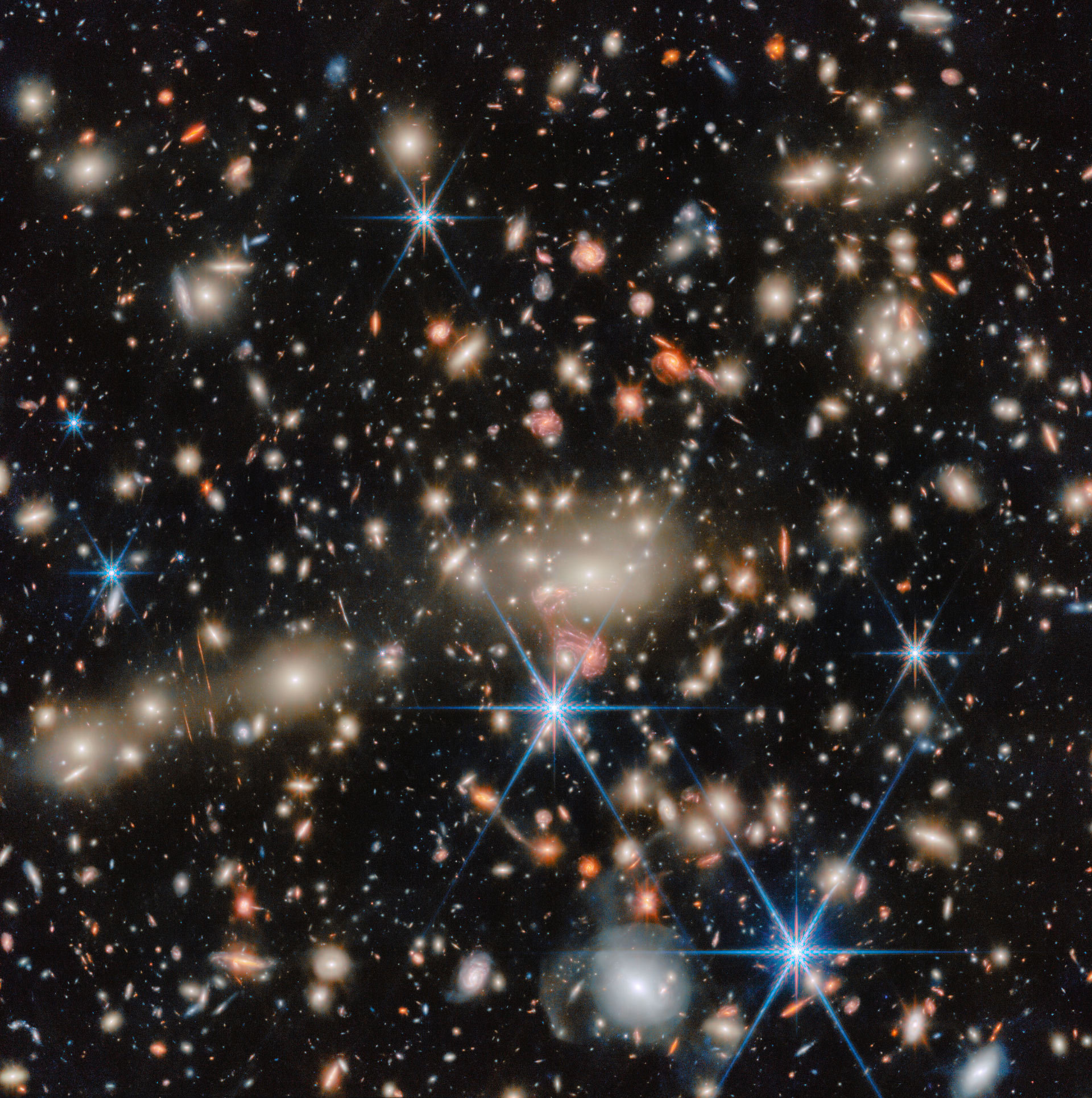
This Webb image shows the galaxy cluster MACS J1149.5+2223. Image credit: NASA / ESA / CSA / Webb / C. Willott, National Research Council Canada / R. Tripodi, INAF-Astronomical Observatory of Rome.
In the new Webb image of MACS J1149, light from background galaxies is dramatically bent and magnified in a phenomenon known as gravitational lensing, creating elongated arcs and warped shapes that testify to both the cluster’s mass.
“The crushing gravity of this cluster does more than just hold all the galaxies together as they drift through space,” the Webb astronomers said in a statement.
“As light from galaxies located behind the cluster makes its way toward our telescope, journeying for billions of years, its path through spacetime is bent by the mass of the intervening galaxies.”
“This phenomenon is called gravitational lensing, and the result is evident in this image of MACS J1149; scattered across the image are subtle and not-so-subtle examples of gravitational lensing, from galaxies that appear to have been stretched into narrow streaks of light to galaxy images that have morphed into strange shapes.”
“A fantastic example of gravitational lensing can be seen near the center of the image, just below the brilliant white galaxies at the heart of the cluster,” they added.
“There, the image of a galaxy with distinct spiral arms has been stretched into something resembling a pink jellyfish.”
“This tangled-looking galaxy is home to what was once the most distant single star ever discovered as well as a supernova whose image appeared four times at once.”
This image of MACS J1149 was captured as part of the CAnadian NIRISS Unbiased Cluster Survey (CANUCS) program.
“This program uses Webb’s sensitive instruments to unveil the evolution of low-mass galaxies in the early Universe, revealing their star formation, dust and chemistry,” the astronomers said.
“These data will also help researchers study the epoch of reionization, when the first stars and galaxies lit up the Universe, map the distribution of mass within galaxy clusters, and understand how star formation can slow to a trickle in a cluster environment.”