In experiments in Thailand, Asian elephants (Elephas maximus) learned to ignore an enticing but ineffective route to food and quickly adapted when a familiar solution stopped working.
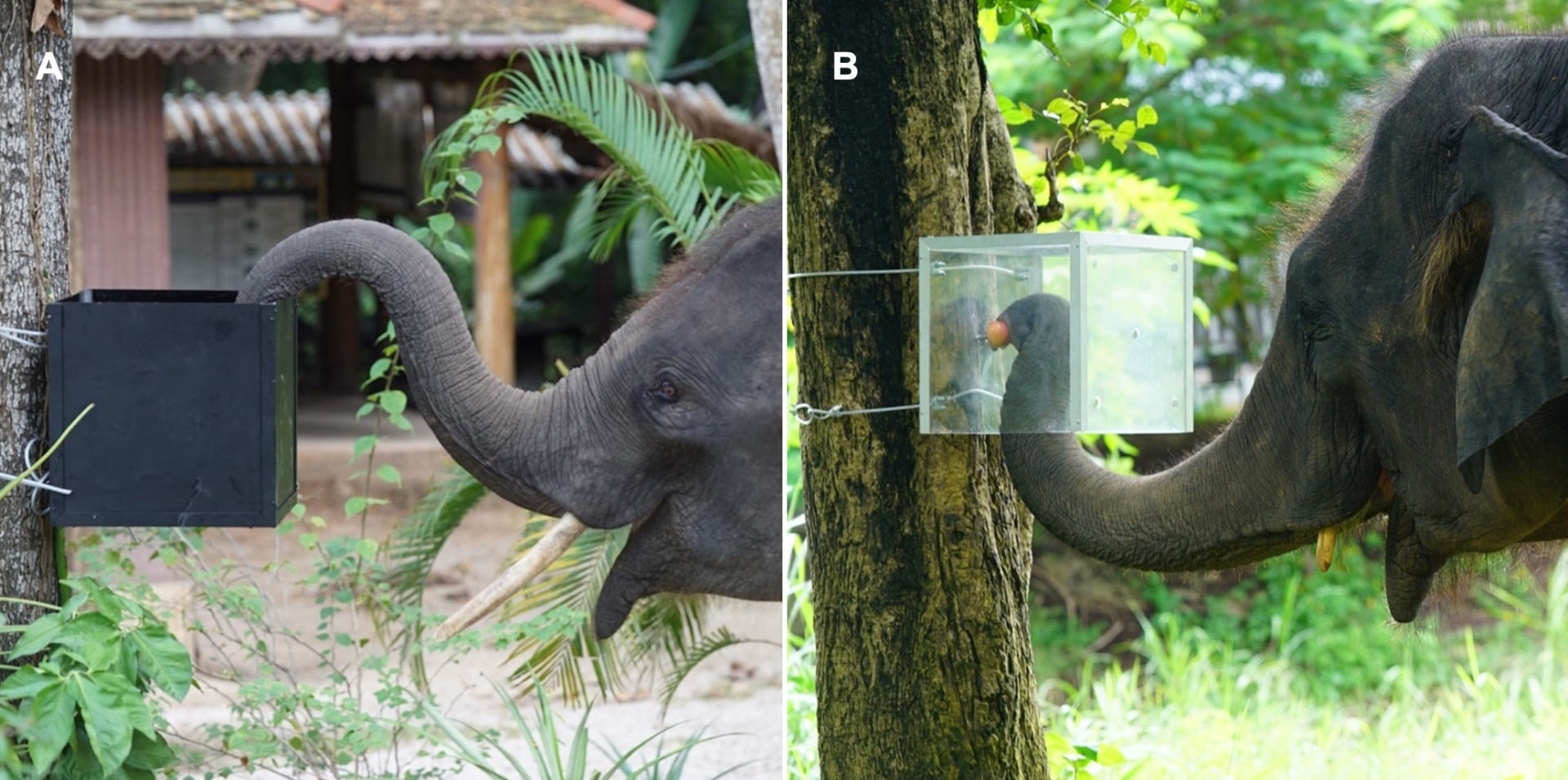
Experiment setup: (A) an elephant enters the ‘over’ opening to gain access to food in a familiarization trial; (B) an elephant enters the ‘under’ opening to gain access to food (apple) in a test trial. Image credit: Sangpa Dittakul.
Inhibitory control – the ability to resist an impulse in favor of more effective behavior – is an important part of decision-making and cognitive flexibility in humans and other animals.
This feature has been demonstrated in various species of birds and mammals, often using a detour test in which subjects must ignore an obvious but ineffective path to a treat in favor of an indirect route.
In a new study, Dr. Sydney Hope from the City University of New York and colleagues tested 16 Asian elephants at the National Elephant Institute in Thailand.
When presented with a transparent box with small holes through which they could see and smell fruit inside, the animals consistently were able to resist the temptation to try to reach directly for the food and instead used an opening on the side of the box as they had been taught earlier.
When the box was later rotated, the elephants at first succumbed to the impulse to reach for the previous position of the opening before quickly correcting their behavior.
This adjustment was slower in older individuals, with one possible explanation being cognitive decline with age.
Overall, the study demonstrates the ability of elephants to resist impulsive but ineffective action in favor of indirect effective behaviors, even when it requires them to adjust a previously effective approach.
This inhibitory control might be a key part of elephants’ famed problem-solving and socializing skills.
Understanding how elephants respond to barriers might also help with the development of more effective mitigation strategies to avoid human-elephant conflict.
“The more we understand about how elephants think, make decisions about risk, and adapt to human-driven environmental change, the better we can predict ‘what they’ll do next’ and the better designed our strategies for human-elephant coexistence can be,” said Dr. Joshua Plotnik, also from the City University of New York.
The team’s paper was published online in the journal PLoS ONE.
_____
S.F. Hope et al. 2026. Asian elephants (Elephas maximus) demonstrate inhibitory control in a detour task. PLoS One 21 (9): e0356549; doi: 10.1371/journal.pone.0356549