Two elusive groups of millipedes, Siphoniulida and Siphonocryptida, were the last missing pieces in the evolutionary history of Earth’s oldest land animals, according to a team of entomologists led by Virginia Tech.
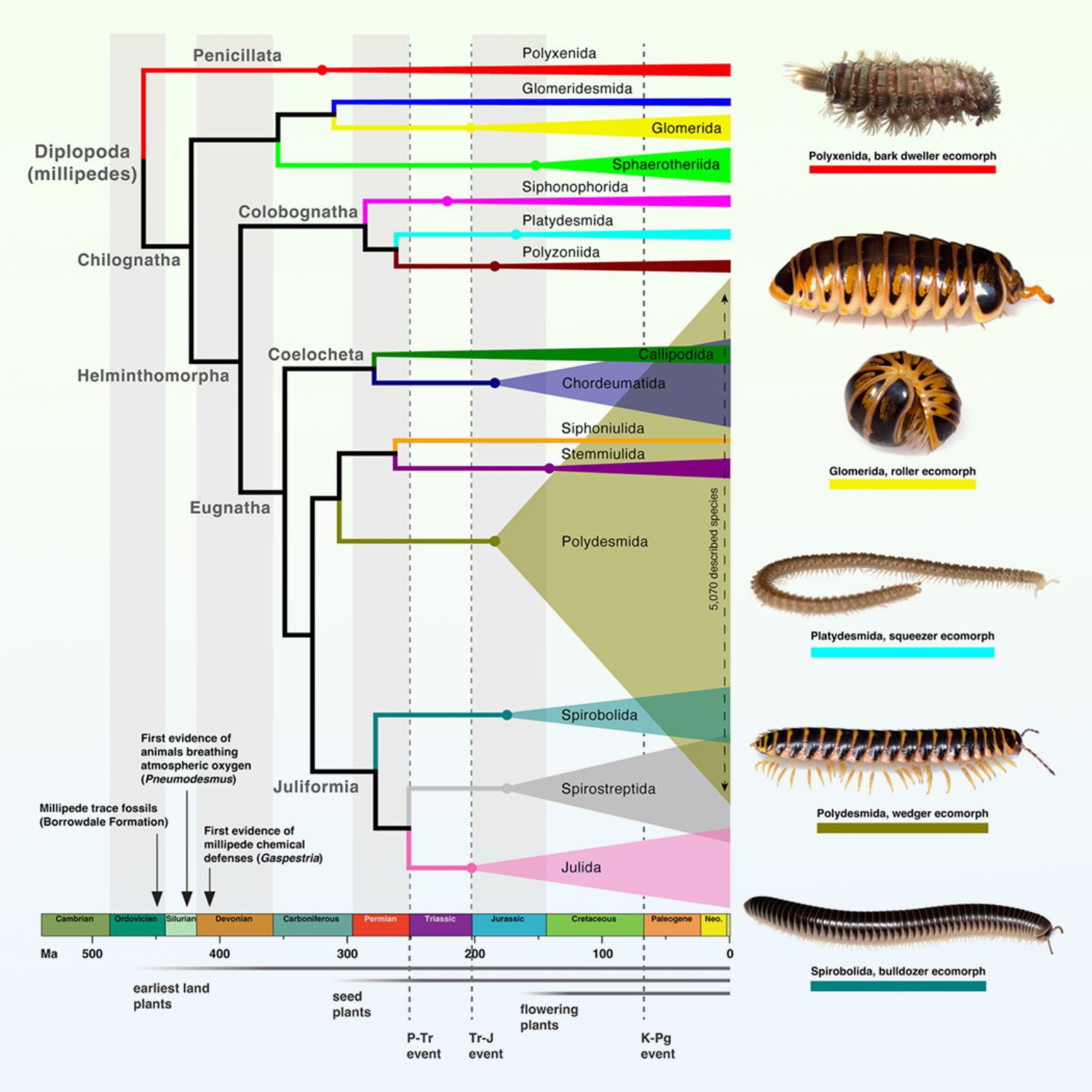
To date, 14,232 millipede species have been described, with at least as many still awaiting discovery. Image credit: Vasquez-Valverde et al., doi: 10.1016/j.cub.2026.05.035.
“Millipedes beat vertebrates onto land by more than 80 million years,” said Virginia Tech’s Dr. Paul Marek, senior author of the study.
“They really set the stage for later life on land, including humans and vertebrates.”
In their research, Dr. Marek and his colleagues combined genomic data from living millipede species with morphological evidence from fossils.
They analyzed hundreds of genes across 82 millipede species and incorporated data from 29 fossils.
The key breakthrough was obtaining DNA from two elusive groups — Siphoniulida and Siphonocryptida — whose genetic material had never before been sequenced.
The researchers traveled to Los Tuxtlas, Mexico, and Spain’s Canary Islands to collect specimens of Siphoniulus neotropicus and Hirudicryptus canariensis.
“It took 10 people over a week just to find this one tiny 10-mm adult,” said first author Luisa ‘Fernanda’ Vasquez-Valverde, also from Virginia Tech.
“Finding them in the field was hard because we were just seeing this little white nematode.”
“We didn’t know for sure it was a millipede until we looked under the microscope.”
One of the two ‘missing’ groups, Siphonocryptida, turned out not to be its own distinct order, but part of an already-known lineage. The other, Siphoniulida, was finally placed on the evolutionary timeline.
The team’s analysis traced millipede origins to nearly 460 million years ago (Ordovician period), roughly 35 million years before the oldest known millipede fossils, suggesting the animals appeared far earlier than previously believed.
Millipedes beat vertebrates onto land by more than 80 million years, making them among the earliest pioneers of terrestrial life, feeding on decaying organic matter before trees, leaves, or flowering plants existed.
“The biggest surprise was just how ancient some of these lineages turned out to be,” Dr. Marek said.
The study traces millipedes’ chemical defenses to about 260 million years ago, making them among Earth’s earliest producers of biological chemical weapons.
“They made the first chemical weapons. They’re little chemical factories,” Dr. Marek said.
The results appear in the journal Current Biology.
_____
Luisa F. Vasquez-Valverde et al. Reshaping the millipede tree of life by inclusion of the last two unsampled orders. Current Biology, published online June 12, 2026; doi: 10.1016/j.cub.2026.05.035