Paleontology News

May 6, 2019 by News Staff

A team of paleontologists from Bulgaria and Germany has found the surprisingly unusual and perfectly preserved millipede in 99-million-year-old amber from Myanmar (formerly Burma). Burmanopetalum inexpectatum. Image credit: Leif Moritz. Millipedes are a highly diverse but also a largely understudied group of arthropods with over 11,000 described species. The actual number of species is estimated to be between 15,000 and 80,000. The entire Mesozoic...

Apr 25, 2019 by News Staff

An international team of paleontologists has found the exceptionally preserved fossilized remains of an enigmatic new type of crab, Callichimaera perplexa,...

Apr 19, 2019 by News Staff

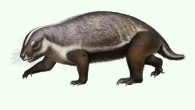
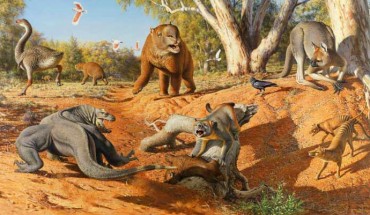
A gigantic meat-eating mammal has been discovered — after its jaw, portions of its skull, and parts of its skeleton spent several decades sitting...

Apr 18, 2019 by News Staff

Paleontologists in Mongolia have discovered a new species of hadrosauroid dinosaur that roamed what is now the Gobi Desert approximately 90 million years...

Apr 17, 2019 by News Staff

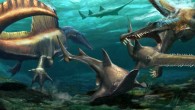
An international team of paleontologists from China and the United States has found high levels of mercury in the end-Permian marine sediments at nearly...

Apr 17, 2019 by News Staff

Dr. Steven May, a paleontology research associate at the University of Texas at Austin, has studied and identified an extensive collection of fossils from...

Apr 15, 2019 by News Staff

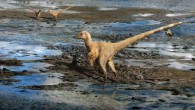
Several footprints and exquisitely-preserved skin impressions made by a small theropod dinosaur approximately 120 million years ago (Aptian age of the...

Apr 12, 2019 by News Staff

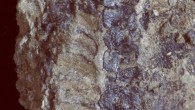
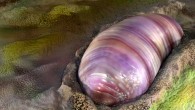
An international team of paleontologists has found the remains of an extinct sea cucumber in 430 million-year-old (Silurian period) fossil-rich deposits...

Apr 9, 2019 by News Staff

An international team of researchers from Australia and the United Kingdom has discovered a new species of pig-footed bandicoot which has been extinct...

Apr 5, 2019 by News Staff

A new species of ancient whale ancestor has been identified from a fossilized skeleton found in Peru. This illustration shows an artistic reconstruction...

Apr 3, 2019 by News Staff

At a site dubbed Tanis in North Dakota’s Hell Creek Formation, paleontologists have unearthed an assemblage of exquisitely-preserved fossilized organisms...

Apr 1, 2019 by Enrico de Lazaro

A new species of mastodon that lived during the Pleistocene period has been identified from fossil found in California and Idaho. The Pacific mastodon...

Mar 26, 2019 by News Staff

Animal life exploded in diversity and form during the Cambrian period about 500 million years ago. An international team of paleontologists has discovered...

Mar 25, 2019 by News Staff

The world’s biggest known Tyrannosaurus rex — one of the largest and most fearsome carnivores of all time — lived about 66 million years...

Mar 20, 2019 by News Staff

The Younger Dryas impact hypothesis, also known as Clovis comet hypothesis, posits that the hemisphere-wide debris field of a large, disintegrating asteroid...

Mar 14, 2019 by Enrico de Lazaro

In 2010, the 28,140-year-old partial carcass of a woolly mammoth (Mammuthus primigenius), nicknamed ‘Yuka,’ was found in Siberian permafrost. Now a...

Mar 11, 2019 by News Staff

Paleontologists in Australia have found fossil fragments from a new genus and species of ornithopod dinosaur that walked the Earth during the Early Cretaceous...

Mar 8, 2019 by News Staff

By analyzing a tooth from the first fossil remains of the extinct Pan-American sloth (Eremotherium laurillardi) found in Belize, a team of paleontologists...

Mar 6, 2019 by News Staff

Paleontologists largely agree that the Chicxulub asteroid impact, possibly coupled with intense volcanic activity in India’s Deccan Traps, wiped out...

Mar 1, 2019 by News Staff

The remarkably complete fossil skeleton of a sea cow with large incisor tusks that lived approximately 20 million years ago (Miocene epoch) has been discovered...