The Middle to Upper Paleolithic Transition approximately 50,000 to 38,000 years ago is marked by the decline and extinction of Neanderthals, the emergence and expansion of anatomically modern Homo sapiens. Paleoanthropologists at the University of Cologne have developed a high-resolution model of population dynamics and applied it to reconstructing this transition in Iberia. Through ensemble simulation, they examined Neanderthal persistence, modern human arrival, and possible interbreeding.
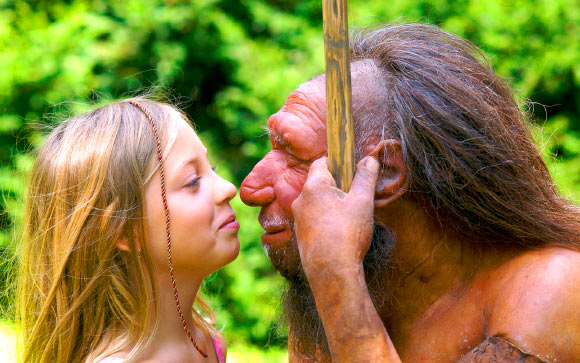
This image shows a Neanderthal and a human kid. Image credit: Neanderthal Museum.
During the transition from the Middle to the Upper Paleolithic, Neanderthal populations across Europe, especially on the Iberian Peninsula, experienced a steady decline leading to their extinction.
At the same time, anatomically modern humans spread across Europe.
This period was also characterized by strong climatic fluctuations, with alternating cold and warm phases: rapid warming phases occurring over only a few centuries contrast with more gradual cooling periods (so-called Dansgaard-Oeschger events), which are interrupted by severe cold phases caused by massive iceberg discharges into the North Atlantic (Heinrich events).
The precise timing of the Neanderthals’ extinction and the arrival of modern humans remains unclear, so a potential encounter between the two species cannot be ruled out.
Genetic analyses of bones from archaeological excavations in comparison with today’s population indicate a mixing in Eastern Europe in the early migration phases of modern humans
Later mixing of the two populations on the Iberian Peninsula is possible due to substantial dating uncertainties, but has not yet been proven.
In the study, University of Cologne’s Professor Yaping Shao and colleagues used a numerical model to simulate exploratively the possibility of both groups meeting on the Iberian Peninsula.
The model takes into account the prevailing climate fluctuations and simulates the populations of both groups as well as their connectivity and interaction.
“Repeated runs of the model with different parameters allow for an assessment of the plausibility of different scenarios: an early extinction of the Neanderthals, a small population size with a high risk of extinction, or a prolonged survival that would allow mixing,” Professor Shao added.
“In most of the runs, however, the two groups did not meet.”
In all three scenarios, the population is highly sensitive to climatic fluctuations.
In those cases where the population could remain stable long enough, mixing of the two species was possible.
With a low probability (1%), at the end of the simulations there are small proportions of 2 to 6% of the total population that have genes from both groups.
This mixing would have been most likely in the north-west of the Iberian Peninsula, an area where modern humans could have arrived early enough before the Neanderthal population collapsed completely.
“By linking climate, demography, and culture, our dynamic model offers a broader explanatory framework that enhances the interpretive power of archaeological and genomic records,” said University of Cologne’s Professor Gerd-Christian Weniger.
A paper on the findings appears online in the journal PLoS ONE.
_____
Y. Shao et al. 2025. Pathways at the Iberian crossroads: Dynamic modeling of the Middle-Upper Paleolithic transition. PLoS One 20 (12): e0339184; doi: 10.1371/journal.pone.0339184