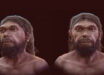
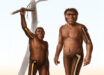
For more than two decades, Sahelanthropus tchadensis — a very early (6.7 to 7.2 million years old) hominin species discovered in Chad in 2001 — has hovered at the center of a contentious question: did one of humanity’s earliest relatives walk upright? New research led by New York University paleoanthropologists adds the strongest evidence yet that it did. Their findings suggest that Sahelanthropus tchadensis was an African ape-like early hominin with the earliest known adaptations to terrestrial bipedalism.
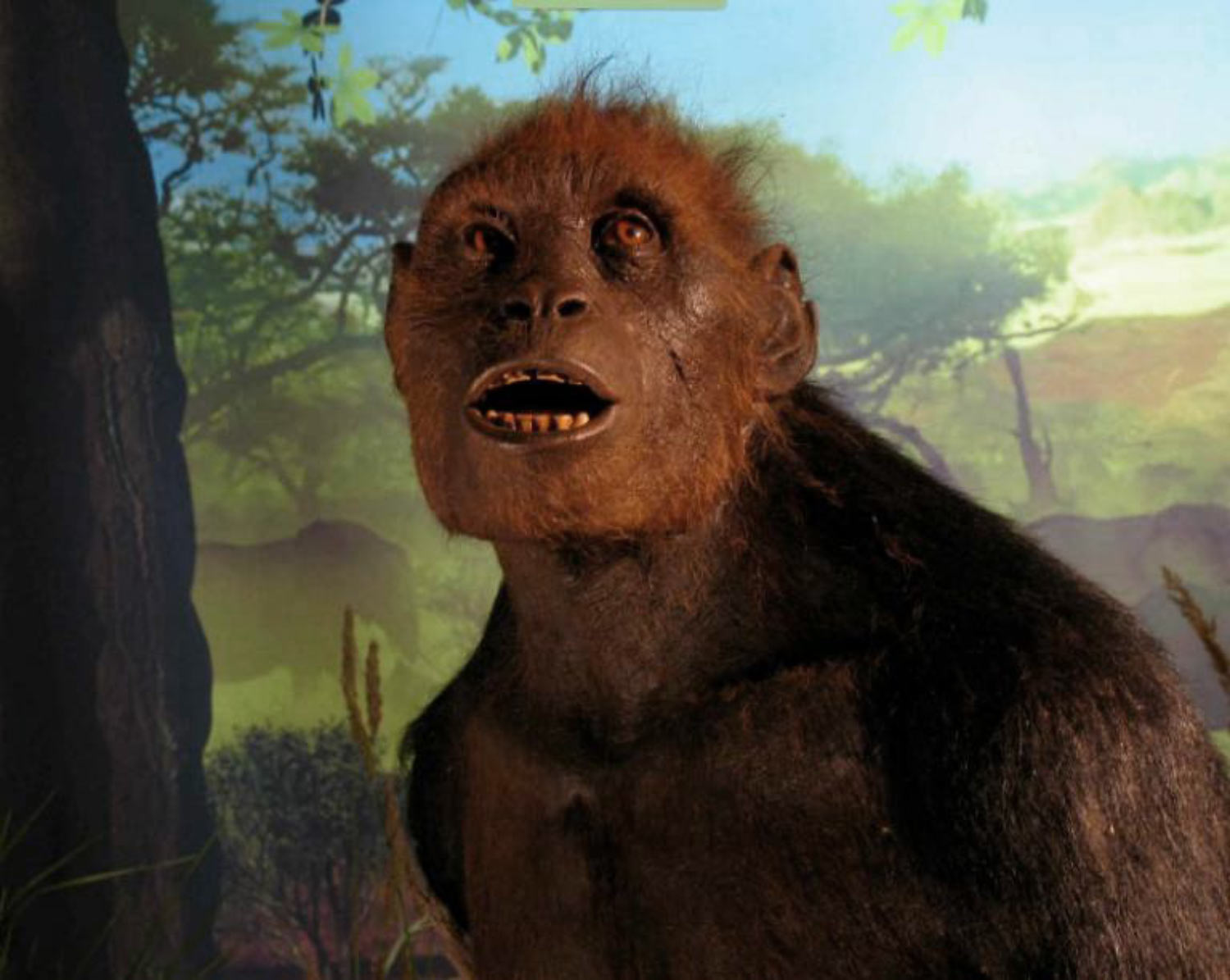
Reconstruction of Sahelanthropus tchadensis. Image credit: University of Silesia.
“Sahelanthropus tchadensis was essentially a bipedal ape that possessed a chimpanzee-sized brain and likely spent a significant portion of its time in trees, foraging and seeking safety,” said New York University’s Dr. Scott Williams.
“Despite its superficial appearance, Sahelanthropus tchadensis was adapted to using bipedal posture and movement on the ground.”
In the study, Dr. Williams and his colleagues focused on a femur and two partial forearm bones of Sahelanthropus tchadensis recovered at the site of Toros-Menalla in Chad.
While earlier work argued that the bones were too apelike to support upright walking, their new analysis combines 3D shape modeling with anatomical traits linked specifically to human-style locomotion.
“Together, these features suggest hominin-like hip and knee function in Sahelanthropus tchadensis and may represent some of the earliest adaptations to bipedalism in the hominin lineage,” they said.
The researchers found that although the external shape of the limb bones most closely resembles that of chimpanzees, their proportions tell a different story.
The relationship between arm and leg length is described as more hominin-like, falling between modern bonobos and early members of the human lineage.
Most striking, they identified a small bony structure on the femur — a femoral tubercle — that serves as the attachment point for the iliofemoral ligament, a key stabilizer of the human hip.
According to the team, this feature has thus far only been identified in hominins.
The femur also shows pronounced internal twisting, known as antetorsion (medial torsion of the femoral shaft), a trait associated with bringing the knees beneath the body’s center of mass during walking.
This torsion falls exclusively with hominins when compared with both living apes and extinct Miocene species.
Taken together, the findings challenge long-standing assumptions about how and when upright walking evolved.
Rather than emerging suddenly, the scientists argue, bipedalism developed gradually.
“We consider the evolution of bipedalism to be a process rather than an event,” they said.
“Sahelanthropus tchadensis may represent an early form of habitual, but not obligate, bipedalism.”
“In addition to terrestrial bipedalism, Sahelanthropus tchadensis likely engaged in a diverse set of arboreal positional behaviors not limited to vertical climbing, below-branch forelimb suspension, arboreal quadrupedalism and bipedalism, and various forms of climbing.”
The authors interpret the fossil as evidence that early hominins evolved from a ‘Pan-like Miocene ape ancestor,’ reinforcing models that place chimpanzee-like creatures near the root of the human family tree.
“Our analysis of these fossils offers direct evident that Sahelanthropus tchadensis could walk on two legs, demonstrating that bipedalism evolved early in our lineage and from an ancestor that looked most similar to today’s chimpanzees and bonobos,” Dr. Williams said.
The study was published this month in the journal Science Advances.
_____
Scott A. Williams et al. 2026. Earliest evidence of hominin bipedalism in Sahelanthropus tchadensis. Science Advances 12 (1); doi: 10.1126/sciadv.adv0130