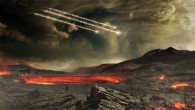
The early Earth could have hosted many carbonate-rich lakes, which would have had high enough phosphorus concentrations to get life started, according...
The existence of habitable alien worlds has been a mainstay of popular culture for more than a century. In the 19th century, astronomers believed that...
A team of Japanese scientists has discovered a 3-million-year-old petit-spot submarine volcano in one of the oldest parts of the Pacific Plate.
The newfound...
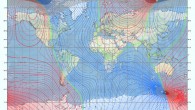
Researchers from NOAA’s National Centers for Environmental Information and the British Geological Survey earlier this month released a new version of...
Australia’s oldest angiosperms (flowering plants) are approximately 126 million years old, and they resembled modern magnolias, buttercups and laurels,...
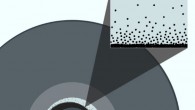
Tiny iron particles fall from Earth’s molten outer core and pile on top of the planet’s solid inner core, according to new research published in the...
The terrestrial fossil record of the current geological epoch, the Anthropocene, will be unique in Earth history and will be dominated by humans, cows,...
BedMachine Antarctica is a new bed topography map based on ice thickness data from different research institutes dating back to 1967, encompassing nearly...
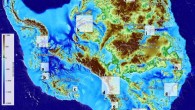
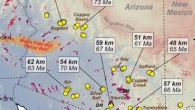
New research suggests that during the Late Cretaceous epoch to the Early Paleogene epoch (80-50 million years ago), much of the southwestern United States...
Nine human species walked the Earth 300,000 years ago. Now there is just one.
A reconstruction of a Neanderthal man. Image credit: Neanderthal Museum.
Neanderthals...
When and how the Earth evolved from a molten mass into a rocky planetary body continually resurfaced by plate tectonics remain some of the biggest questions...
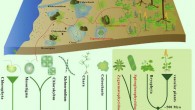
Horizontal gene transfer from soil bacteria to algae allowed early life to move to land, according to new research.
Cheng et al report genome sequences...
The Nile is a 4,130-mile (6,650 km) long river in northeastern Africa. It has been suggested that the river in its present path is at least 6 million...
Fractured rocks of impact craters may be suitable hosts for deep microbial communities on Earth and potentially other terrestrial planets, yet direct evidence...
The end-Triassic mass extinction occurred 201.51 million years ago and resulted in the demise of some 76% of all marine and land species. Up until now,...
The end-Cretaceous mass extinction 66 million years ago eradicated roughly 75% of the animal and plant species on Earth, including whole groups like non-avian...
A team of geoscientists from Australia, Canada and the UK has detected primordial chemical signatures preserved within young kimberlites, small-volume...
Energetic storms generate strong ocean waves, which can interact with shallow seafloor features located near the edge of continental shelves known as ocean...