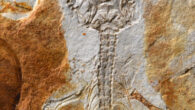
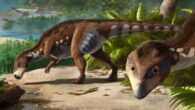
A new genus and species of fossil lizard has been described from two fossilized specimens found in eastern Inner Mongolia, China.
Close-up of the holotype...
Most birds today can lift the upper beak independently of the brain case, enabled by a series of mobile joints and bending zones in the skull. The computed...
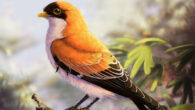
A new species of confuciusornithid bird being named Confuciusornis shifan has been identified from a nearly complete skeleton found in northeastern China.
Life...
Paleontologists have identified a new species of the extinct frog genus Baurubatrachus from fossils found in the state of São Paulo, Brazil.
Life reconstruction...
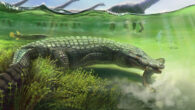
In the Monte Alto region in the Brazilian state of São Paulo, paleontologists have unearthed the fossilized remains of a new crocodyliform species that...
A new genus and species of enantiornithine bird has been described from a partial right humerus found in southern Patagonia, Argentina.
An artist’s impression...
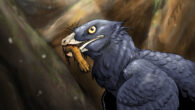
Paleontologists have found the fossilized remains of a small mammal foot preserved inside the body cavity of the holotype specimen of Microraptor zhaoianus,...
A new genus and species of titanosauriform sauropod dinosaur with an unusual tail has been identified from a partial skeleton found in northeastern China.
An...
Australian Museum’s Professor Tim Flannery and colleagues argue that the ancestors of Theria (placental and marsupial mammals) evolved in the supercontinent...
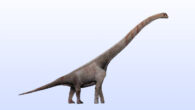
Paleontologists have identified a new genus and species of titanosaurian dinosaur from the fossilized remains found in the Brazilian state of Minas Gerais.
Life...
Paleontologists have long debated why groups such as non-avian dinosaurs became extinct whereas mammals and other lineages survived the end-Cretaceous...
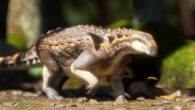
Ankylosaurid dinosaurs were heavily armored herbivores with tails modified into club-like weapons. These tail clubs have widely been considered defensive...
Spinosaurus aegyptiacus, a sail-backed theropod dinosaur that lived in what is now North Africa during the Cretaceous period, about 95 million years ago,...
Paleontologists in Australia have unearthed the country’s first head and associated body of a long-necked marine reptile called Eromangasaurus australis.
The...
A new genus and species of nodosaurid ankylosaur has been identified from fossils found in Patagonia, Argentina.
Life reconstruction of Patagopelta cristata....
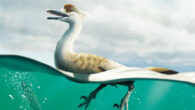
A new genus and species of theropod dinosaur with a streamlined body as in diving birds has been identified from a well-preserved skeleton found in Mongolia.
Life...
About 66 million years ago, a 10-km-wide asteroid crashed into Earth near the site of the small town of Chicxulub in what is now Mexico. The impact unleashed...
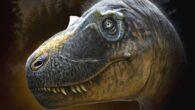
Daspletosaurus wilsoni, a tyrannosaurid dinosaur that lived 76.5 million years ago in what is now Montana, the United States, displays a unique combination...
A new genus and species of rhabdodontid ornithopod dinosaur has been identified from the fossilized skull bones found in the Haţeg Basin in western Romania.
Inhabitants...