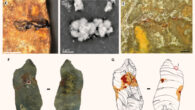
Archaeologists have found traces of ancient ochre-based multicomponent adhesives on 40,000-year-old stone tools from Le Moustier, France.
Photographs,...
Homo sapiens associated with the Lincombian-Ranisian-Jerzmanowician culture were present in central and northwestern Europe long before the extinction...
When the ancestors of modern Eurasians migrated out of Africa and interbred with Eurasian archaic hominins, namely Neanderthals and Denisovans, DNA of...
Archaeologists from MONREPOS, the Johannes Gutenberg University of Mainz and Leiden University have recently learned that around 125,000 years ago, hunting...
Paleoanthropologists have reconstructed the face of a Neanderthal man whose 56,000-year-old remains were found at La Chapelle-aux-Saints in south-central...
Approximately 6% of the Altai Neanderthal genome was inherited from an ancient lineage of anatomically modern Homo sapiens that migrated from Africa to...
Anthropologists in Greece have used facial reconstruction techniques to show how Homo heidelbergensis, a poorly understood relative of Neanderthals that...
During the Upper Paleolithic, lions become an important theme in Paleolithic art and are more frequent in anthropogenic faunal assemblages. However, the...
Molecular de-extinction could offer avenues for drug discovery by reintroducing bioactive molecules that are no longer encoded by living organisms.
Archaic...
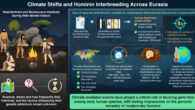
Looking at habitat overlap for Neanderthals and Denisovans, Pusan National University researcher Jiaoyang Ruan and colleagues found patterns of interbreeding...
Non-figurative markings on the walls of La Roche-Cotard cave in France are the oldest known engravings made by our sister species.
The 57,000-year-old...
Humans whose genetic ancestors lived outside Africa have a small proportion of the genome that traces back to interbreeding events with Neanderthals. To...
The dispersal of anatomically modern Homo sapiens out of Africa and across Eurasia provides a unique opportunity to examine the impacts of genetic selection...
Early humans and their hominin relatives had to adapt to new environments to spread out of Africa. In a new study, paleoanthropologists from the Institute...
In new research, scientists examined chemical properties locked inside tooth enamel of two Middle Paleolithic Neanderthals and a Magdalenian human from...