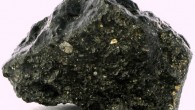
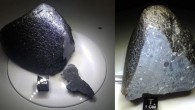
Zircons – one of the most commonly used geochronometers – found within the Martian meteorite NWA 7533 have enabled an international team of scientists...
U.S. researchers reporting in the journal Nature Geoscience have found strong evidence that the Red Planet has granitic rocks.
Distinctive feldspar-rich...
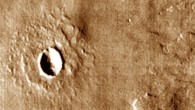
Northern Arizona University scientist Prof Nadine Barlow and Dr Joseph Boyce from the University of Hawaii have discovered a new class of Martian impact...
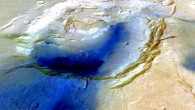
Planetary scientists have discovered remnants of giant supervolcanoes in a region in the northern highlands of Mars known as Arabia Terra. The discovery...
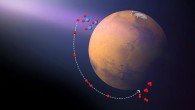
A new study published in the journal Nature Geoscience explains how global atmospheric circulation creates a previously undetected layer of ozone above...
In five papers published today in the journal Science, scientists using the ChemCam, CheMin instruments, the Alpha Particle X-ray Spectrometer (APXS) and...
NASA scientists reported Thursday that the Mars rover Curiosity has not found any clear signs of methane, a gas that on our planet is a strong indicator...
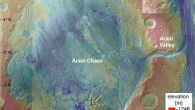
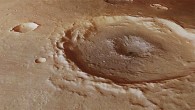
According to a team of planetary scientists led by Dr Manuel Roda from the Utrecht University, a huge impact crater on Mars known as Aram Chaos formed...
According to a new study published online in the Geophysical Research Letters, some water-carved Martian valleys appear to have been caused by runoff from...
A large international team of researchers used Curiosity’s Sample Analysis at Mars (SAM) suite of instruments to measure the abundances of different...
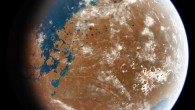
A study published in the June issue of the Journal of Geophysical Research: Planets (full paper in .pdf) provides new evidence that an ocean covered as...
According to a new study reported in the journal Nature, the atmosphere of Mars could have been rich in oxygen almost 4 billion years ago.
An artist’s...
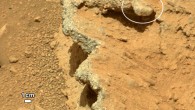
According to a study published in the journal Science, rounded pebbles found in September 2012 by NASA’s Curiosity rover indicate that a stream once...
Geologists led by Dr Lydia Hallis from the University of Hawaii have examined a meteorite that formed on Mars more than 1 billion years ago to determine...
Massive underground explosions, perhaps involving ice, have created the pits inside two large impact craters in the Thaumasia Planum region on Mars, say...
Narrow ridges found in Martian impact craters in the Nilosyrtis highlands and the Nili Fossae region are the fossilized remnants of underground cracks...
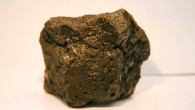
U.S. scientists have identified a new class of meteorite that fell to Earth and likely originated from the crust of the Red Planet.
Fragments of the meteorite...