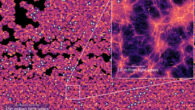
Using spectral data from the Hobby-Eberly Telescope at McDonald Observatory, astronomers have produced the most detailed 3D map yet of faint cosmic structures...
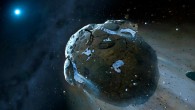
Earlier work has demonstrated that an extremophile bacterium species called Deinococcus radiodurans can survive the radiation, cold, and desiccation associated...
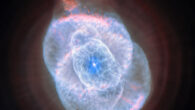
New images from the NASA/ESA Hubble Space Telescope and ESA’s Euclid mission have revealed the complex, multi-shell structure of the extraordinary planetary...
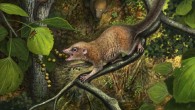
The newly-discovered minuscule fossils of Purgatorius — a shrew-sized mammal considered the earliest known relative of all primates, including humans,...
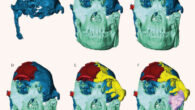
Beyond their value for classification and evolutionary relationships, changes in the size and shape of the hominin face through time can reflect important...
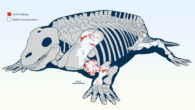
Paleontologists at the University of Toronto Mississauga have found dozens of tooth marks on the fossilized bones of three juveniles of Diadectes, one...
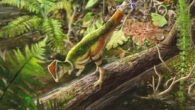
For many years, the fossil record of pachycephalosaurs (dome-headed dinosaurs) has been dominated by fossilized skulls. The postcranial material of young...
New research from the University of Kansas untangles a decades-old astrophysical puzzle, showing how competing forces — gravity’s pull and magnetospheric...
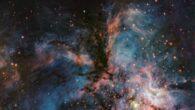
Using the High Acuity Wide-field K-band Imager (HAWK-I) on ESO’s Very Large Telescope (VLT), astronomers have captured a new image of the emission nebula...
Prehistoric humans and Neanderthals didn’t just interbreed, they did so with a consistent sex bias, as male Neanderthals and female modern humans mated...
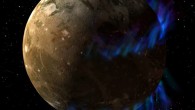
Scientsts from the United States, Europe and China have used the Ultraviolet Spectrograph (UVS) onboard NASA’s Juno spacecraft to map detailed patch...