Astrobiology News

Jul 20, 2017 by News Staff

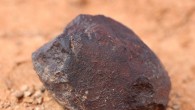
New research from Monash University and the University of Queensland has added a new dimension to understanding life on the Red Planet with the discovery that meteorites may be able to ‘trap’ evidence of extraterrestrial life. This image shows Watson 021, a single H7 ordinary chondrite, weighing 135 g. The sample has a large crack, lined with alteration minerals, that runs down its middle and only one third of its fusion crust remains intact....

Jul 14, 2017 by News Staff

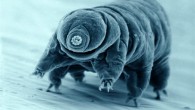
Water-dwelling, eight-legged, segmented micro-animals called tardigrades will survive the risk of extinction from all astrophysical catastrophes, and be...

Jul 14, 2017 by News Staff

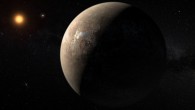
According to two separate teams of astrophysicists from the Harvard-Smithsonian Center for Astrophysics (CfA) and the Lowell Center for Space Science and...

May 24, 2017 by News Staff

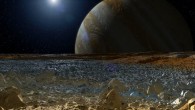
A new study published in the Astrophysical Journal Letters examines whether radioactive decay could support life on ocean worlds like Jupiter’s moon...

Mar 24, 2017 by James Romero

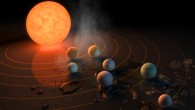
Exoplanet hunters struck gold earlier this year with the discovery of seven rocky bodies orbiting around dwarf star TRAPPIST-1, a find that both raised...

Feb 11, 2017 by News Staff

A team of researchers led by Vladimir Airapetian, a solar scientist at NASA’s Goddard Space Flight Center, has developed a model that estimates the oxygen...

Feb 10, 2017 by News Staff

In a new report to NASA released this week, a 21-member team of scientists assess the scientific value and engineering design of a future mission to the...

Sep 28, 2016 by James Romero

The combination of seismic activity and water locked away at depth within Mars could be releasing sufficient hydrogen gas to support communities of microorganisms,...

Sep 9, 2016 by James Romero

The technology to ‘seed’ planets well beyond our solar system with basic life forms, skipping billions of years of evolution on Earth and spreading...