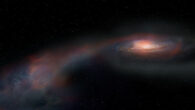
The significant gamma-ray emission is coming from a population of millisecond pulsars within the Sagittarius dwarf spheroidal galaxy, an elliptical loop-shaped...
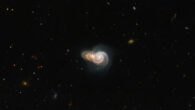
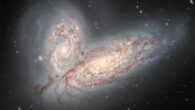
LEDA 2073461 and SDSS J115331.86+360024.2 look like they’re interacting, but they are actually separated by millions of light-years.
This Hubble image...
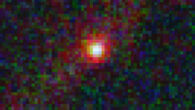
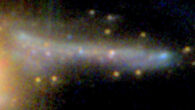
The newly-discovered blue supergiant is much hotter than the Sun, and existed when the Universe was about 2.6 billion years old.
Left panel shows the color...
Astronomers using the Atacama Large Millimeter/submillimeter Array (ALMA) and the NASA/ESA Hubble Space Telescope have observed SDSS J144845.91+101010.5,...
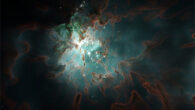
Sagittarius B1, a region close to the center of our Milky Way Galaxy, hosts more than 100,000 solar masses of young stars.
This image, taken with the...
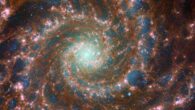
New data from the NASA/ESA/CSA James Webb Space Telescope and the NASA/ESA Hubble Space Telescope compliment each other to provide a comprehensive view...
Earendel is a B-type giant star, a luminous blue variable star, or even a binary system with an extremely hot primary member, according to new observations...
New research led by Curtin University geologists suggests that regions of space with dense interstellar clouds may send more high-energy comets crashing...
Astronomers from the University of Cambridge and elsewhere have analyzed the spectroscopic and photometric data from three instruments (NIRSpec, NIRISS...
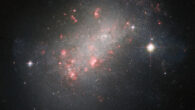
The NASA/ESA Hubble Space Telescope has produced a spectacularly detailed image of an isolated dwarf irregular galaxy called NGC 1156.
This Hubble image...
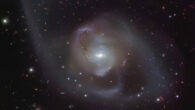
Astronomers using the FOcal Reducer and low dispersion Spectrograph 2 (FORS2) instrument on ESO’s Very Large Telescope (VLT) have taken a picture of...
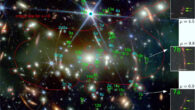
Astronomers using the NASA/ESA/CSA James Webb Space Telescope have spotted ancient globular clusters around a remarkable galaxy that is strongly gravitationally...
Astronomers using the Gemini North telescope, one of the twin telescopes of the International Gemini Observatory, have captured a stunning image of a pair...
Earendel emitted its light approximately 900 million years after the Big Bang.
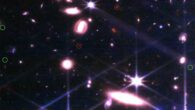
This Webb/NIRCam image shows Earendel (center), the most distant star ever...
Although star formation is one of the most fundamental processes of astrophysics, there is no widely accepted theory of star formation, despite decades...
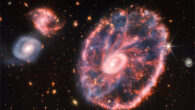
Using two instruments aboard the NASA/ESA/CSA James Webb Space Telescope, astronomers have produced detailed images of the Cartwheel Galaxy and its two...
Astronomers from the Max Planck Institute for Astrophysics and elsewhere have analyzed an image taken by the NASA/ESA/CSA James Webb Space Telescope of...
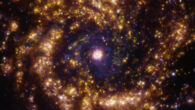
Using the Multi-Unit Spectroscopic Explorer (MUSE) instrument on ESO’s Very Large Telescope (VLT) in Chile, astronomers have captured a stunning image...
About 30% of short gamma-ray bursts (sGRBs), which form during the collisions of neutron stars, lack a coincident host galaxy, raising questions about...