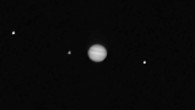
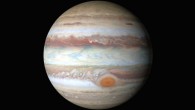
During asteroid search operations, NASA’s OSIRIS-REx spacecraft snapped several images of Jupiter and its Galilean moons: Io, Europa, Callisto, and Ganymede.
This...
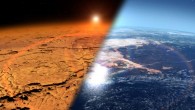
Intense volcanism early in Mars history could have aided the emergence of life on the red planet through filtering out harmful ultraviolet (UV) radiation...
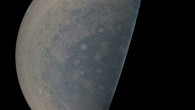
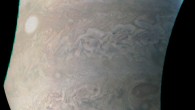
NASA’s Juno spacecraft successfully completed a close flyby of Jupiter on February 2, 2017.
Cyclones swirl around the south pole, and white oval storms...
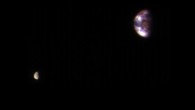
This image composite combines the best Earth image with the best Moon image from four sets of images acquired on November 20, 2016, by the High Resolution...
A study published in the Journal of Geophysical Research: Planets provides new evidence for a warm early Mars that hosted water across a geologically long...
As NASA’s Juno probe makes its closest flyby of the gas giant, new research from France’s space agency could help make more sense of the data it sends...
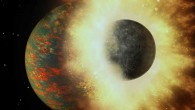
Grant Mathews, professor of theoretical astrophysics and cosmology in the University of Notre Dame’s College of Science, believes the event that led...
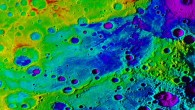
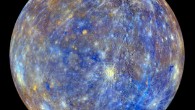
Using images from NASA’s MErcury Surface, Space ENvironment, GEochemistry and Ranging (MESSENGER) spacecraft, planetary researchers have discovered a...
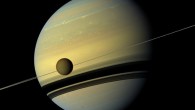
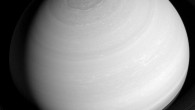
New near-infrared images of Saturn from NASA’s Cassini spacecraft show the northern polar region including the hexagon and polar vortex.
The north polar...
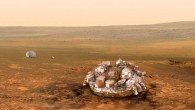
A new image from NASA’s Mars Reconnaissance Orbiter (MRO) shows a bright spot that may be a parachute of ESA’s ExoMars Schiaparelli module, and a larger...
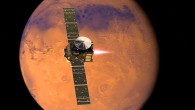
ESA’s ExoMars Trace Gas Orbiter (TGO) has entered an elliptical orbit around Mars, while contact has not yet been confirmed with the Schiaparelli lander.
ESA’s...
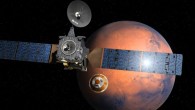
Artist’s impression depicting the separation of the Schiaparelli module from the Trace Gas Orbiter, and heading for Mars. Image credit: D. Ducros / ESA.
ESA’s...
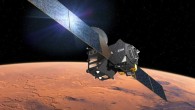
Artist’s impression visualizing the ExoMars 2016 Trace Gas Orbiter, with its thrusters firing, beginning its entry into Mars orbit on October 19, 2016....
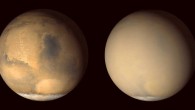
A global-scale dust storm could envelop the Red Planet within the next few months, according to planetary researchers at NASA’s Jet Propulsion Laboratory...
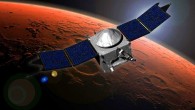
NASA’s Mars Atmosphere and Volatile EvolutioN (MAVEN) spacecraft, sent to Mars to explore its upper atmosphere, ionosphere and interactions with the...
Recent images from NASA’s MESSENGER spacecraft reveal small fault scarps on Mercury’s surface. These cliff-like landforms are small enough that planetary...
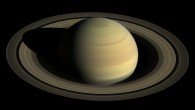
The latest images from NASA’s Cassini spacecraft show the northern hemisphere of Solar System’s second-largest planet, as that part of the gas giant...
In a new paper in the journal Nature Geoscience, researchers offer a new answer to a long-debated question: how did carbon-based life develop on Earth,...