Astronomy News

Jan 27, 2012 by News Staff

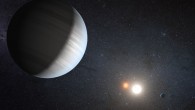
NASA’s Kepler mission has discovered 11 new planetary systems hosting 26 extrasolar planets. According to NASA’s Jet Propulsion Laboratory, these planets range in size from 1.5 times the radius of Earth to giants larger than Jupiter. All of them are closer to their host star than Venus is to our Sun. Image of Kepler-23 taken at the Lick Observatory (Dr. Eric Ford et al) Fifteen planets are between Earth and Neptune in size. Further observations...

Jan 8, 2012 by Sergio Prostak

NASA’s Swift spacecraft has detected a gamma-ray burst, called GRB 111209A, which is one of the longest events of this kind ever observed. The duration...

Dec 23, 2011 by News Staff

An international team of astrophysicists has discovered the ruins of a planetary system consisting of the cores of two former giant planets orbiting around...

Dec 23, 2011 by News Staff

A U.S. team of researchers has discovered the evidence of complex hydrocarbon and/or nitrile molecules lying on the Pluto’s surface. Artist’s impression...

Dec 21, 2011 by News Staff

NASA’s Kepler mission has detected two extrasolar Earth-sized planets, reported in a press release from the Harvard-Smithsonian Center for Astrophysics. The...

Dec 7, 2011 by News Staff

European astronomers have obtained the best images ever of an unusual double star, where the companion star is a vampire, according to a press release...

Dec 5, 2011 by News Staff

The Kepler mission has discovered the first super-Earth in the habitable zone of a distant Sun-like star, according to NASA. The newly found planet Kepler-22b...

Dec 5, 2011 by News Staff

A team of astronomers has discovered 18 Jupiter-like planets in orbit around massive stars, stated in a press release from the California Institute of...

Nov 21, 2011 by News Staff

Researchers from Tel Aviv University predict lightning sprites in the atmospheres of Jupiter, Saturn and Venus. Only a few decades ago, scientists discovered...

Nov 16, 2011 by News Staff

Using the LABOCA camera on the Atacama Pathfinder Experiment (APEX) telescope on the plateau of Chajnantor in the Chilean Andes, a team of astronomers...

Nov 4, 2011 by News Staff

Space scientists investigating the composition of very distant galaxies have discovered two galaxies in the young Universe that have more heavy chemical...

Sep 22, 2011 by News Staff

A new image from ESO’s telescope reveals the Lambda Centauri Nebula, a cloud of glowing hydrogen and newborn stars in the constellation of Centaurus....

Sep 19, 2011 by News Staff

NASA’s Kepler mission detected Kepler-16b, the closest astronomers have come to discovering Luke Skywalker’s home world of Tatooine, according...

Sep 13, 2011 by News Staff

The HARPS team led by Michel Mayor from University of Geneva, Switzerland, announced the discovery of more than 50 new exoplanets orbiting nearby stars,...

Sep 12, 2011 by News Staff

ESO’s New Technology Telescope has captured an image of the open cluster NGC 2100. This brilliant star cluster is around 15 million years old, and located...

Aug 25, 2011 by News Staff

Astronomers at the California Institute of Technology (Caltech) have discovered that the dwarf planet 2007 OR10 — nicknamed Snow White — is an icy...

Aug 25, 2011 by News Staff

Scientists using data from NASA’s Wide-field Infrared Survey Explorer (WISE) have discovered the coldest class of star-like bodies, with temperatures...

Aug 21, 2011 by News Staff

Our solar system, where planets have a range of sizes and move in near-circular paths, may be rather unusual, according to a German-British team led by...

Aug 12, 2011 by News Staff

A giant cosmic necklace glows brightly in this NASA Hubble Space Telescope image. The object, aptly named the Necklace Nebula, is a recently discovered...

Aug 12, 2011 by News Staff

A team of astronomers, using the Spitzer Space Telescope, has reported the first extragalactic detection of the C70 fullerene molecule, and the possible...