Anthropology News

May 16, 2019 by News Staff

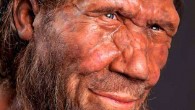
A new study that analyzed dental evolutionary rates in early Neanderthals from Sima de los Huesos, a cave site in Atapuerca Mountains, Spain, found that the teeth of these Middle Pleistocene hominins diverged from the modern human lineage approximately 800,000 years ago, which is much earlier than previously thought. Sima de los Huesos hominins lived in what is now Spain about 400,000 years ago. Image credit: © Kennis & Kennis / Madrid Scientific...

May 2, 2019 by Enrico de Lazaro

In 1980, a Buddhist monk found the right half a fossilized hominin jawbone in Baishiya Karst Cave on the Tibetan Plateau, Xiahe, China. An analysis of...

Apr 12, 2019 by News Staff

According to a new study published in the journal Cell, modern Papuans carry hundreds of gene variants from two Denisovan lineages — distinct from...

Apr 11, 2019 by News Staff

An early human species with a unique mix of primitive (that is, Australopithecus-like) and derived (that is, Homo sapiens-like) morphological features...

Mar 21, 2019 by News Staff

It’s widely accepted that continental Sahul, the combined landmass of Australia, New Guinea and Tasmania, was settled very early in human history. But...

Mar 18, 2019 by News Staff

A class of speech sounds that is now present in nearly half of the world’s languages — labiodentals, produced by positioning the lower lip against...

Feb 27, 2019 by News Staff

19th and early 20th century postural reconstructions of Neanderthals, and particularly the extensive one of the partial skeleton of an elderly male Neanderthal...

Jan 31, 2019 by News Staff

Two groups of archaic humans — Neanderthals and their enigmatic cousins, Denisovans — occupied Denisova Cave in the Altai region of Siberia...

Jan 31, 2019 by News Staff

Humans are born with operational language processing and memory capacities and can use at least two types of cues to segment otherwise continuous speech,...

Jan 28, 2019 by News Staff

In a study published in the journal Scientific Reports, a team of researchers from University College London and Nordic Sport (UK) Limited examined the...

Jan 11, 2019 by News Staff

Ancient inhabitants of Easter Island (Rapa Nui) built their famous statues (moai) and megalithic platforms (ahu) that supported them near the island’s...

Dec 21, 2018 by News Staff

The first detailed comparative description of the external neuroanatomy of the 3.67-million-year-old Australopithecus prometheus fossil known as the Little...

Nov 30, 2018 by News Staff

An international team of archaeologists and paleoanthropologists has uncovered 2.4-million-year-old stone artifacts and cutmarked bones at the archaeological...

Nov 15, 2018 by News Staff

Neanderthals had just as many head trauma injuries as Upper Paleolithic humans, according to new research from the University of Tübingen, Germany. Neanderthals...

Nov 8, 2018 by News Staff

Two teeth from Neanderthal children who lived 250,000 years ago in what is today France contain evidence of repeated exposure to high levels of lead, a...

Oct 31, 2018 by News Staff

Our close evolutionary cousins may have had a subtle, but somewhat different breathing mechanism compared to anatomically modern humans, according to a...

Oct 30, 2018 by News Staff

An international team of archaeologists and paleoanthropologists has found fossil faunal remains and associated stone tools at the middle Pleistocene (300,000-500,000...

Oct 22, 2018 by News Staff

In a paper published in the journal Quaternary Science Reviews, University of York’s Dr. Penny Spikins and co-authors argue that Neanderthals embraced...

Oct 11, 2018 by News Staff

Ancient inhabitants of Easter Island (Rapa Nui) survived periods of drought due to their utilization of brackish groundwater discharge that surfaces buoyantly...

Oct 11, 2018 by News Staff

Over our species history, humans have typically lived in small groups of under a hundred individuals. But a new study, published in the journal Royal Society...