Anthropology News

Apr 17, 2024 by News Staff

Conventionally, climate is held responsible for the emergence and extinction of hominin species. In most vertebrates, however, interspecies competition is known to play an important role. New research shows for the first time that competition was fundamental to speciation — the rate at which new species emerge — across 5 million years of hominin evolution. It also suggests that the species formation pattern of our Homo lineage was unlike...


Apr 11, 2024 by News Staff

Because it is often assumed that fundamental behavioral differences distinguish Neanderthals and Homo sapiens, the ability to structure space within the...

Apr 9, 2024 by News Staff

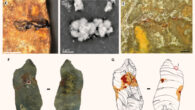
Nelson Mandela University researcher Charles Helm and his colleagues have found an intriguing rock about 30 km (18.6 miles) east of the South African Blombos...

Apr 8, 2024 by News Staff

Wooden tools rarely survive in the Paleolithic record limiting our understanding of Pleistocene hunter-gather lifeways. With 187 wooden artifacts, the...

Mar 7, 2024 by Sergio Prostak

Archaeologists have dated an assemblage of ancient stone tools excavated from the archaeological site of Korolevo on the Tysa River in western Ukraine...

Feb 21, 2024 by News Staff

Archaeologists have found traces of ancient ochre-based multicomponent adhesives on 40,000-year-old stone tools from Le Moustier, France. Photographs,...

Jan 31, 2024 by News Staff

Homo sapiens associated with the Lincombian-Ranisian-Jerzmanowician culture were present in central and northwestern Europe long before the extinction...

Jan 15, 2024 by Sergio Prostak

A Brazilian anthropologist has reconstructed the face of the archaic human species Homo longi from a well-preserved skull discovered in northeastern China...

Jan 10, 2024 by Sergio Prostak

Gigantopithecus blacki, the largest ever primate and one of the largest species of the southeast Asian megafauna, persisted in China from about 2 million...

Dec 20, 2023 by News Staff

The new-submerged Northwest Shelf of Sahul — the combined landmass of Australia and New Guinea at times of lower sea level — was a vast area...

Dec 14, 2023 by News Staff

When the ancestors of modern Eurasians migrated out of Africa and interbred with Eurasian archaic hominins, namely Neanderthals and Denisovans, DNA of...

Dec 7, 2023 by News Staff

Archaeologists from MONREPOS, the Johannes Gutenberg University of Mainz and Leiden University have recently learned that around 125,000 years ago, hunting...

Nov 29, 2023 by Enrico de Lazaro

Archaeologists from the Johannes Gutenberg University Mainz, the Leibniz Zentrum für Archäologie and Leiden University say they have found cut marks...

Nov 28, 2023 by News Staff

Archaeologists from the Senckenberg Centre for Human Evolution and Palaeoenvironment at the University of Tübingen have analyzed the ancient animal remains...

Nov 21, 2023 by Enrico de Lazaro

Paleoanthropologists have reconstructed the face of a Neanderthal man whose 56,000-year-old remains were found at La Chapelle-aux-Saints in south-central...

Nov 2, 2023 by News Staff

In new research, scientists from the University of East Anglia and elsewhere studied 874 speakers of 29 different languages, including English, Spanish,...

Oct 23, 2023 by Enrico de Lazaro

Populations genetically related to present-day Europeans first appeared in Europe at some point after 38,000-40,000 years ago, following a cold period...

Oct 20, 2023 by News Staff

Approximately 6% of the Altai Neanderthal genome was inherited from an ancient lineage of anatomically modern Homo sapiens that migrated from Africa to...

Oct 17, 2023 by Enrico de Lazaro

Pierolapithecus catalaunicus is an extinct species of great ape that lived in what is now Europe about 12 million years ago. A remarkably complete, although...

Oct 13, 2023 by Sergio Prostak

Anthropologists in Greece have used facial reconstruction techniques to show how Homo heidelbergensis, a poorly understood relative of Neanderthals that...